From Consent to Ragion di Stato: The Transition from Politics to the Conservation of Monarchies in Early Modern Spanish Economic Thought
Titolo Rivista HISTORY OF ECONOMIC THOUGHT AND POLICY
Autori/Curatori Rogelio Fernández Delgado
Pubblicazione Online First 17/09/2026 Fascicolo 2026/Online First
Lingua Inglese Numero pagine 22 P. 1-22 Dimensione file 247 KB
DOI 10.3280/hetp2026-23653
Il DOI è il codice a barre della proprietà intellettuale: per saperne di più
clicca qui
Qui sotto puoi vedere in anteprima la prima pagina di questo articolo.
Se questo articolo ti interessa, lo puoi acquistare (e scaricare in formato pdf) seguendo le facili indicazioni per acquistare il download credit. Acquista Download Credits per scaricare questo Articolo in formato PDF
FrancoAngeli è membro della Publishers International Linking Association, Inc (PILA), associazione indipendente e non profit per facilitare (attraverso i servizi tecnologici implementati da CrossRef.org) l’accesso degli studiosi ai contenuti digitali nelle pubblicazioni professionali e scientifiche.
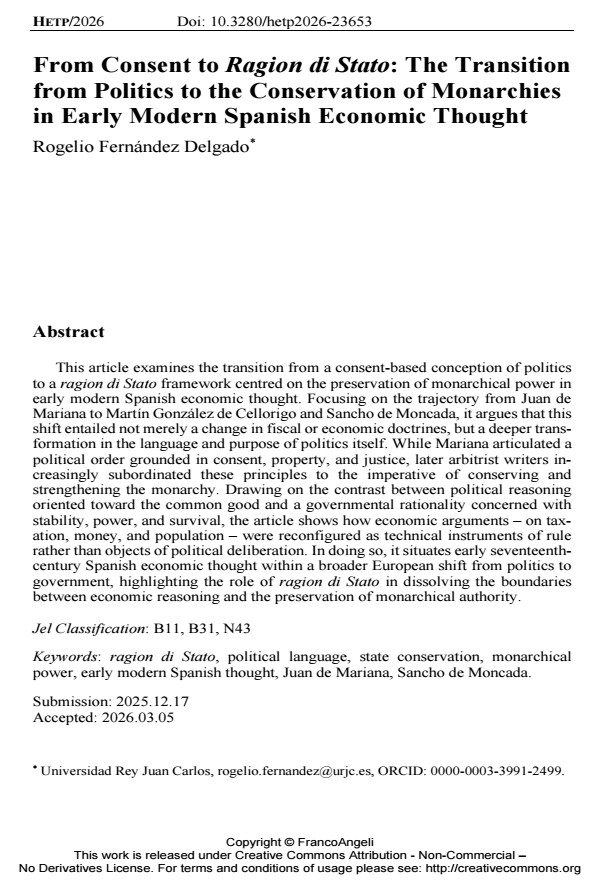
This article examines the transition from a consent-based conception of politics to a ragion di Stato framework centred on the preservation of monarchical power in early modern Spanish economic thought. Focusing on the trajectory from Juan de Mariana to Martín González de Cellorigo and Sancho de Moncada, it argues that this shift entailed not merely a change in fiscal or economic doctrines, but a deeper trans-formation in the language and purpose of politics itself. While Mariana articulated a political order grounded in consent, property, and justice, later arbitrist writers in-creasingly subordinated these principles to the imperative of conserving and strengthening the monarchy. Drawing on the contrast between political reasoning oriented toward the common good and a governmental rationality concerned with stability, power, and survival, the article shows how economic arguments ‒ on tax-ation, money, and population ‒ were reconfigured as technical instruments of rule rather than objects of political deliberation. In doing so, it situates early seventeenth-century Spanish economic thought within a broader European shift from politics to government, highlighting the role of ragion di Stato in dissolving the boundaries between economic reasoning and the preservation of monarchical authority.
Parole chiave:ragion di Stato, political language, state conservation, monarchical power, early modern Spanish thought, Juan de Mariana, Sancho de Moncada.
Jel codes:B11, B31, N43
Rogelio Fernández Delgado, From Consent to Ragion di Stato: The Transition from Politics to the Conservation of Monarchies in Early Modern Spanish Economic Thought in "HISTORY OF ECONOMIC THOUGHT AND POLICY" Online First/2026, pp 1-22, DOI: 10.3280/hetp2026-23653