Medical Humanities, Innovation, and Perspectives: The Care of the Human in the Technological Era
Titolo Rivista SALUTE E SOCIETÀ
Autori/Curatori Riccardo Sebastiani, Sara Pellegrini
Anno di pubblicazione 2026 Fascicolo 2026/3
Lingua Inglese Numero pagine 13 P. 171-183 Dimensione file 294 KB
DOI 10.3280/SES2026-003012
Il DOI è il codice a barre della proprietà intellettuale: per saperne di più
clicca qui
Qui sotto puoi vedere in anteprima la prima pagina di questo articolo.
Se questo articolo ti interessa, lo puoi acquistare (e scaricare in formato pdf) seguendo le facili indicazioni per acquistare il download credit. Acquista Download Credits per scaricare questo Articolo in formato PDF
FrancoAngeli è membro della Publishers International Linking Association, Inc (PILA), associazione indipendente e non profit per facilitare (attraverso i servizi tecnologici implementati da CrossRef.org) l’accesso degli studiosi ai contenuti digitali nelle pubblicazioni professionali e scientifiche.
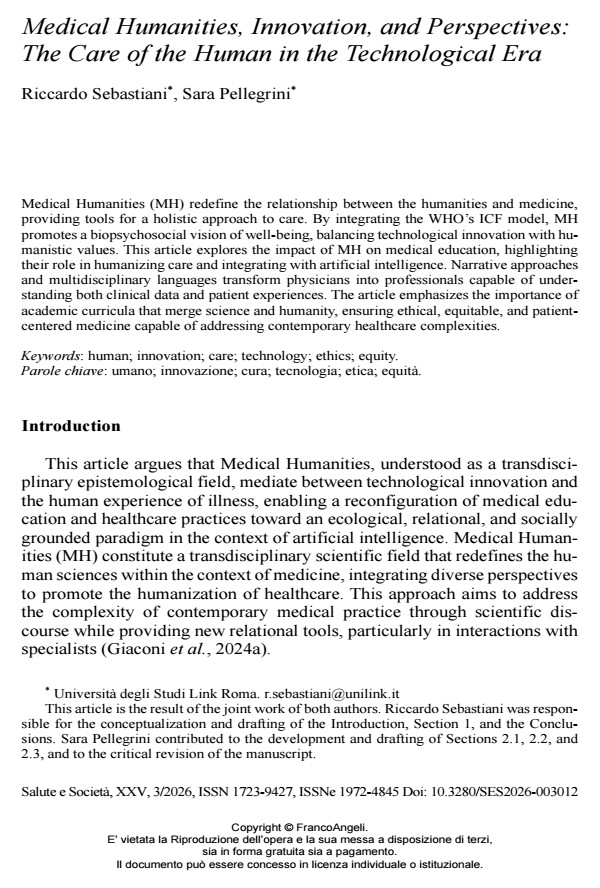
Medical Humanities (MH) redefine the relationship between the humanities and medicine, providing tools for a holistic approach to care. By integrating the WHO’s ICF model, MH promotes a biopsychosocial vision of well-being, balancing technological innovation with humanistic values. This article explores the impact of MH on medical education, highlighting their role in humanizing care and integrating with artificial intelligence. Narrative approaches and multidisciplinary languages transform physicians into professionals capable of understanding both clinical data and patient experiences. The article emphasizes the importance of academic curricula that merge science and humanity, ensuring ethical, equitable, and patient-centered medicine capable of addressing contemporary healthcare complexities.
Parole chiave:umano; innovazione; cura; tecnologia; etica; equità
- Adamson A.S., Smith A. (2018). Machine learning and health care disparities in dermatology. JAMA Dermatology, 154(11): 1247-1248.
- Aiken E. (2018). An ecological model for health, illness and medicine: Pathogenesis and healing as self-organising processes in semiotic biofields (Doctoral dissertation, Swinburne).
- Ansdell G., DeNora T. (2016). Musical pathways in recovery: Community music therapy and mental wellbeing. London: Routledge.
- AOU AL – Azienda Ospedaliero-Universitaria SS. Antonio e Biagio e Cesare Arrigo (2024). NAME Piemonte: presentati i risultati. Available at: https://www.ospedale.al.it/it/comunicazione/notizie/name-piemonte-presentati-risultati (12/07/2024).
- Azienda Ospedaliera di Alessandria (2022). Intelligenza Artificiale: applicazioni in Sanità e quadro normativo. Available at: https://www.ospedale.al.it/it/comunicazione/notizie/intelligenza-artificiale-applicazioni-sanita-quadro-normativo (07/07/2022).
- Barr N., Lopes D.G., Schwendinger M., Gafaro S. (2025). Ethical Implications and Patient-Centered Innovations in Digital Healthcare: A Mixed-Methods Approach. In: Pesqueira A., de Bem Machado, A., eds., Navigating Privacy, Innovation, and Patient Empowerment Through Ethical Healthcare Technology. Hershey: IGI Global Scientific Publishing.
- Berry S.L., Williams A.-L., Lamb E.G., Klugman C.M. (2023). Evolution in health and medical humanities education: A proposal for accreditation. Medical Humanities, 49(1): 134-138.
- Bickerdike L., Booth A., Wilson P.M., Farley K., Wright K. (2017). Social prescribing: Less rhetoric and more reality. A systematic review of the evidence. BMJ Open, 7(4): e013384.
- Blease C., Kaptchuk T.J., Bernstein M.H., Mandl K.D., Halamka J.D., DesRoches C.M. (2019). Artificial intelligence and the future of primary care: exploratory qualitative study of UK general practitioners’ views. Journal of medical Internet research, 21(3): e12802. DOI: 10.2196/1280
- Bloom P. (2016). Against Empathy: The Case for Rational Compassion. New York: Ecco Press.
- Doshi-Velez F., Kim B. (2017). Towards a rigorous science of interpretable machine learning. arXiv:1702.08608.
- Elliot A. (2021). La cultura dell’intelligenza artificiale. Vita quotidiana e rivoluzione digitale. Torino: Codice.
- Engebretsen E., Henrichsen G.F., Ødemark J. (2020). Towards a translational medical humanities: introducing the cultural crossings of care. Medical Humanities, 46(2): e2.
- Freidson E. (1970). Professional dominance: The social structure of medical care. Atherton: Atherton Press.
- Giaconi C., Del Bianco N., D’Angelo I. (2024a). Il rapporto con gli specialisti. In: d’Alonzo L., Giaconi C., eds., Manuale per l’inclusione. Brescia: Scholé.
- Giaconi C., Taddei A., Del Bianco N., D’Angelo I., Cappellini S.A. (2024b). “Tuttincampo”. Autodeterminazione e servizi innovativi per giovani adulti con disabilità. In: Pinnelli S., Fiorucci A., Giaconi C., eds., I linguaggi della Pedagogia Speciale. La prospettiva dei valori e dei contesti di vita. Lecce: Pensa Multimedia.
- Greenhalgh T., Hurwitz B., eds. (1998). Narrative based medicine: Dialogue and discourse in clinical practice. London: BMJ Books.
- Kerrissey M., Tietschert M., Novikov Z., Bahadurzada H., Sinaiko A.D., Martin V., Singer S.J. (2022). Social features of integration in health systems and their relationship to provider experience, care quality and clinical integration. Medical Care Research and Review, 79(3), 359-370. DOI: 10.1177/1077558721102479
- Kirmayer L.J., Gómez-Carrillo A., Sukhanova E., Garrido E. (2023). Narrative medicine. In Person Centered Medicine. Berlin: Springer.
- Kleinman A. (1988). The illness narratives: Suffering, healing, and the human condition. New York: Basic Books.
- Lascioli A., Pasqualotto L. (2021). Il piano educativo individualizzato su base ICF: Strumenti e prospettive per la scuola. Roma: Carocci.
- Lyons R. (2024). Recovery [Playlist]. Fondazione Sasso Corbaro, Spotify.
- Lupton D. (2014). The quantified self. Cambridge: Polity Press.
- Luria A.R. (1976). Cognitive Development: Its Cultural and Social Foundations. Cambridge, MA: Harvard University Press.
- Morin E. (2021). I miei filosofi. Trento: Il Margine.
- Mura A., ed. (2018). Orientamento formativo e Progetto di Vita: Narrazione e itinerari didattico-educativi. Milano: FrancoAngeli.
- Ong W.J. (1982). Orality and literacy: The technologizing of the word. London: Methuen.
- Palla I., Turchetti G., Melani G., Bigagli G., D’Acquino M.T., Polvani S. (2025). NAME Piemonte: un progetto di ricerca e formazione di Medicina Narrativa. Sistema Salute, 69(2): 222–234. DOI: 10.48291/.SISA.69.2.
- Parsons T. (1996). Il sistema sociale. Milano: Edizioni di Comunità.
- Scott-Fordsmand H. (2023). Reversing the medical humanities. Medical Humanities, 49(3): 347-360.
- Sharon T. (2017). Self-tracking for health and the quantified self: Re-articulating autonomy, solidarity, and authenticity in an age of personalized healthcare. Philosophy & Technology, 30(1): 93-121.
- Strauss A.L. (1987). Qualitative analysis for social scientists. Cambridge: Cambridge University Press.
- Thompson P. (2023). Any sound you can imagine? The Bedroom Producer, creativity and popular music education. Journal of Popular Music Education, 7(2): 205-218.
- Tjoa E., Guan C. (2021). A survey on explainable artificial intelligence (XAI): Toward medical XAI. IEEE Transactions on Neural Networks and Learning Systems, 32(11): 4793-4813. DOI: 10.1109/TNNLS.2020.301515
- Unioncamere, Fondazione Symbola (2023). Io sono cultura 2023: L’Italia della qualità e della bellezza sfida la crisi. Available at: http://symbola.net/wp-content/uploads/2023/07/Io-Sono-Cultura-2023-DEF-1.pdf (28/09/2025).
- Università degli Studi di Milano (2023). Medical humanities. Available at: http://www.unimi.it/it/corsi/insegnamenti-dei-corsi-di-laurea/2027/medical-humanities (30/09/2025).
- Università di Foggia (2023). Medical Humanities and Welfare Policies. Retrieved from Unioncamere, Fondazione Symbola (2023). Io sono Cultura 2023: L’Italia della qualità e della bellezza sfida la crisi. Available at: https://www.unesco.it/it/news/io-sono-cultura-2023-rapporto-annuale-di-fondazione-symbola-e-unioncamere/ (27/09/2025).
- Wigand M.E., Becker T., Steger F. (2020). Psychosocial Reactions to Plagues in the Cultural History of Medicine: A Medical Humanities Approach. The Journal of Nervous and Mental Disease, 208(6): 443-444. DOI: 10.1097/NMD.000000000000120
- World Health Organization (1948). Constitution of the World Health Organization. Available at: http://apps.who.int/gb/bd/PDF/bd47/EN/constitution-en.pdf (28/09/2025).
- World Health Organization (2001). International Classification of Functioning, Disability and Health (ICF). Available at: http://iris.who.int/handle/10665/43833 (30/09/2025).
Riccardo Sebastiani, Sara Pellegrini, Medical Humanities, Innovation, and Perspectives: The Care of the Human in the Technological Era in "SALUTE E SOCIETÀ" 3/2026, pp 171-183, DOI: 10.3280/SES2026-003012