“Svolta spaziale” e “Produzione dello spazio”. Perché Lefebvre non è “postmoderno”?
Titolo Rivista ARCHIVIO DI STUDI URBANI E REGIONALI
Autori/Curatori Francesco Biagi
Anno di pubblicazione 2026 Fascicolo 2025/143
Lingua Italiano Numero pagine 22 P. 118-139 Dimensione file 157 KB
DOI 10.3280/ASUR2025-143007
Il DOI è il codice a barre della proprietà intellettuale: per saperne di più
clicca qui
Qui sotto puoi vedere in anteprima la prima pagina di questo articolo.
Se questo articolo ti interessa, lo puoi acquistare (e scaricare in formato pdf) seguendo le facili indicazioni per acquistare il download credit. Acquista Download Credits per scaricare questo Articolo in formato PDF
FrancoAngeli è membro della Publishers International Linking Association, Inc (PILA), associazione indipendente e non profit per facilitare (attraverso i servizi tecnologici implementati da CrossRef.org) l’accesso degli studiosi ai contenuti digitali nelle pubblicazioni professionali e scientifiche.
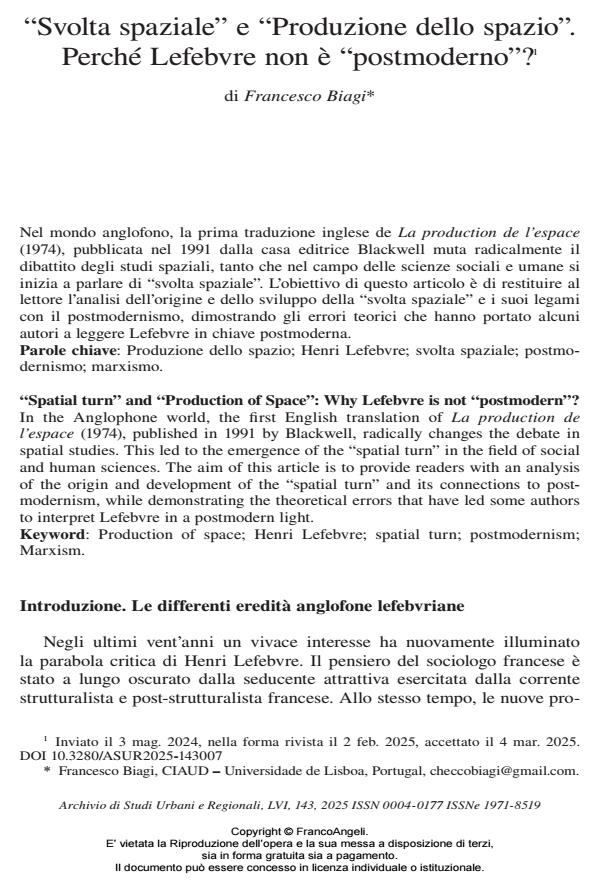
Nel mondo anglofono, la prima traduzione inglese de La production de l’espace (1974), pubblicata nel 1991 dalla casa editrice Blackwell muta radicalmente il dibattito degli studi spaziali, tanto che nel campo delle scienze sociali e umane si inizia a parlare di “svolta spaziale”. L’obiettivo di questo articolo è di restituire al lettore l’analisi dell’origine e dello sviluppo della “svolta spaziale” e i suoi legami con il postmodernismo, dimostrando gli errori teorici che hanno portato alcuni autori a leggere Lefebvre in chiave postmoderna.
Parole chiave:Produzione dello spazio; Henri Lefebvre; svolta spaziale; postmodernismo; marxismo.
- Ajzenberg A., Lethierry H. et Bazinek L. (2011). Maintenant Henri Lefebvre. Paris: L’Harmattan.
- Anderson P. (1977). Il dibattito nel marxismo occidentale. RomaBari: Laterza. BachmannMedick D. (2016). Cultural Turns. Berlin/Boston: De Gruyter.
- Balicco D. e Bianchi P. (2013). Interpretazioni del capitalismo contemporaneo. Jameson, Harvey, Arrighi. Testo disponibile al sito: www.leparoleelecose.it/ interpretazionidelcapitalismocontemporaneo/.
- Bhabha H. (1990). Nation and Narration. New York: Routledge. Bhabha H. (1994). The Location of Culture. New York: Routledge.
- Biagi F. (2020). Henri Lefebvre’s Critical Theory of Space. LondonNew York: Palgrave Mcmillan. DOI: 10.1007/978303052367
- Casey E. (1997). The Fate of Place. Berkeley: University of California Press. Connor S. (2004). The Cambridge Companion to Postmodernism. Cambridge: Cambridge University Press.
- Crang M. and Thrift N., eds. (2000). Thinking Space. New York: Routledge.
- Dear M. (1994). Les aspects postmodernes de Henri Lefebvre. Espaces et sociétés, 76(2): 3140.
- Dear M. (2000). The Postmodern Urban Condition. Oxford: Blackwell.
- Elden S. (2001). Politics, Philosophy, Geography: Henri Lefebvre in recent AngloAmerican Scholarship. Antipodes, 33(5): 809825. DOI: 10.1111/14678330.0021
- Elden S. (2004). Understanding Henri Lefebvre. New York: Continuum.
- Espinosa Hernandez R. (2023). La teori´a de la produccio´n del espacio, de Henri Lefebvre. Un proyecto de espaciologi´a cri´tica. Tesi di dottorato in Geografia: Mejico: Universidad Nacional Autónoma de México. Facultad de Filosofía y Letras.
- Foucault M. (2011). Spazi altri. MilanoUdine: Mimesis.
- Gottdiener M. (1985). The Social Production of Urban Space. Austin: Texas: University of Texas Press.
- Hamel P. et Poitras C. (1994). Henri Lefebvre, penseur de la postmodernité. Espaces et sociétés, 76(2): 4158.
- Harvey D. (1978). Giustizia sociale e città. Milano: Feltrinelli.
- Harvey D. (2016). Il capitalismo contro il diritto alla città. Verona: Ombre Corte. Heidegger M. (1991). La questione della tecnica. In: Id., Saggi e discorsi. Milano: Mursia.
- Heidegger M. (1998). Paesaggio creativo: Perché restiamo in provincia? (1934). In: Id., Scritti Politici (19331966). Casale Monferrato: Piemme.
- Heidegger M. (2006). Essere e tempo. Milano: Mondadori.
- Jameson F. (1984). Postmodernism, or The Cultural Logic of Late Capitalism. New Left Review, I(146): 5992.
- Jameson F. (1998). The Cultural Turn. London: Verso.
- Jameson F. (2015). Postmodernismo ovvero la logica culturale del tardo capitalismo. Roma: Fazi (ed. orig.: 1991; I ed. it.: 2007).
- Katznelson I. (1992). Marxism and the City. Oxford: Oxford University Press. Kipfer S. (2002). Urbanization, Everyday Life and the Survival of Capitalism:
- Lefebvre, Gramsci and the Problematic of Hegemony. Capitalism Nature Socialism, 13(2): 117149. DOI: 10.1080/1045575020856548
- Kipfer S., Goonewardena K., Schmid C. and Milgrom R. (2008). Space, Difference and Everyday Life. New York: Routledge.
- Lebas E. and Kofman L. (1996). Introduction. In: Lebas E. and Kofman L., eds., Henri Lefebvre: Key Writings. London/New York: Athlone/Continuum.
- Lefebvre H. (1949). Il materialismo dialettico. Torino: Einaudi. Lefebvre H. (1965). La proclamation de la Commune. Paris: Gallimard. Lefebvre H. (1972). La fine della storia. Epilegomeni. Milano: Sugar.
- Lefebvre H. (1973). La rivoluzione urbana. Roma: Armando Editore.
- Lefebvre H. (1975). Hegel Marx Nietzsche ou le royaume des ombres. Paris: Casterman.
- Lefebvre H. (1976). La produzione dello spazio. Milano: Moizzi. Lefebvre H. (1977a). Critica della vita quotidiana. Vol. I. Bari: Dedalo. Lefebvre H. (1977b). Critica della vita quotidiana. Vol. II. Bari: Dedalo. Lefebvre H. (1980). La rivoluzione non è più quella. Bari: Dedalo.
- Lefebvre H. (2009). La somme et le reste. Paris: La Nef (ed. or.: 1959). Lefebvre H. (2015a). Critique de la vie quotidienne. Vol. III. Paris: L’Arche. Lefebvre H. (2015b). Il tempo degli equivoci. Milano: Pgreco.
- Lefebvre H. (2017). Quando la città si dissolve nella metamorfosi planetaria. Scienza e Politica, XXIV (56): 223239.
- Lethierry H. (2009). Penser avec Henri Lefebvre, sauver la vie et la ville? Lyon: La chronique sociale.
- Lethierry H. (2015). Agir avec Henri Lefebvre. Lyon: La chronique sociale. Lethierry H., sous la direction de (2011). Sauve qui peut la ville. Paris: L’Harmattan.
- Liggett H. and Perry D.C. (1995). Spatial practices. Thousand Oaks: Sage Publications.
- Losurdo D. (2017). Il marxismo occidentale. RomaBari: Laterza. Lyotard J.F. (1981). La condizione postmoderna. Milano: Feltrinelli. Mandel E. (1975). Late capitalism. London: Verso.
- Massey D. (1992). Politics and Space/Time. New Left Review, I(196): 6584. Merrifield A. (2002). Metromarxism. London: Routledge.
- Merrifield A. (2006). Henri Lefebvre: A Critical Introduction. London: Routledge. Merrifield A. (2009). Review essay. The whole and the rest: Remi Hess and les lefebriens français. Environment and Planning D: Society and Space, 27: 936949.
- MüllerSchöll U. (2007). Le systeme et le reste. La théorie critique de Henri Lefebvre. Paris: Anthropos.
- Ross K. (1988). The emergence of social space. Minneapolis: University of Minnesota Press.
- Ross K. (1995). Fast cars, clean bodies. Cambridge: The MIT Press.
- Ross K. (1997). Lefebvre on the Situationists: An Interview. October, 79: 6984.
- Schmid C. (2008). Henry Lefebvre’s Theory of the Production of Space: towards a Threedimensional Dialectic. In: Kipfer S., Goonewardena K., Schmid
- C. and Milgrom R., eds., Space, Difference, and Everyday Life. New York: Routledge.
- Shields R. (1998). Lefebvre. Love and Struggle, New York: Routledge.
- Sim S. (2001). The Routledge companion to postmodernism. New York: Routledge. Soja E. (1989). Postmodern Geographies. London: Verso.
- Soja E. (1996). Thirdspace. Oxford: Blackwell. Soja E. (2000). Postmetropolis. Oxford: Blackwell.
- Soja E. (2007). Dopo la metropoli. Bologna: Pàtron Editore.
- Soja E. (2009). Takins Space Personally. In: Warf B. and Arias S., eds., The Spatial Turn. New York: Routledge.
- Stanek L. (2011). Henri Lefebvre on Space. Minneapolis: University of Minnesota Press.
- Vattimo G. e Rovatti P.A. (2009). Il pensiero debole. Milano: Feltrinelli. Warf B. and Arias S., eds. (2009). The Spatial Turn. New York: Routledge.
- Zaru E. (2022). Crisi della modernità. Storia, teorie e dibattiti (19792020). Pisa: Edizioni ETS.
Francesco Biagi, “Svolta spaziale” e “Produzione dello spazio”. Perché Lefebvre non è “postmoderno”? in "ARCHIVIO DI STUDI URBANI E REGIONALI" 143/2025, pp 118-139, DOI: 10.3280/ASUR2025-143007