The role of digital technologies in the mediation of institutional relationships and learning processes in Italian schools
Journal title PRISMA Economia - Società - Lavoro
Author/s Francesco Orazi, Davide Lucantoni
Publishing Year 2025 Issue 2025/1
Language Italian Pages 19 P. 57-75 File size 165 KB
DOI 10.3280/PRI2025-001005
DOI is like a bar code for intellectual property: to have more infomation
click here
Below, you can see the article first page
If you want to buy this article in PDF format, you can do it, following the instructions to buy download credits
FrancoAngeli is member of Publishers International Linking Association, Inc (PILA), a not-for-profit association which run the CrossRef service enabling links to and from online scholarly content.
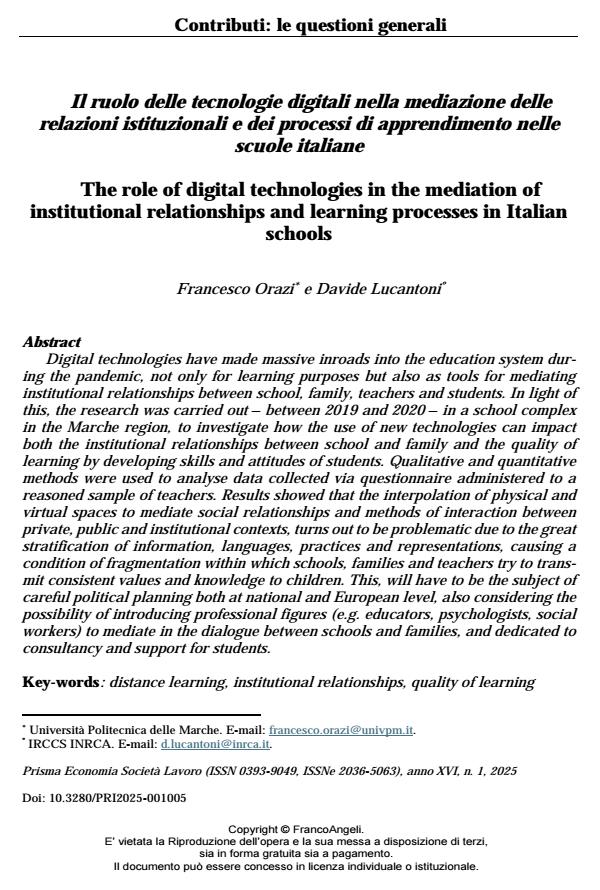
Digital technologies have made massive inroads into the education system during the pandemic, not only for learning purposes but also as tools for mediating institutional relationships between school, family, teachers and students. In light of this, the research was carried out ‒ between 2019 and 2020 ‒ in a school complex in the Marche region, to investigate how the use of new technologies can impact both the institutional relationships between school and family and the quality of learning by developing skills and attitudes of students. Qualitative and quantitative methods were used to analyse data collected via questionnaire administered to a reasoned sample of teachers. Results showed that the interpolation of physical and virtual spaces to mediate social relationships and methods of interaction between private, public and institutional contexts, turns out to be problematic due to the great stratification of information, languages, practices and representations, causing a condition of fragmentation within which schools, families and teachers try to transmit consistent values and knowledge to children. This, will have to be the subject of careful political planning both at national and European level, also considering the possibility of introducing professional figures (e.g. educators, psychologists, social workers) to mediate in the dialogue between schools and families, and dedicated to consultancy and support for students.
Keywords: distance learning, institutional relationships, quality of learning
- Biscaldi A., Matera V. (2019) Antropologia dei social media, Carocci: Roma.
- Catalano S., Alibrandi G. (2024) “Studio confermativo sulla dimensionalità di una scala per la rilevazione degli indicatori di preoccupazione prestazionale scolastica”, Italian Journal of Educational Research, 33, pp. 219-230.
- Chiusaroli D. (2023) “L’alleanza co-educativa tra scuola e famiglia per un sistema inclusivo” Annali online della Didattica e della Formazione Docente, 15(25), pp. 132-144.
- Colla V. (2022) “Costruire l’alleanza scuola-famiglia nelle interazioni tra genitori e figli durante i compiti a casa: adottare lo “sguardo valutativo dell’insegnante” come pratica interattiva”, Società Italiana di Pedagogia, pp. 167-170.
- Crozier M., Friedberg E. (1994) Attore sociale e sistema, Etas: Milano.
- Damiano E. (2013) La mediazione didattica. Per una teoria dell'insegnamento, FrancoAngeli: Milano.
- Deleuze G., Guattari F. (1972) L’Anti-Edipo. Capitalismo e schizofrenia (ed. 2002), Einaudi: Segrate.
- Errington J. (2001) Ideologia, in A. Dranti (a cura di), Culture e discorso, Meltemi: Milano.
- Evans L., Frith J., Saker M. (2022) “Social Worlds”, From Microverse to Metaverse, Emerald Publishing Limited: Leeds, pp. 25-32.
- Fisher M. (2009) Realismo capitalista (ed. 2018), Nero Editions: Roma.
- Furedi F. (2008) Il nuovo conformismo. Troppa psicologia nella vita quotidiana, Feltrinelli: Milano.
- Gao T., Yang L., Zhou J., Zhang Y., Wang L., Wang Y., Wang T. (2024) “Development and validation of a nomogram prediction model for ADHD in children based on individual, family, and social factors”, Journal of Affective Disorders, 356, pp. 483-491.
- Herring S. C., Ge-Stadnyk J. (2024) “Emoji and illocutionarity: Acting on, and acting as, language”. In Structures in M. Gill, A. Malmivirta, B. Wårvik (a cura di), Structures in Discourse: Interaction, adaptability, and pragmatic functions (pp. 124-155), John Benjamins Publishing Company: Amsterdam.
- Iacchia E., Ancarani P. (2018) Momentaneamente silenziosi: guida per operatori insegnanti e genitori di bambini e ragazzi con mutismo selettivo, FrancoAngeli: Milano.
- Interian R., G. Marzo R., Mendoza I., Ribeiro C. (2023) “Network polarization, filter bubbles, and echo chambers: an annotated review of measures and reduction methods”, International Transactions in Operational Research, 30(6), pp. 3122-3158.
- Jehi T., Kha R., Dos Santos H., Majzoub N. (2022) “Effect of COVID-19 outbreak on anxiety among students of higher education; A review of literature”, Current Psychology, pp. 1-15.
- Lin Q. (2025) “Visual Technology and the Aestheticization of Everyday Life”, Visual Culture in Contemporary China II, 83.
- Lischi, S. (2023) “Detriti, tracce sommerse e segnali di futuro nel discorso sul medium”, Immagini, media, dispositivi: studi e prospettive, 6, pp. 29-36.
- Leone M. (2011) “Dall’ideologia linguistica all’ideologia semiotica – Riflessioni sulla smentita”, Eidos, 14, pp. 236-249.
- Leone M. (2025) Il senso dell’immersione, in M. Leone (a cura di), Il senso immerso: Libertà e smarrimenti del corpo digitale, Aracne: Roma.
- Lybeck R., Koiranen I., Koivula A. (2024) “From digital divide to digital capital: the role of education and digital skills in social media participation”, Universal Access in the Information Society, 23(4), pp. 1657-1669.
- Marcuse H. (1955) Eros e civiltà (ed. 2001), Einaudi: Segrate.
- Midoro V. (2025) Scuola 2025: ripensare l’educazione nell’era della complessità digitale, disponibile su: https://www.agendadigitale.eu/scuola-digitale/scuola2025ripensare-leducazione-nellera-della-complessita-digitale/.
- Nass C., Yen C. (2012) The Man Who Lied to His Laptop: What We Can Learn About Ourselves from Our Machines, Current: London.
- Ophir E., Nass C., Wagner A. D. (2009) “Cognitive control in media multitaskers”, Proceedings of the National Academy of Sciences, 106(37), pp. 15583-15587.
- Orazi F., Lucantoni D. (2021) La nuova alleanza tra scuola e famiglia nella società ipermediata, Il Mulino: Bologna.
- Orazi F., Lucantoni D. (2024) “Grammatiche tecnologiche, giochi linguistici e forme di vita nella Digital Society”, Studi di sociologia: LXII, 2, pp. 111-123.
- Orazi F., Sofritti F., Lucantoni D. (2020) “La pandemia nell’area Medio-Adriatica: risultati e scenari di una web survey”, Culture della sostenibilità, (26), pp. 147-162.
- Orazi F., Sofritti F., Lucantoni D. (2024) “Mental well-being of children and adolescents during COVID-19: evidence from the Italian context and possible future developments”. Frontiers in Sociology, 9, 1387030.
- Pacetti E., Soriani A., Marcato E. (2023) “Linee guida per una comunicazione scuola-famiglia mediata da tecnologie più inclusive: una Ricerca-Formazione presso un istituto comprensivo di Bologna”, RicercAzione, 15(1), pp. 213-226.
- Pacinelli A., (2008) Metodi per la ricerca sociale partecipata, FrancoAngeli: Milano.
- Prensky M. (2003) “Digital game-based learning”, Computers in Entertainment (CIE), 1(1), pp. 21-21.
- Ranieri, M. (2024). Intelligenza artificiale a scuola. Una lettura pedagogico-didattica delle sfide e delle opportunità. Rivista di Scienze dell'Educazione, 62(1), 123-135.
- Rockwell S. C., Singleton L. A. (2007) “The effect of the modality of presentation of streaming multimedia on information acquisition”, Media Psychology, 9(1), pp. 179-191.
- Romeo F. P. (2024) Allearsi: Quadro concettuale, ricerche e pratiche sulla relazione scuola-famiglia e territorio, FrancoAngeli: Milano.
- Rossi P. G., Rivoltella P. C. (2019) Il corpo e la macchina. Tecnologia, cultura, educazione, Editrice Morcelliana: Brescia.
- Rossini V., Pizzolorusso F. (2022) “Corresponsabilità scuola-famiglia e sfide post pandemiche. Risultati di un’indagine on line”, LA FAMIGLIA, 56(266), pp. 61-77.
- Sciortino L. (2022) “La tradizione tradita: dalla varietà all'uniformità culturale”, Informazione Filosofica, 2 (6), pp. 115-131.
- Spitzer M. (2012) Demenza digitale. Come la nuova tecnologia ci rende stupidi, Corbaccio: Milano.
- Tapscott D. (2011) Net generation, Franco Angeli: Milano.
- Villa F. M., Crippa A., Rosi A. (2023) “ADHD and eating disorders in childhood and adolescence: An updated minireview”, Journal of Affective Disorders, 321, pp. 265- 271.
Francesco Orazi, Davide Lucantoni, Il ruolo delle tecnologie digitali nella mediazione delle relazioni istituzionali e dei processi di apprendimento nelle scuole italiane in "PRISMA Economia - Società - Lavoro" 1/2025, pp 57-75, DOI: 10.3280/PRI2025-001005