Telework and the spatio-temporal reorganization of work: insights from post-pandemic France and Italy
Journal title STUDI ORGANIZZATIVI
Author/s Emiliana Armano, Patrick Cingolani, Domenica Farinella, Corinne Siino
Publishing Year 2025 Issue 2025/2
Language English Pages 19 P. 120-138 File size 214 KB
DOI 10.3280/SO2025-002005
DOI is like a bar code for intellectual property: to have more infomation
click here
Below, you can see the article first page
If you want to buy this article in PDF format, you can do it, following the instructions to buy download credits
FrancoAngeli is member of Publishers International Linking Association, Inc (PILA), a not-for-profit association which run the CrossRef service enabling links to and from online scholarly content.
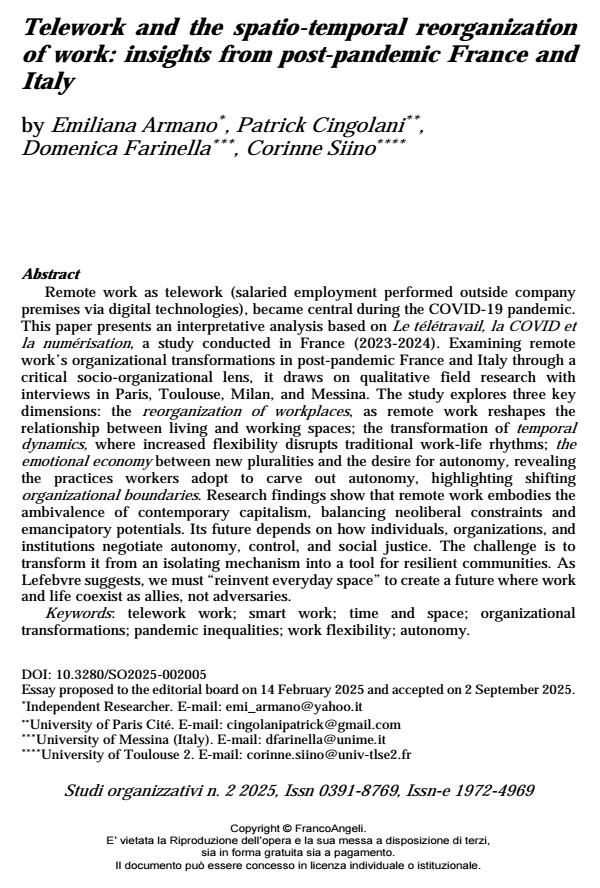
Remote work as telework (salaried employment performed outside company premises via digital technologies), became central during the COVID-19 pandemic. This paper presents an interpretative analysis based on Le télétravail, la COVID et la numérisation, a study conducted in France (2023-2024). Examining remote work’s organizational transformations in post-pandemic France and Italy through a critical socio-organizational lens, it draws on qualitative field research with interviews in Paris, Toulouse, Milan, and Messina. The study explores three key dimensions: the reorganization of workplaces, as remote work reshapes the relationship between living and working spaces; the transformation of temporal dynamics, where increased flexibility disrupts traditional work-life rhythms; the emotional economy between new pluralities and the desire for autonomy, revealing the practices workers adopt to carve out autonomy, highlighting shifting organizational boundaries. Research findings show that remote work embodies the ambivalence of contemporary capitalism, balancing neoliberal constraints and emancipatory potentials. Its future depends on how individuals, organizations, and institutions negotiate autonomy, control, and social justice. The challenge is to transform it from an isolating mechanism into a tool for resilient communities. As Lefebvre suggests, we must “reinvent everyday space” to create a future where work and life coexist as allies, not adversaries.
Keywords: telework work; smart work; time and space; organizational transformations; pandemic inequalities; work flexibility; autonomy.
- Aguiléra A., Lethiais V., Rallet A., Proulhac L. (2016). “Le télétravail, un objet sans désir ?”, Revue d’Économie Régionale & Urbaine, 1, 245-266.
- Aguiléra A., Pigalle E., Belton Chevallier L., (2025). “Exploring perceived changes in the frequency of private trips and local trips after telework adoption in France”, Transportation Research Interdisciplinary Perspectives, 31, https://doi.org/10.1016/j.trip.2025.101478.
- Armano E., Murgia A. (2017). “Hybrid areas of work in Italy, Hypotheses to interpret the transformations of precariousness and subjectivity.” In: Armano E., Bove A., Murgia A. (eds) Mapping Precariousness, Labour Insecurity and Uncertain Livelihoods, Subjectivities and Resistance, London, Routledge.
- Baumlin F., Bendavid R., Lanoë-Danel E. (2022). Pratiques et représentations associées au télétravail en Europe. R. Bendavid (ed.), Le rapport au travail post-Covid, Paris: Fondation Jean Jaurès.
- Bertolini S., Fullin G., Pacetti V. (2022). “Il lavoro da remoto tra terziarizzazione, digitalizzazione e trasformazioni delle relazioni di impiego.” Meridiana, 104: 9-28, DOI: 10.2307/27186252.
- Bertolini S., Fullin G., Pacetti V. (2022b) (eds.). Smart Working, special Issue, Meridiana, 104.
- Betti E. (2022). Dal lavoro a domicilio allo smart working: continuità e discontinuità in una prospettiva storica e di genere. Meridiana, 104: 201-218, DOI: 10.23744/4756
- Beyes T., Holt R. (2020). “The Topographical Imagination: Space and Organization Theory.” Organization Theory, 1(2).
- Butera F. (2020). “Valorizzare il lavoro attraverso la progettazione partecipata.” Studi Organizzativi, 1: 156-178, doi : 10.3280/SO2020-001-S1010.
- Casilli A.A. (2020). Le travail à inégales distances. Par ici la sortie ! : cahiers éphémères et irréguliers pour saisir ce qui nous arrive et imaginer les mondes de demain, 1, Editions du Seuil.
- Carreri A., Gosetti G., Poggio B., Zanoni P. (2020). “Lavoro e digitalizzazione: soggettività, controllo e qualità del lavoro nella quarta rivoluzione industriale.” Sociologia del Lavoro, 158: 51-73, DOI: 10.3280/SL2020-158003
- Chung H. (2021). The Flexibility Paradox: Why Flexible Working Leads to (Self)Exploitation. Bristol, UK: Bristol University Press.
- Cingolani P. (2021), La colonisation du quotidien, Paris, Éditions Amsterdam.
- Cingolani P., Corsani A. (2024). « Télétravail à domicile”. In: Bureau M.C., Corsani A., Giraud O. (eds.), Les zones grises des relations de travail et d’emploi, Tome 2 (249-259), Buenos Aires: Teseo. https://doi.org/10.55778/ts911693406c190 | CC BY-NC-ND.
- Cingolani P., Corsani A., Farinella D., Siino C. (2024). Le télétravail, la Covid et la numérisation. Paris, Working paper.
- Code du travail français, Articles L1222-9 à L1222-11, modifiés par l’Ordonnance n°2017-1387 du 22 septembre 2017.
- DARES Analyses (2024). Comment évolue la pratique du télétravail depuis la crise sanitaire? n.64.
- Di Matteo D., La Regina R., Mariotti I., Militello E. (2021). “Quali determinanti per il South Working? Una nuova proposta di sviluppo per il Sud, le aree interne e il Paese”, Rivista economica del Mezzogiorno, 4, 678-701, DOI: 10.1432/104472
- Dordoni A. (2025). Gender Inequalities and Precarious Work–Life Balance in Italian Academia: Emergency Remote Work and Organizational Change During the COVID-19 Lockdown. Social Sciences, 14(8), 471. https://doi.org/10.3390/socsci14080471.
- Eurofound (2020). Living, Working and COVID-19. Luxembourg: Publications Office of the European Union.
- Eurofound (2022). The Right to Disconnect Across Europe: A Comparative Analysis of Policies, Practices and Experiences. Luxembourg: Publications Office of the European Union.
- Eurofound (2023). Telework in the EU: Regulatory Frameworks and Prevalence. Luxembourg: Publications Office of the European Union.
- Farinella D., Arcidiacono D. (2023). “Beyond formality: Informalization and tertiarisation of labour in the gig economy”. In: Ness I. (ed.), Routledge international gig economy handbook (pp. 116–131). Routledge.
- Federici S. (2004). Caliban and the Witch: Women, the Body and Primitive Accumulation. New York: Autonomedia.
- Felstead A., Henseke G. (2017). “Assessing the Growth of Remote Working and Its Consequences for Effort, Well-being and Work-Life Balance.” New Technology, Work and Employment, 32(3), 195-212, https://doi.org/10.1111/ntwe.12097.
- Florida R., Rodríguez-Pose A., Storper M. (2021). “Cities in a Post-COVID World.”, Urban Studies, 58(10), 2083-2100, https://doi.org/10.1177/00420980211018072.
- Gillet A., Tremblay D. (2023) (eds.), Télétravail et Inégalités. Dossier, SociologieS, OpenEditionJournals.
- Gorz A. (1988). Métamorphoses du travail. Quête du sens : Critique de la raison économique. Paris: Galilée.
- Legge n.81/2017, Misure per la tutela del lavoro autonomo non imprenditoriale e misure volte a favorire l’articolazione flessibile nei tempi e nei luoghi del lavoro subordinato.
- Lefebvre H. (1967). “Le droit à la ville.”, L’Homme et la société, 6(1) : 29-35.
- Mariotti I., Di Matteo D., Rossi F. (2022) “Who were the losers and winners during the Covid-19 pandemic? The rise of remote working in suburban areas”, Regional Studies, Regional Science, 9(1): 685-708, DOI: 10.1080/21681376.2022.2139194
- Messenger J. C., Gschwind L. (2016). “Three Generations of Telework: New ICTs and the (R)evolution from Home Office to Virtual Office.” New Technology, Work and Employment, 31(3): 195-208, https://doi.org/10.1111/ntwe.12073.
- Murgia A. (2025). Hybrid Labour: Measuring, Classifying, and Representing Workers at the Boundaries of Employment and Self-employment. London: Routledge.
- Niebler V., Altenried M., Macannuco J. (2020). “Platform Labour: Contingent Histories and new Technologies”, Soft Power Revista euro-americana de teoría e historia de la política y del derecho, 13(7,1): 255-265, ttp://dx.doi.org/10.14718/SoftPower.2020.7.1.13.
- Peruzzi M., Sacchetto D. (2021) (eds.). Il lavoro da remoto. Aspetti giuridici e sociologici. Torino: Giappichelli.
- Postone M. (1993), Time, labor and Social Domination, Chicago, Cambridge University Press.
- Raguseo E., Gastaldi L., Neirotti P. (2016). “Smart Work: Supporting Employees’ Flexibility Through ICT, HR Practices and Office. Layout.” Evidence-based HRM: A Global Forum for Empirical Scholarship, 4(3), 240-256.
- Rosa H. (2012). Aliénation et accélération : vers une théorie critique de la modernité tardive. Paris: La Découverte.
- Taskin L., Parmentier M. Stinglhamber F. (2019). “The dark side of office designs: towards de-humanization. .” New Technology, Work and Employment, 34(3): 262-284, https://doi.org/10.1111/ntwe.12150
- Tirabeni L., Miele F. (2020). “Digital technologies and power dynamics in the organization: A conceptual review of remote working and wearable technologies at work.” Sociology Compass, 6(14), https://doi.org/10.1111/soc4.12795.
- Thoemmes J. (2023). “Les paradoxes du télétravail.” Les mondes du travail, 30: 119-136.
- Thompson E. P. (1967). “Time, Work-Discipline, and Industrial Capitalism.” Past & Present, 38: 56-97.
Emiliana Armano, Patrick Cingolani, Domenica Farinella, Corinne Siino, Telework and the spatio-temporal reorganization of work: insights from post-pandemic France and Italy in "STUDI ORGANIZZATIVI " 2/2025, pp 120-138, DOI: 10.3280/SO2025-002005