Violenza di genere e tecnologie: ripensare le disuguaglianze nell’era digitale
Journal title SOCIOLOGIA DELLA COMUNICAZIONE
Author/s Chiara Gius, Antonella Mascio
Publishing Year 2026 Issue 2025/70
Language Italian Pages 14 P. 5-18 File size 595 KB
DOI 10.3280/SC2025-070001
DOI is like a bar code for intellectual property: to have more infomation
click here
Below, you can see the article first page
If you want to buy this article in PDF format, you can do it, following the instructions to buy download credits
FrancoAngeli is member of Publishers International Linking Association, Inc (PILA), a not-for-profit association which run the CrossRef service enabling links to and from online scholarly content.
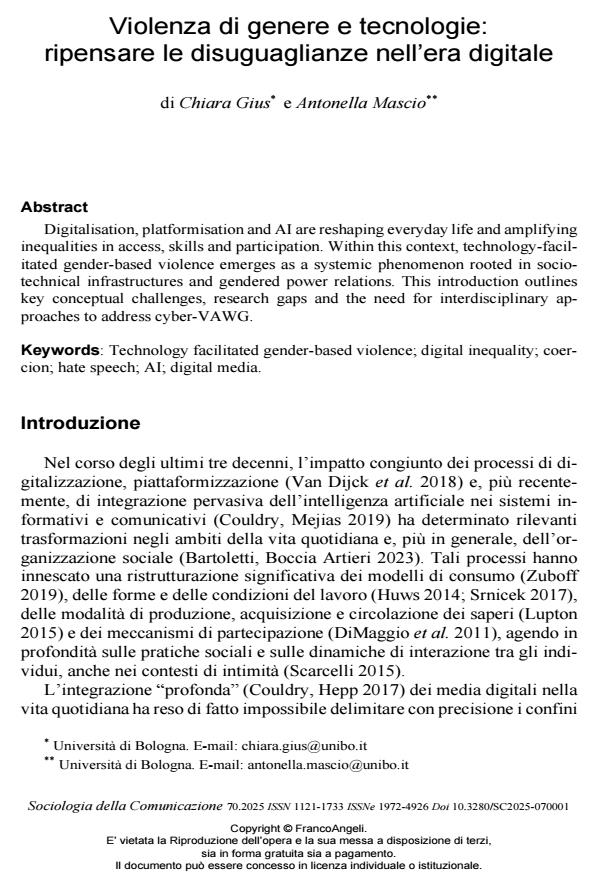
Digitalisation, platformisation and AI are reshaping everyday life and amplifying inequalities in access, skills and participation. Within this context, technology-facilitated gender-based violence emerges as a systemic phenomenon rooted in socio-technical infrastructures and gendered power relations. This introduction outlines key conceptual challenges, research gaps and the need for interdisciplinary approaches to address cyber-VAWG.
Keywords: Technology facilitated gender-based violence; digital inequality; coercion; hate speech; AI; digital media.
- Bartoletti R., Boccia Artieri G. (2023), Algoritmi e vita quotidiana: un approccio socio-comunicativo critico, in «Sociologia della comunicazione», n. 66(2), pp. 5-20.
- boyd d.m., Ellison N.B. (2007), Social network sites: Definition, history, and scholarship, in «Journal of Computer-Mediated Communication» n.13(1), pp. 210-230.
- Brown C., Hegarty K. (2024), Fear and distress: how can we measure the impact of technology-facilitated abuse in relationships?, in «Social Sciences» n. 13(1), pp. 2-16.
- Castells M. (1996), The Rise of the Network Society, The Information Age: Economy, Society and Culture, Blackwell.
- Collins P. H. (1993), Toward a new vision: Race, class, and gender as categories of analysis and connection, in B. Laudry (ed), Race, Sex & Class, pp. 65–75, Routledge.
- Couldry N., Hepp A. (2017), The Mediated Construction of Reality, Polity Press, Cambridge.
- Couldry B., Mejias U.A. (2019), The Costs Of Connection: How Data Is Colonizing Human Life And Appropriating It For Capitalism, Stanford University Press, Stanford.
- Crenshaw K. (1991), Mapping the Margins: Intersectionality, Identity Politics, and Violence Against Women of Color, in «Stanford Law Review» n. 43(6), pp. 1241-1299. DOI: 10.2307/122903
- Daniels J. (2009), Rethinking cyberfeminism(s): Race, gender, and embodiment, in «WSQ: Women’s Studies Quarterly» n. 37(1–2), pp.101–124.
- Deuze M. (2012), Media Life, Polity Press, Cambridge, UK.
- - (2023), Life in Media, MIT Press, Cambridge, USA.
- DiMaggio P. (2001), The Internet’s implications for society, in «Annual Review of Sociology» n. 27, pp.307-336.
- EIGE (2017), Cyber violence against women and girls. https://eige.europa.eu/sites/default/files/documents/cyber_violence_against_women_and_girls.pdf (ultimo accesso 28/12/2025)
- - (2022), Combating cyber violence against women and girls: The COVD-19 pandemic and care, https://eige.europa.eu/publications-resources/publications/combating-cyber-violence-against-women-and-girls (ultimo accesso 28/12/2
- 025).
- Elliott A., Urry, J. (2010), Mobil Lives, Routledge, London-New York.
- European Declaration of Digital Rights and Principles for the Digital Decade (2022), https://ec.europa.eu/newsroom/dae/redirection/document/94370 (ultimo accesso 28/12/2025)
- Gius C. (2021), Addressing the Blurred Question of ‘Responsibility’: insights from Online News Comments on a Case of Non-Consensual Pornography, in «Journal of Gender Studies» n. 31(2), pp. 193-203. DOI: 10.1080/09589236.2021.189261
- GREVIO (2021), General Recommendation No.1 on the digital dimension of violence against women https://www.coe.int/en/web/istanbul-convention/-/grevio-publishes-its-general-recommendation-no-1
- Hall M., Lewis R., Hearn J. (2023), Digital Gender-sexual Violations. Violence, Technologies, Motivations, Routledge, London-New York.
- Hall M., Lewis R., Hearn J. (2024), The Bounded Limitlessness of Digital Gender–Sexual Violations: The Implications for Women and Gender– Sexual Relations, in «Violence Against Women» n. 0(0). DOI: 10.1177/1077801224129229
- Huws U. (2014), Labor in the global digital economy: The cybertariat comes of age, New York University Press, New York.
- Hargittai E., Micheli M. (2019), Internet skills and why they matter, in Graham M., Dutton W.H. (eds.), Society and the internet. How networks of information and communication are changing our lives, pp. 109-126, Oxford University Press, Oxford.
- Henry N., Powell A. (2015), Embodied Harms: Gender, Shame, and Technology-Facilitated Sexual Violence, in «Violence Against Women» n. 21(6), pp. 758-79. DOI: 10.1177/1077801215576581
- Hargittai E. (2001), From the ‘Digital Divide’toDigital Inequality’: Studying internet use as penetration increases, in «Princeton Center for Arts and Cultural Policy Studies, Working Paper».
- Harris B., Woodlock D. (2019), Digital coercive control: Insights from two landmark domestic violence studies, in «The British Journal of Criminology » n. 59(3), pp. 530-50.
- Jane E.A. (2014), ‘Back to the kitchen, cunt’: Speaking the unspeakable about online misogyny, in «Continuum» n. 28(4), pp. 558–570. DOI: 10.1080/10304312.2014.92447
- - (2017), Misogyny online: A short (and Brutish) history, Sage, London.
- Jenkins H., Ford S., Green J. (2013), Spreadable media: Creating value and meaning in a networked culture, NYU Press, New York.
- Livingstone S. (2013), Children and the Internet, Polity Press, Cambridge.
- Lupton D. (2015), Digital Sociology, Routledge, London.
- Martínez-Bacaicoa J., Alonso-Fernández M., Wachs S., Gámez-Guadix M. (2023), Prevalence And Motivations For Technology-Facilitated Gender- and Sexuality-Based Violence Among Adults: A Mixed- Methods Study, in «Sex Roles» n. 89(9-10), pp. 670-684.
- Medeiros de Araújo A.V.M., do Bonfim C.V., Bushatsky M., Furtado B.M.A. (2022), Technology-facilitated sexual violence: A review of virtual violence against women, in «Research, Society and Development» n.11(2), pp. 1-17.
- Morahan-Martin J. (2000), Women and the Internet: Promise and Perils, in «Cyber Psychology & Behavior» n. 3(5), pp. 683–691.
- Mossberger K., Tolbert C. J., McNeal R.S. (2007), Digital Citizenship: The Internet, Society, and Participation, MIT Press, Boston
- Parlamento Europeo (2021), Combating Gender-Based Violence: Cyber Violence [Online]. Disponibile su: https://www.europarl.europa.eu/RegData/etudes/STUD/2021/662621/EPRS_STU(2021)662621_EN.pdf (Ultimo accesso: 18/12/2025).
- Plan International (2020), The state of the world’s girls 2020: Free to be online? [Online]. Disponibile su: https://plan-international.org/publications/free-to-be-online (Ultimo accesso: 18/12/2025).
- Powell A., Henry N. (2017), Sexual violence in the digital age, Palgrave Macmillan, London.
- Powell A., Henry N., Flynn A. (2024), Digital criminology: Crime and justice in digital society, Routledge, London-New York.
- Robinson L., Schulz J., Blank, G., Ragnedda M., Ono H., Hogan B., Khilnani A. (2020), Digital inequalities 2.0: Legacy inequalities in the information age, in «First Monday», n. 25(7).
- Sartori L. (2006), Il divario digitale. Internet e nuove disuguaglianze sociali, il Mulino, Bologna.
- Save the Children Italia (2024), Le ragazze stanno bene? Indagine sulla violenza di genere onlife in adolescenza. https://www.savethechildren.it/cosa-facciamo/pubblicazioni/le-ragazze-stanno-bene (ultimo accesso 18/12/2025).
- Scarcelli C.M (2019), Manosphere periferiche. Ragazzi, omosocialità e pratiche digitali, in «About Gender», 10(19), pp. 1-34. DOI: 10.15167/2279-5057/AG2021.10.19.127
- - (2015), Intimità digitali. Adolescenti, amore e sessualità ai tempi di internet, FrancoAngeli, Milano.
- Security Hero (2023), 2023 State of Deepfakes: Realities, Threats, and Impact. https://www.securityhero.io/state-of-deepfakes/ (ultimo accesso 18/12/2025).
- Srnicek N. (2017). Platform Capitalism. Wiley, Hoboken, NJ.
- Stark E. (2007). Coercive control: How men entrap women in personal life, Oxford University Press, Oxford.
- Uhl C.A., Rhyner K.J., Terrance C.A., Lugo N.R. (2018), An Examination of Nonconsensual Pornography Websites, in «Feminism & Psychology» 28(1), 50–68. DOI: 10.1177/095935351772022
- United Nations (2023) Promotion and protection of human rights in the context of digital technologies, https://docs.un.org/en/A/RES/78/213 (ultimo accesso 18/12/2925).
- United Nations Population Fund (2021), Technology-facilitated gender-based violence: Making all spaces safe. https://www.unfpa.org/publications/technology-facilitated-gender-based-violence-making-all-spaces-safe (ultimo accesso 18/12/2025).
- United Nations Educational, Scientific and Cultural Organization (2023), “Your opinion doesn’t matter, anyway”: exposing technology-facilitated gender-based violence in an era of generative AI. https://unesdoc.unesco.org/ark:/48223/pf0000387483 (ultimo accesso 18/12/2025).
- Van Dijck J., Poell T., De Waal M. (2018), The Platform Society: Public Values in a Connective World, Oxford University Press, Oxford.
- Zuboff S. (2019), The Age of Surveillance Capitalism, PublicAffairs, New York.
Chiara Gius, Antonella Mascio, Violenza di genere e tecnologie: ripensare le disuguaglianze nell’era digitale in "SOCIOLOGIA DELLA COMUNICAZIONE " 70/2025, pp 5-18, DOI: 10.3280/SC2025-070001