Fake sex, real hate: deepfake pornography as technological violence in 4chan’s manosphere
Journal title SOCIOLOGIA DELLA COMUNICAZIONE
Author/s Francesco Pira, Umberto Spaticchia, Roberta Casagrande
Publishing Year 2026 Issue 2025/70
Language Italian Pages 22 P. 95-116 File size 885 KB
DOI 10.3280/SC2025-070006
DOI is like a bar code for intellectual property: to have more infomation
click here
Below, you can see the article first page
If you want to buy this article in PDF format, you can do it, following the instructions to buy download credits
FrancoAngeli is member of Publishers International Linking Association, Inc (PILA), a not-for-profit association which run the CrossRef service enabling links to and from online scholarly content.
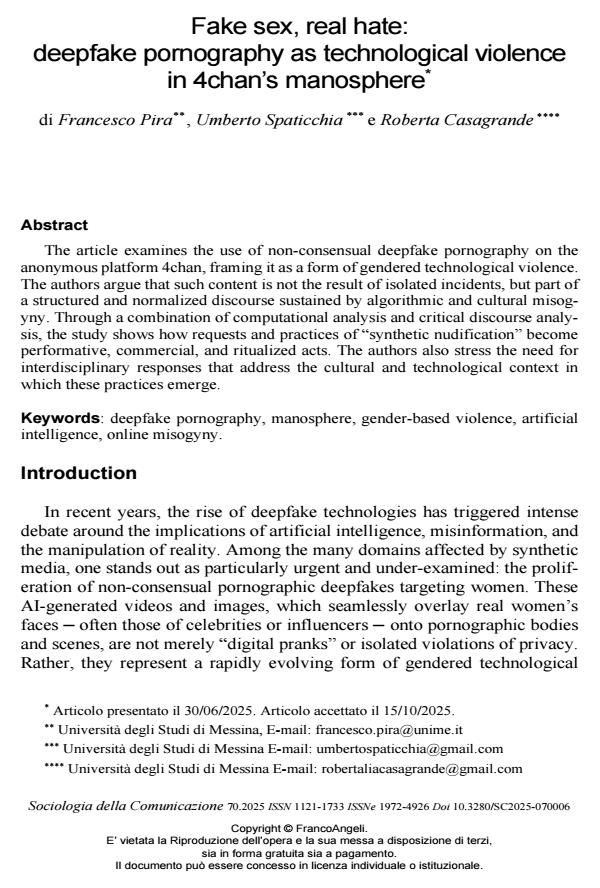
The article examines the use of non-consensual deepfake pornography on the anonymous platform 4chan, framing it as a form of gendered technological violence. The authors argue that such content is not the result of isolated incidents, but part of a structured and normalized discourse sustained by algorithmic and cultural misogyny. Through a combination of computational analysis and critical discourse analysis, the study shows how requests and practices of “synthetic nudification” become performative, commercial, and ritualized acts. The authors also stress the need for interdisciplinary responses that address the cultural and technological context in which these practices emerge.
Keywords: deepfake pornography, manosphere, gender-based violence, artificial intelligence, online misogyny.
- Ajder H., Patrini G., Cavalli F., Cullen L. (2019), The State of Deepfakes: Landscape, Threats, and Impact, Deeptrace. [online] Testo disponibile in: https://regmedia.co.uk/2019/10/08/deepfake_report.pdf (June 25, 2025).
- Baudrillard J. (1981), Simulacres et simulation, Éditions Galilée, Paris; trad. it. (1994), Simulacri e simulazione, Feltrinelli, Milano.
- Beever J., McDaniel R., Stanlick N. (2019), Understanding Digital Ethics: Cases and Contexts, Routledge, London. DOI: 10.4324/978131528213
- Fairclough N. (1995), Critical Discourse Analysis: The Critical Study of Language, Longman, London.
- Founta A.-M., Chatzakou D., Kourtellis N., Blackburn J., Vakali A., Leontiadis I. (2018), A Unified Deep Learning Architecture for Abuse Detection, arXiv preprint, arXiv:1802.00385. [online] https://arxiv.org/abs/1802.00385 (June 25, 2025).
- Glick P., Fiske S.T. (1996), The Ambivalent Sexism Inventory: Differentiating hostile and benevolent sexism, in «Journal of Personality and Social Psychology», 70(3), pp. 491-512. DOI: 10.1037/0022-3514.70.3.49
- Golbeck J. (2024), A Dataset for the Study of Online Radicalization Through Incel Forum Archives, in «Journal of Quantitative Description: Digital Media», 4.
- Laffier J., Rehman L. (2023), Deepfakes and Harm to Women: A Narrative Review of Gendered Abuse in Online Environments.
- Massanari A. (2017), #Gamergate and The Fappening: How Reddit’s algorithm, governance, and culture support toxic technocultures, in «New Media & Society», 19(3), pp. 329-346. DOI: 10.1177/146144481560880
- Markham, A. N. & Buchanan, E. (2012), Ethical Decision-Making and Internet Research: Recommendations from the AoIR Ethics Working Committee, Association of Internet Researchers.
- Mento C., Pira F. (2023), La violenza in un “click”: Profili sociologici, psicologici e giuridici del revenge porn, Franco Angeli, Milano.
- Milner, R. M. (2016), The World Made Meme: Public Conversations and Participatory Media, MIT Press, Cambridge.
- Noble S.U. (2018), Algorithms of Oppression: How Search Engines Reinforce Racism, NYU Press, New York.
- Phillips W. (2015), This is Why We Can’t Have Nice Things: Mapping the Relationship between Online Trolling and Mainstream Culture, MIT Press, Cambridge.
- Pitsilis G.K., Ramampiaro H., Langseth H. (2018), Detecting Offensive Language in Tweets Using Deep Learning, arXiv preprint, arXiv:1801.04433. [online] https://arxiv.org/abs/1801.04433 (June 25, 2025).
- Sugiura L. (2021), The Incel Rebellion: The Rise of the Manosphere and the Virtual War Against Women, Emerald Group Publishing, Bingley.
- van Dijk A. (1998), Ideology: A Multidisciplinary Approach, Sage, London.
Francesco Pira, Umberto Spaticchia, Roberta Casagrande, Fake sex, real hate: deepfake pornography as technological violence in 4chan’s manosphere in "SOCIOLOGIA DELLA COMUNICAZIONE " 70/2025, pp 95-116, DOI: 10.3280/SC2025-070006