Localised experiences of diversity and immigrant policies in Italian inner areas
Journal title PRISMA Economia - Società - Lavoro
Author/s Federico Rossi
Publishing Year 2026 Issue 2025/2
Language Italian Pages 19 P. 96-114 File size 133 KB
DOI 10.3280/PRI2025-002007
DOI is like a bar code for intellectual property: to have more infomation
click here
Below, you can see the article first page
If you want to buy this article in PDF format, you can do it, following the instructions to buy download credits
FrancoAngeli is member of Publishers International Linking Association, Inc (PILA), a not-for-profit association which run the CrossRef service enabling links to and from online scholarly content.
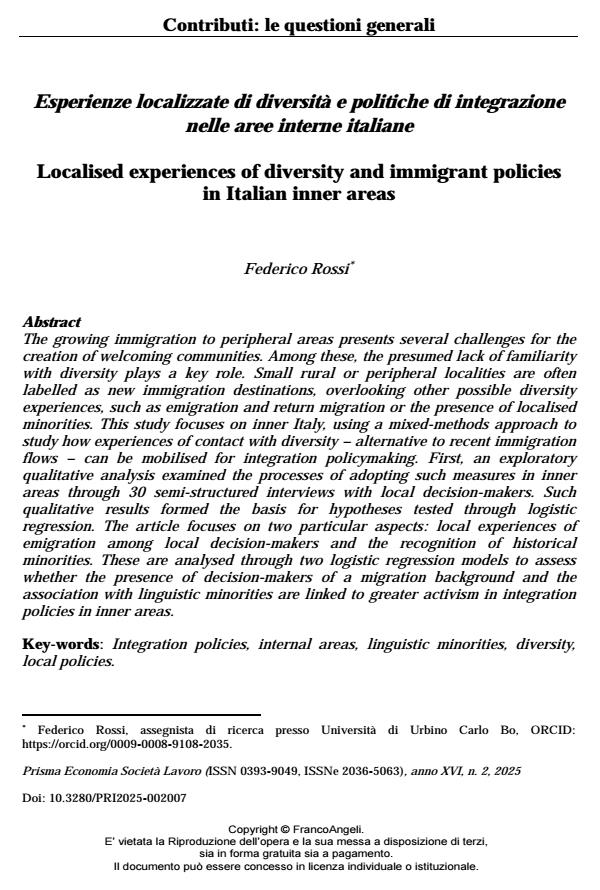
The growing immigration to peripheral areas presents several challenges for the creation of welcoming communities. Among these, the presumed lack of familiarity with diversity plays a key role. Small rural or peripheral localities are often labelled as new immigration destinations, overlooking other possible diversity experiences, such as emigration and return migration or the presence of localised minorities. This study focuses on inner Italy, using a mixed-methods approach to study how experiences of contact with diversity – alternative to recent immigration flows – can be mobilised for integration policymaking. First, an exploratory qualitative analysis examined the processes of adopting such measures in inner areas through 30 semi-structured interviews with local decision-makers. Such qualitative results formed the basis for hypotheses tested through logistic regression. The article focuses on two particular aspects: local experiences of emigration among local decision-makers and the recognition of historical minorities. These are analysed through two logistic regression models to assess whether the presence of decision-makers of a migration background and the association with linguistic minorities are linked to greater activism in integration policies in inner areas.
Keywords: Integration policies, internal areas, linguistic minorities, diversity, local policies.
- Adam, I. (2013), “Immigrant Integration Policies of the Belgian Regions: Sub-State Nationalism and Policy Divergence after Devolution”, Regional & Federal Studies, 23(5), pp. 547-569.
- Agenzia per Coesione Territoriale (2020), Strategia Nazionale Aree Interne. La selezione delle aree, -- disponibile su: https://www.agenziacoesione.gov.it/strategia-nazionale-aree-interne/la-selezione-delle-aree/.
- Alexander, M. (2010), “Local policies towards migrants as an expression of Host-Stranger relations: A proposed typology”, Journal of Ethnic and Migration Studies, 29(3), pp. 411-430.
- Angelo, A. (2012), “La convivenza a Taipana: minoranze linguistiche e nuova immigrazione”. In: Osti, G., Ventura, F. (a cura di) Vivere da stranieri in aree fragili. L’immigrazione internazionale nei comuni rurali italiani, Liguori Editore: Napoli, pp. 155-167.
- Barberis, E., Pavolini, E. (2015), “Settling Outside Gateways. The State of the Art and the Issues At Stake”, Sociologica, 2, DOI: 10.2383/81426.
- Bevilacqua, P. (2001). “Società rurale ed emigrazione”. In: Bevilacqua, P, De Clementi, A., Franzina, E. (a cura di), Storie dell’emigrazione italiana. Partenze, Donzelli: Roma, pp. 95-112.
- Bevilacqua, S.A., Bertaux, D. (2022), “Asylum Seekers in Small Villages: Spatial Proximity and Integration in Italian and French Villages”, Borders in Globalization Review, 4(1), pp. 29-40.
- Butler, R. (2021), “Youth, mobilities and multicultures in the rural Anglosphere: positioning a research agenda”, Ethnic and Racial Studies, 44(16), pp. 63-82.
- Camarero, L., Sampedro, R., Oliva, J. (2012), “Foreigners, Neighbours, Immigrants: Translocal Mobilities in Rural Areas in Spain”. In: Hedberg, C., do Carmo, R.M. (a cura di) Translocal Ruralism. Mobility and Connectivity in European Rural Spaces, Springer: Londra, pp. 143-162.
- Camera dei Deputati (2019), Relazione sul funzionamento del sistema di accoglienza predisposto al fine di fronteggiare le esigenze straordinarie connesse all’eccezionale afflusso di stranieri nel territorio nazionale, -- disponibile su: https://documenti.camera.it/_dati/leg18/lavori/documentiparlamentari/IndiceETesti/051/003/INTERO.pdf.
- Caponio, T. (2010), “Conclusion: making sense of local migration policy arenas”. In: Caponio, T., Borkert, M. (a cura di) The Local Dimension of Migration Policymaking, Amsterdam University Press: Amsterdam, pp. 161-195.
- Caponio, T., Donatiello, D., Ponzo, I. (2022), “Relational and reputational resources in the governance of top-down asylum-seekers’ reception in Italian rural areas”, Territory, Politics, Governance, 10(3), pp. 407-425.
- Charmaz, K. (2006), Constructing Grounded Theory. A Practical Guide through Qualitative Analysis Sage: Londra.
- Cloke, P. (2003), Country Visions, Pearson Education Limited: Harlow.
- Coluzzi, P. (2006), “Minority Language Planning and Micronationalism in Italy: The Cases of Lombardy and Friuli”, Journal of Multilingual and Multicultural Development, 27(6), pp. 457-471.
- Corrado, A. (2011), “Clandestini in the Orange Towns: Migrations and Racisms in Calabria’s Agriculture”, Race/Ethnicity: Multidisciplinary Global Contexts, 4(2), pp. 191-201.
- Fonseca, M.L. (2008), “New Waves of Immigration to Small Towns and Rural Areas in Portugal”, Population, Space and Place, 14, pp. 525-535.
- Galera, G., Giannetto, L., Membretti, A., Noya, A. (2018), “Integration of Migrants, Refugees and Asylum Seekers in Remote Areas with Declining Population”, OECD Local Economic and Employment Development (LEED) Working Papers, 3,
- Glorius, B. (2017), “The challenge of diversity in rural regions: refugee reception in the German federal state of Saxony”, Hungarian Geographical Bulletin, 66(2), pp. 113-128.
- Haselbacher, M., Segarra, H. (2022), “Politics of adjustment: rural mayors and the accommodation of refugees”, Territory, Politics, Governance, 10(3), pp. 346-365.
- Hedberg, C., Do Carmo, M. (2012), “Translocal Ruralism: Mobility and Connectivity in European Rural Spaces”. In: Hedberg, C., Do Carmo, M. (a cura di), Translocal Ruralism. Mobility and Connectivity in European Rural Spaces. Springer: Londra, pp. 1-12.
- Istat (non disponibile), IstatData. La banca dati dell’Istituto Nazionale di Statistica, -- disponibile su: https://esploradati.istat.it/databrowser/.
- Kalantaryan, S., Scipioni, M., Natale, F., Alessandrini, A. (2021), “Immigration and integration in rural areas and the agricultural sector: An EU perspective”, Journal of Rural Studies, 88, pp. 462-472.
- Kasimis, C. (2006), “The New Role of Migrants in the Rural Economies of Southern Europe”. In: Papademetriou, D. (a cura di) Europe and Its Immigrants in the 21st Century. A New Deal or a Continuing Dialogue of the Deaf?, Migration Policy Institute: Bruxelles, pp. 179-205.
- Kordel, S., Weidinger, T. (2018), “Current Processes of Immigration to European Peripheries: Status Quo, Implications and Development Strategies”. In: Kordel, S., Weidinger, T., Jelen, I. (a cura di) Processes of Immigration in Rural Europe. Cambridge Scholars Publishing: Newcastle upon Tyne, pp. XV-XXX.
- Kreichauf, R. (2020), “Legal Paradigm Shifts and Their Impacts on the Scio-Spatial Exclusion of Asylum Seeker in Denmark”. In: Glorius, B., Doomernik, J. (a cura di) Geographies of Asylum in Europe and the Role of European Localities. Springer: Cham, pp. 45-67.
- Liuzzi, A. (2016), “Old and new minorities: the case of Arbëreshë communities and Albanian immigrants in Southern Italy”, Migration Letters, 13(2), pp. 258-268.
- Löffler, R., Beismann, M., Walder, J., Steinicke, E. (2014), “New Highlanders in Traditional Out-migration Areas in the Alps. The Example of the Friulan Alps”, Journal of Alpine Research, 102(3),
- Maddens, B., Billiet, J., Beerten, R. (2000), “National identity and the attitude towards foreigners in multi-national states: the case of Belgium”, Journal of Ethnic and Migration Studies, 26(1), pp. 45-60.
- Maraschio, N., Robustelli, C. (2011), “Minoranze linguistiche: la situazione in Italia”. In: Stickel, G. (a cura di) National, Regional and Minority Languages in Europe: Contributions to the Annual Conference 2009 of EFNIL in Dublin. Peter Lang AG: Pieterlen, pp. 73-81.
- Martins, J.R., Davino, C. (2023), “Local Migration Governance in European Shrinking Areas: a German and an Italian Case”, Journal of International Migration and Integration, 24, pp. 863-888.
- McAreavey, R. (2017), New Immigration Destinations. Migrating to Rural and Peripheral Areas, Routledge: New York.
- Medda-Windischer, R. (2018), “Migration in Sub-State Territories with Historical-Linguistic Minorities: Main Challenges and New Perspectives”, Acta Universitatis Sapientiae, European and Regional Studies, 14, pp. 57-70.
- Membretti, A., Lucchini, F. (2018), “Foreign Immigration and Housing Issues in Small Alpine Villages. Housing as a Pull Factor for New Highlanders”. In: Kordel, S., Weidinger, T., Jelen, I. (a cura di) Processes of Immigration in Rural Europe. Cambridge Scholars Publishing: Newcastle upon Tyne, pp. 203-219.
- Membretti, A., Viazzo, P.P. (2017), “Stranieri e mutamento culturale nelle terre alte”. In: Membretti, A., Kofler, I., Viazzo, P.P. (a cura di), Per forza o per scelta. L’immigrazione straniera nelle Alpi e negli Appennini. Aracne Edizioni: Canterano, pp. 101-110.
- Ministero dell’Interno (2009), III Rapporto dell’Italia sull’Attuazione della Convenzione Quadro per la Protezione delle Minoranze Nazionali, -- disponibile su: https://www1.interno.gov.it/mininterno/export/sites/default/it/assets/files/ 16/0022_III_Rapporto_protezione_minoranze.pdf.
- Ministero dell’Interno (non disponibile), Eligendo. Gli Open Data, -- disponibile su: https://elezionistorico.interno.gov.it/eligendo/opendata.php.
- Morén-Alegret, R. (2004), “Foreign Immigration in Spanish Rural Areas and Small Towns: Current Situation and Perspectives”, Finisterra, 39(77), pp. 21-38.
- Morén-Alegret, R., Wladycka, D. (2020), International Immigration, Integration and Sustainability in Small Towns and Villages. Socio-Territorial Challenges in Rural and Semi-Rural Europe. Palgrave Macmillan: Londra
- Panelli, R., Hubbard, P., Coombe, B., Suchet-Pearson, S. (2009), “De-centring White ruralities: Ethnic diversity racialisation and Indigenous countrysides”, Journal of Rural Studies, 25, pp. 355-364.
- RETESAI (2021), Rapporto Annuale SAI. Sistema di Accoglienza e Integrazione, Ministero dell’Interno, Centro Copie l’Istantanea: Roma.
- Rossi, F. (2023), “Incorporation policies in diversifying rural localities in Italy: challenges and opportunities”, Mondi Migranti, 2, pp. 215-235.
- Rosso, D. (2016), “Responding to the Challenge. The Search for Hope in the Mediterranean”, Diaconia, 7, pp. 68-74.
- Schiller, M. (2016), European Cities, Municipal Organizations and Diversity. The New Politics of Difference. Palgrave Macmillan: Londra.
- Sciortino, G. (2003), “L’emigrazione italiana e i suoi fantasmi”, Polis, 17(1), pp. 125-149.
- Semprebon, M., Marzorati, M., Bonizzoni, P. (2023), “Migration governance and the role of the third sector in small-sized towns in Italy”, Journal of Ethnic and Migration Studies, 49(11), pp. 2742-2759.
- Toso, F. (2008), Le minoranze linguistiche in Italia, il Mulino: Bologna.
- Turgeon, L., Bilodeau, A. (2014), “Minority nations and attitudes towards immigration: the case of Quebec”, Nations and Nationalism, 20(2), pp. 317-336.
- UN – United Nations (2022), Handbook on Measuring International Migration through Population Censuses. Studies in Methods. Statistic Divion, Department of Economic and Social Affair, United Nations: New York.
- Van Liempt, I., Miellet, S. (2021), “Being far away from what you need: the impact of dispersal on resettled refugees’ homemaking and place attachment in small to medium-sized towns in the Netherlands”, Journal of Ethnic and Migration Studies, 47(11), pp. 2377-2395.
- Whyte, Z., Romme Larsen, B., Fog Olwig, K. (2018), “New neighbours in a time of change: local pragmatism and the perception of asylum centres in rural Denmark”, Journal of Ethnic and Migration Studies, 45(11), pp. 1953-1969.
- Woods, M. (2018), “Precarious rural cosmopolitanism. Negotiating globalization, migration and diversity in Irish small towns”, Journal of Rural Studies, 64, pp. 164-176.
Federico Rossi, Esperienze localizzate di diversità e politiche di integrazione nelle aree interne italiane in "PRISMA Economia - Società - Lavoro" 2/2025, pp 96-114, DOI: 10.3280/PRI2025-002007