«Il banco vince sempre». Immaginari e temporalità algoritmiche degli specialisti del marketing digitale
Titolo Rivista SOCIOLOGIA DELLA COMUNICAZIONE
Autori/Curatori Lorenza Parisi
Anno di pubblicazione 2024 Fascicolo 2023/66
Lingua Italiano Numero pagine 17 P. 95-111 Dimensione file 277 KB
DOI 10.3280/SC2023-066006
Il DOI è il codice a barre della proprietà intellettuale: per saperne di più
clicca qui
Qui sotto puoi vedere in anteprima la prima pagina di questo articolo.
Se questo articolo ti interessa, lo puoi acquistare (e scaricare in formato pdf) seguendo le facili indicazioni per acquistare il download credit. Acquista Download Credits per scaricare questo Articolo in formato PDF
FrancoAngeli è membro della Publishers International Linking Association, Inc (PILA), associazione indipendente e non profit per facilitare (attraverso i servizi tecnologici implementati da CrossRef.org) l’accesso degli studiosi ai contenuti digitali nelle pubblicazioni professionali e scientifiche.
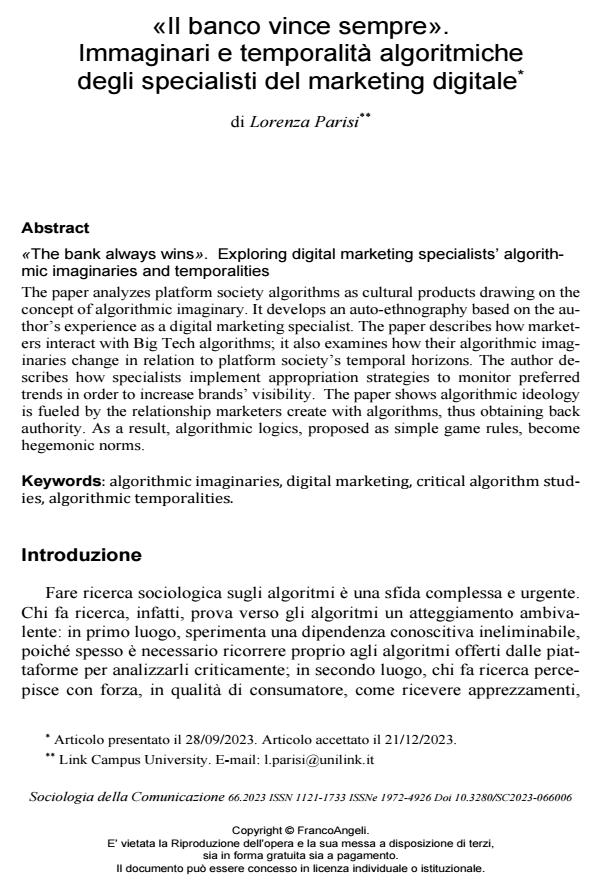
The paper analyzes platform society algorithms as cultural products drawing on the concept of algorithmic imaginary. It develops an auto-ethnography based on the author’s experience as a digital marketing specialist. The paper describes how marketers interact with Big Tech algorithms; it also examines how their algorithmic imaginaries change in relation to platform society’s temporal horizons. The author describes how specialists implement appropriation strategies to monitor preferred trends in order to increase brands’ visibility. The paper shows algorithmic ideology is fueled by the relationship marketers create with algorithms, thus obtaining back authority. As a result, algorithmic logics, proposed as simple game rules, become hegemonic norms.
Parole chiave:algorithmic imaginaries, digital marketing, critical algorithm studies, algorithmic temporalities
- Anderson L. (2006), Analytic autoethnography, in «Journal of contemporary ethnography», 35(4), pp. 373-395.
- Abel C., Pei L., Larson I., Olgado B. S., Turner B. (2022), «Tinder Will Know You Are A 6: Users’ Perceptions of Algorithms on Tinder», http://hdl.handle.net/10125/79685
- Airoldi M. (2021), Machine habitus: Toward a sociology of algorithms, John Wiley & Sons, Hoboken, New Jersey.
- Airoldi M., Gambetta D. (2018), Sul mito della neutralità algoritmica, in «The Lab’s Quartetly», 20, 4, pp.25-45.
- AlgorithmWatch (2020), Automating Society Report 2020, https://automatingsociety.algorithmwatch.org.
- Aragona B., Felaco C. (2020), Understanding algorithms. Spaces, expert communities, and cultural artifacts, in «Etnografia e ricerca qualitativa», 3/2020, pp. 423-439.
- Avezzù G. (2017), The Data Don’t Speak for Themselves: The Humanity of VOD Recommender Systems, in «Cinéma & Cie. Film and Media Studies Journal», 17(29).
- Beer D. (2009), Power through the algorithm? Participatory web cultures and the
- technological Unconscious, in «New Media & Society», 11(6), pp. 985-1002.
- Boccia Artieri G. B. (2014), La rete dopo l’overload informativo. La realtà dell’algoritmo da macchia cieca a bene comune, in «Paradoxa», 7(2), 100-113.
- - (2020), Fare Sociologia attraverso l’algoritmo: potere, cultura e agency, in «Sociologia Italiana», (15).
- Bonini T., Gandini A. (2020), The field as a black box: ethnographic research in the age of platforms, in «Social Media+Society», 6(4), DOI: 10.1177/205630512098
- Bonini T., Treré E. (2024), Algorithms of Resistance, MIT Press, Cambridge, MA.
- Bucher T. (2017), The algorithmic imaginary: exploring the ordinary affects of Facebook algorithms, in «Information, Communication & Society», 20(1), pp.30-44, DOI: 10.1080/1369118X.2016.1154086
- - 2018), If... then: Algorithmic power and politics. Oxford University Press, Oxford.
- Cardon D. (2015), À quoi rêvent les algorithms, Seuil, Paris; trad. it. (2016) Che cosa sognano gli algoritmi, Mondadori, Milano.
- Castells M., Fernandez-Ardevol M., Linchuan Qiu J., Sey A. (2006), Mobile communication and society. A global perspective, MIT Press, Cambridge, MA.
- Crawford K., (2021), The Atlas of AI, Yale University Press, New Haven, Connecticut.
- Cheney-Lippold J. (2017), We Are Data: Algorithms and the Making of Our Digital Selves, NYU Press, New York.
- Comunello F., Parisi L. (2020), Dating Apps, in K. Ross (Ed.) The International Encyclopedia of Gender, Media, and Communication, Wiley, Hoboken, NJ, pp. 1- 6.
- d’Eramo M. (2020), Dominio: la guerra invisibile dei potenti contro i sudditi, Feltrinelli, Milano.
- DeVito M. A., Gergle D., Birnholtz J. (2017), Algorithms ruin everything: # RIPTwitter, Folk Theories, and Resistance to Algorithmic Change in Social Media, In Proceedings of the 2017 CHI conference on human factors in computing systems (pp. 3163-3174).
- Ellis C., Adams T. E., Bochner A. P. (2011), Autoethnography: An overview, in «Forum: Qualitative Social Research», http://dx.doi.org/10.17169/fqs-12.1.1589.
- Eslami M., Rickman A., Vaccaro K., Aleyasen A., Vuong A., Karahalios K, Sandvig C. (2015), “I always assumed that I wasn’t really that close to [her]”. Reasoning about Invisible Algorithms in News Feeds, in «Proceedings of the 33rd annual ACM conference on human factors in computing systems», pp. 153-162.
- Eslami M., Karahalios K., Sandvig C., Vaccaro K., Rickman A., Hamilton K., Kirlik A. (2016), First I ‘like’ it, then I hide it: Folk theories of social feeds, in «Proceedings of the 2016 conference on human factors in computing systems» (ed CHI 16 Conference Committee), San Jose, CA, 7–12 May, pp.2371–2382. New York: ACM.
- Esposito E. (2022), Artificial communication: How algorithms produce social intelligence, MIT Press, Cambridge, MA.
- Fuchs C. (2017), Social media: A critical introduction, Sage, New York.
- Gershon I., (2010), The Breakup 2.0: Disconnecting over New Media, Cornell University Press, Ithaca, NY.
- Gillespie T. (2013), The relevance of algorithms, in T. Gillespie, P. Boczkowski, & K. Foot (Eds.), Media technologies: Essays on communication, materiality, and society, MIT Press, Cambridge, MA, pp. 167–194.
- - (2017), Algorithmically recognizable: Santorum’s Google problem, and Google’s Santorum problem, in «Information, Communication & Society», 20(1), 63-80, DOI: 10.1080/1369118X.2016.1199721
- Gillespie T., Seaver N. (2016), Critical algorithm studies: A reading list https://socialmediacollective.org/reading-lists/critical-algorithm-studies/.
- Google (2006), Ten Things Google Has Found to be True, www.google.com/corporate/tenthings.html (consultato a maggio 2006, oggi non più disponibile).
- Hall S. (1990), Encoding, decoding, in During S. (Ed.) (1999), The cultural studies reader, Routledge, London-New York, pp. 507-517.
- Heinze A., Fletcher G., Rashid T., Cruz, A. (2016), Digital and social media marketing, Routledge, New York.
- Klawitter E., Hargittai E. (2018), “It’s like learning a whole other language”: The role of algorithmic skills in the curation of creative goods, in «International Journal of Communication», 12, pp. 3490–3510.
- Kotler P., Kartajaya H. & Setiawan I. (2016), Marketing 4.0: moving from Traditional to Digital. John Wiley &, Hoboken, New Jersey.
- Lomborg S., & Kapsch P. H. (2020), Decoding algorithms, in «Media, Culture & Society», 42(5), 745-761.
- Mager A. (2014), Defining algorithmic ideology: Using ideology critique to scrutinize corporate search engines, in «tripleC: Communication, Capitalism & Critique», 12(1), pp. 28-39,
- Natale S. (2022), Macchine ingannevoli: Comunicazione, tecnologia, intelligenza artificiale, Einaudi, Torino.
- Nowotny H. (2021), IN AI WE TRUST: power, illusion and control of predictive algorithms, John Wiley & Sons, Hoboken, New Jersey.
- Parisi L., Comunello F. (2019), Dating in the time of “relational filter bubbles: exploring imaginaries, perceptions and tactics of Italian dating app users, in «The Communication Review», 23:1, pp. 66- 89, DOI: 10.1080/10714421.2019.1704111
- Parisi L., Parente G. A. (2020), Questioning the algorithmic transparency of location-based platforms, in «Journal of Sociocybernetics», 17 (1).
- Petre C., Duffy B. E., Hund E. (2019), “Gaming the system”: Platform paternalism and the politics of algorithmic visibility, in «Social Media + Society», 5(4),
- Proferes N. (2017), Information flow solipsism in an exploratory study of beliefs about Twitter, in «Social Media + Society», 3(1). DOI: 10.1177/20563051176984
- Pireddu M. (2017), Algoritmi. Il software culturale che regge le nostre vite, Luca Sossella Editore, Roma.
- Rader E., Gray R. (2015), Understanding user beliefs about algorithmic curation in the Facebook news feed, in «Proceedings of the 33rd annual ACM conference on human factors in computing systems», CHI ’15 (pp. 173–182), ACM Press.
- Risi E., Pronzato R. (2022), Algorithmic Prosumers, in Armano E., Briziarelli M., Risi E. (eds.), Digital Platforms and Algorithmic Subjectivities, University of Westminster Press, London, pp. 149-165.
- Sassatelli R. (2004), Consumo, cultura e società, il Mulino, Bologna.
- Seaver N. (2017), Algorithms as culture: Some tactics for the ethnography of algorithmic systems, in «Big Data & Society», 4(2),
- Shaw A. (2017), Encoding and decoding affordances: Stuart Hall and interactive media technologies, in «Media, culture & society», 39(4), pp. 592-602, DOI: 10.1177/0163443717692741
- Silverstone R., Hirsch E. (1994), Consuming technologies, Taylor & Francis, Milton Park, UK.
- Ytre-Arne B. Moe, H. (2021), Folk theories of algorithms: Understanding digital irritation, in «Media, culture & society», 43(5), pp. 807–824, DOI: 10.1177/01634437209723
- Van Dijck J., Poell T., De Waal M. (2018), The platform society: Public values in a connective world, Oxford University Press, Oxford.
- Zuboff S. (2019), The Age of Surveillance Capitalism: The Fight for a Human Future at the New Frontier of Power, Profile Books, London.
Lorenza Parisi, «Il banco vince sempre». Immaginari e temporalità algoritmiche degli specialisti del marketing digitale in "SOCIOLOGIA DELLA COMUNICAZIONE " 66/2023, pp 95-111, DOI: 10.3280/SC2023-066006