The genesis of semantics in Fichte’s late philosophy
Journal title RIVISTA DI STORIA DELLA FILOSOFIA
Author/s Matteo V. D'Alfonso
Publishing Year 2014 Issue 2014/4
Language Italian Pages 20 P. 763-782 File size 106 KB
DOI 10.3280/SF2014-004011
DOI is like a bar code for intellectual property: to have more infomation
click here
Below, you can see the article first page
If you want to buy this article in PDF format, you can do it, following the instructions to buy download credits
FrancoAngeli is member of Publishers International Linking Association, Inc (PILA), a not-for-profit association which run the CrossRef service enabling links to and from online scholarly content.
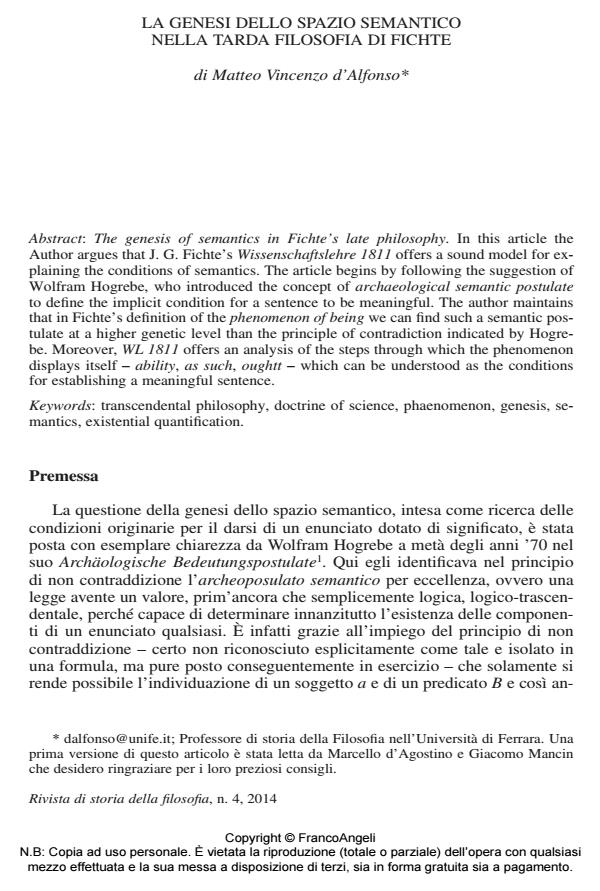
In this article the Author argues that J. G. Fichte’s Wissenschaftslehre 1811 offers a sound model for explaining the conditions of semantics. The article begins by following the suggestion of Wolfram Hogrebe, who introduced the concept of archaeological semantic postulate to define the implicit condition for a sentence to be meaningful. The author maintains that in Fichte’s definition of the phenomenon of being we can find such a semantic postulate at a higher genetic level than the principle of contradiction indicated by Hogrebe. Moreover, WL 1811 offers an analysis of the steps through which the phenomenon displays itself - ability, as such, oughtt - which can be understood as the conditions for establishing a meaningful sentence.
Keywords: Transcendental philosophy, doctrine of science, phaenomenon, genesis, semantics, existential quantification
- - d’Alfonso 2001: Matteo V. d’Alfonso, Die vielfältigen Gestalten des Phaenomens in der WL 1810, in: Der transzendental-philosophische Zugang zur Wahrheit – Beiträge aus der aktuellen Fichte-Forschung, Hrsg. Von Erich Fuchs, Marco Ivaldo, Giovanni Moretto Frommann-Holzboog, Stuttgart-Bad Cannstatt 2001, pp. 209-24.
- - d’Alfonso 2005: Id., Vom Wissen zur Weisheit. Fichtes Wissenschaftslehre 1811, Rodopi, Amsterdam-New York, 2005.
- - Fichte-Schelling 1986: Johann Gottlieb Fichte – Friedrich Wilhelm Joseph Schelling, Carteggio e scritti polemici, a cura di Francesco Moiso, Prismi, Napoli 1986.
- - Fichte 1999: Johann Gottlieb Fichte, Dottrina della scienza. Esposizione del 1811, a cura di Gaetano Rametta, Guerini, Milano 1999.
- - Fichte 2000: Id., Dottrina della scienza. Seconda esposizione del 1804, a cura di Matteo Vincenzo d’Alfonso, Guerini, Milano 1999.
- - Frege 1892: Gottlob Frege, Über Sinn und Bedeutung, in: «Zeitschrift für Philosophie und philosophische Kritik», 1892, pp. 25-50.
- - Furlani 2004: Simone Furlani, L’ultimo Fichte. Il sistema della Dottrina della scienza negli anni 1810-1814, Guerini, Milano 2004.
- - Hintikka 1973: Jaakko Hintikka, Logic, Language Games and Information. Kantian Themes in the Philosophy of Logic, Oxford University Press, Oxford 1973..
- - Hogrebe 1974: Wolfram Hogrebe, Kant und das Problem einer transzendentalen Semantik, Alber, Freiburg-München 1974; tr. it. Per una semantica trascendentale, con una postfazione di Giovanni Deriu, Officina, Roma 1977.
- - Hogrebe 1977: Id., Archäologische Bedeutungspostulate, Alber, Freiburg-München 1977.
- - Hogrebe 2012: Id., Predicazione e Genesi. La metafisica come euristica fondamentale a partire dai Weltalter di Schelling, in: Hogrebe/Gabriel, Predicazione e Genesi – L’assoluto e il mondo, Rosenberge e Sellier, Torino 2012.
- - Ivaldo 1987: Marco Ivaldo, I principi del sapere, Bibliopolis, Napoli 1987. .
- - Lauth 1999: Reinhard Lauth, Il sistema di Fichte nelle tarde lezioni berlinesi, in Fichte 1999, pp.11-50.
- - Pareyson 1976: Luigi Pareyson, Fichte. Il sistema della libertà, Mursia, Milano 1976.
- - Pareyson 1995: Id., Ontologia della libertà, a cura di Giuseppe Riconda e Gianni Vattimo, Einaudi, Torino 1995.
- - Rametta 1995: Gaetano Rametta, Le strutture speculative della Dottrina della scienza: il pensiero di J. G. Fichte negli anni 1801-1807, Pantograf, Genova 1995.
- - Rametta 1999: Id., Introduzione, in: Fichte 1999, pp. 53-88.
- - Taver 1999: Katja V. Taver. Johann Gottlieb Fichtes Wissenschaftslehre von 1810. Versuch einer Exegese, Rodopi, Amsterdam-Atlanta 1999. - Zöller 2001: Günter Zöller, Leben und Wissen: Der Stand der Wissenscahftslehre beim letzten Fichte, in: Der transzendentalphilosophische Zugang zur Wirklichkeit, Hrsg. Erich Fuchs, Frommann-Holzboog, Stuttgart-Bad Cannstatt 2001, pp. 307-330.
Matteo V. D'Alfonso, La genesi dello spazio semantico nella tarda filosofia di Fichte in "RIVISTA DI STORIA DELLA FILOSOFIA" 4/2014, pp 763-782, DOI: 10.3280/SF2014-004011