Medicina Antiaging: un approccio possibile?

Journal title SALUTE E SOCIETÀ
Author/s Filippo Ongaro
Publishing Year 2015 Issue 2016/1
Language Italian Pages 10 P. 154-163 File size 391 KB
DOI 10.3280/SES2016-001011
DOI is like a bar code for intellectual property: to have more infomation click here

Below, you can see the article first page

If you want to buy this article in PDF format, you can do it, following the instructions to buy download credits
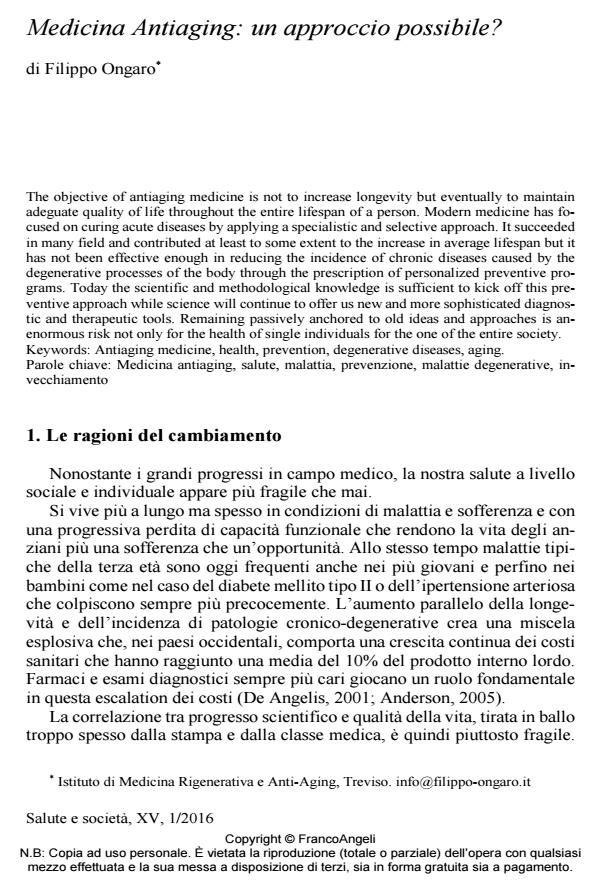
Article preview

FrancoAngeli is member of Publishers International Linking Association, Inc (PILA), a not-for-profit association which run the CrossRef service enabling links to and from online scholarly content.

The objective of antiaging medicine is not to increase longevity but eventually to maintain adeguate quality of life throughout the entire lifespan of a person. Modern medicine has focused on curing acute diseases by applying a specialistic and selective approach. It succeeded in many field and contributed at least to some extent to the increase in average lifespan but it has not been effective enough in reducing the incidence of chronic diseases caused by the degenerative processes of the body through the prescription of personalized preventive programs. Today the scientific and methodological knowledge is sufficient to kick off this preventive approach while science will continue to offer us new and more sophisticated diagnostic and therapeutic tools. Remaining passively anchored to old ideas and approaches is anenormous risk not only for the health of single individuals for the one of the entire society.

Keywords: Antiaging medicine, health, prevention, degenerative diseases, aging.

  1. Branch W.T. (2000). Is the therapeutic nature of the patient-physician relationship being undermined? Archives of Internal Medicine, 160: 2257-60. DOI: 10.1001/archinte.160.15.225
  2. Chiong W. (2001). Diagnosing and defining disease. Journal of the American Medical Association, 285(1): 89-90. DOI: 10.1001/jama.285.1.89-JMS0103-2-
  3. De Angelis C.D., Fontanarosa P.B., Flanagin A. (2001). Reporting financial conflicts of interest and relationships between investigators and research sponsors. Journal of the American Medical Association, 286(1): 89-91. DOI: 10.1001/jama.286.1.8
  4. Dubois R. (1987). The mirage of health. New York: Rutgers University Press
  5. Duris P., Gohau G. (1999). Storia della biologia. Torino: Giulio Einaudi Editore
  6. Fries J. (1980). Aging, natural death and the compression of morbidity. New England Journal of Medicine, 303: 130-5. DOI: 10.1056/NEJM19800717303030
  7. Grumbach K. (2003). Chronic illness, comorbidities and the need for medical generalism. The Annals of Family Medicine, 1(1): 4-7. DOI: 10.1370/afm.4
  8. Klatz R., Goldman R. (a cura di) (2003). The Science of Anti-Aging Medicine. Chicago: A4M Publications
  9. Liotta L.A., Kohn E.C., Petricoin E.F. (2001). Clinical proteomics: personalized molecular medicine. Journal of the American Medical Association, 286(18): 2211-14. DOI: 10.1001/jama.286.18.221
  10. OMS (1948). Preamble to the Constitution of the World Health Organization as adopted by the International Health Conference, New York, 19-22 June, 1946
  11. Rees J. (2002). Complex disease and the new clinical sciences. Science, 296: 689-701. DOI: 10.1126/science.296.5568.69
  12. Rose M.R. (1999). Can human aging be postponed? Scientific American, 281: 106-111. DOI: 10.1038/scientificamerican1299-10
  13. Rothenberg R., Becker K., Hart K., Wise K. (2007). Forever ageless: Advanced Edition. Santa Fe: California Healthspan Institute
  14. Tosato M., Zamboni V., Ferrini A., Cesari M. (2007). The aging process and potential interventions to extend life expectancy. Journal of Clinical Interventions in Aging, 2(3): 401-12
  15. Wagner C. (2001). Aging versus antiaging: geriatrics is in trouble while antiaging medicine takes off. The Futurist, 35(5): 8-9
  16. Aderem A. (2005). Systems biology: its practice and challenges. Cell , 121: 511-13. DOI: 10.1016/j.cell.2005.04.020AlbrechtG.L.,FitzpatrickR.,ScrimshawS.C.(acuradi)(2000).Thehandbookofsocialstudiesonhealth&Medicine.London:SagePublication
  17. Anderson G.F. (2005). Medicare and chronic conditions. New England Journal of Medicine, 353: 305-08. DOI: 10.1056/NEJMsb04413
  18. Bell J. (1998). The new genetics in clinical practice. British Medical Journal, 316(7131): 618-20. DOI: 10.1136/bmj.316.7131.61

Filippo Ongaro, Medicina Antiaging: un approccio possibile? in "SALUTE E SOCIETÀ" 1/2016, pp 154-163, DOI: 10.3280/SES2016-001011