Landscapes, Times and Geographies of Transition
Journal title CRIOS
Author/s Michelangelo Russo
Publishing Year 2025 Issue 2023/26
Language Italian Pages 14 P. 78-91 File size 810 KB
DOI 10.3280/CRIOS2023-026011
DOI is like a bar code for intellectual property: to have more infomation
click here
Below, you can see the article first page
If you want to buy this article in PDF format, you can do it, following the instructions to buy download credits
FrancoAngeli is member of Publishers International Linking Association, Inc (PILA), a not-for-profit association which run the CrossRef service enabling links to and from online scholarly content.
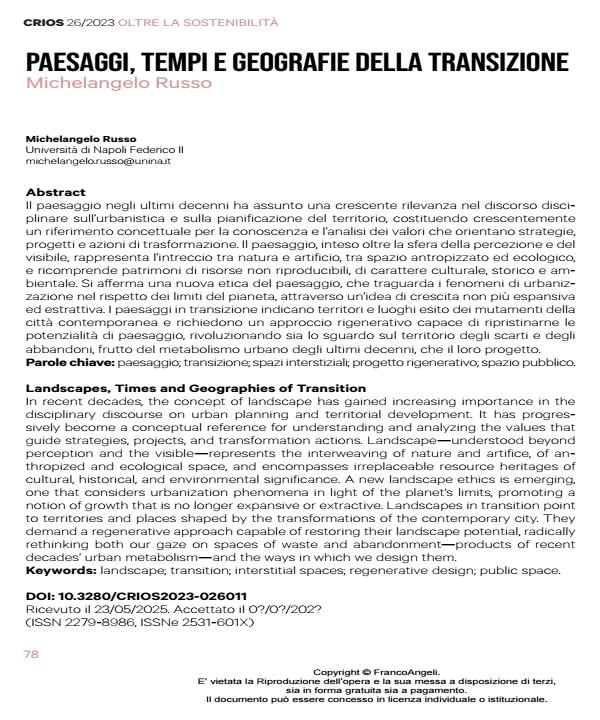
In recent decades, the concept of landscape has gained increasing importance in the disciplinary discourse on urban planning and territorial development. It has progressively become a conceptual reference for understanding and analyzing the values that guide strategies, projects, and transformation actions. Landscape—understood beyond perception and the visible—represents the interweaving of nature and artifice, of anthropized and ecological space, and encompasses irreplaceable resource heritages of cultural, historical, and environmental significance. A new landscape ethics is emerging, one that considers urbanization phenomena in light of the planet's limits, promoting a notion of growth that is no longer expansive or extractive. Landscapes in transition point to territories and places shaped by the transformations of the contemporary city. They demand a regenerative approach capable of restoring their landscape potential, radically rethinking both our gaze on spaces of waste and abandonment—products of recent decades’ urban metabolism—and the ways in which we design them.
Keywords: landscape; transition; interstitial spaces; regenerative design; public space.
- Amenta L., Russo M., Van Timmeren A. (2022). Regenerative Territories. Dimension of Circularity for Healthy Metabolism. GeoJournal Library 128.
- Bennett J. (2023). Materia vibrante. Un’ecologia politica delle cose. Palermo: Timeo.
- Berque A. (2022). Pensare il paesaggio. Milano: Mimesis.
- Berque A., Conan M., Donadieu P., Roger A. (2002). Mouvance: un lessico per il paesaggio. Il contributo francese. In Lotus Navigator, 5.
- Bianchetti C. (2003). Abitare la città contemporanea. Milano: Skira. Brenner N. (2014). Oltre la metropoli. L’urbanizzazione regionale in Italia. Milano: Guerini.
- Callon M. (1984). Some elements of a sociology of translation: domestication of the scallops and the fishermen of St Brieuc Bay. In The Sociological Review, 32(1).
- Corboz A. (1985). Il territorio come palinsesto. In Casabella.
- Forman R. T. T., Godron M. (1986). Landscape Ecology. New York: John Wiley & Sons. Fors H., Busse Nielsen A., Konijnendijk van den Bosch C., Jansson
- M. (2017). From borders to ecotones Privatepublic comanagement of urban woodland edges bordering private housing. Urban Forestry & Urban Greening, 30.
- Ingold T. (2021). The Perception of the Environment: Essays on Livelihood, Dwelling and Skill. London: Routledge.
- Jakob M. (2009). Il paesaggio. Bologna: Il Mulino. Jakob M. (2018). What is Landscape? Trento: List Lab.
- Jullien F. (2014). Contro la comparazione. Lo “scarto” e il “tra”: un altro accesso all’alterità. Milano: Mimesis.
- Keil R. (2018). Suburban Planet: Making the World Urban from the Outside. CambridgeMilford: Polity.
- Latour B. (1999). Pandora’s Hope: Essays on the Reality of Science Studies. Cambridge: Harvard University Press.
- Law J. (2004). After Method: Mess in Social Science Research. London: Routledge.
- Magnaghi A. (2012). Il territorio come bene comune. Firenze: University Press.
- Magnaghi A. (2020). Il principio territoriale. Torino: Bollati Boringhieri.
- Mininni M. V. (2011). Approssimazioni alla città. Roma: Donzelli Editore.
- Raffestin C. (2005). Dalla nostalgia del territorio al desiderio di paesaggio. Firenze: Alinea.
- Russo M. (2014). Urbanistica per una diversa crescita. Roma: Donzelli.
- Russo M. (2018). Ripensare la resilienza, progettare la città attraverso il suo metabolismo. In Technè, 15.
- Russo M. (2019). Il palinsesto del paesaggio come progetto del territorio. In Marino B. G. (a cura di), Across the Stones. Immagini, paesaggi e memoria. La conoscenza interdisciplinare per la conservazione e la valorizzazione della Fortezza del Girifalco. Roma: Editori Paparo, 101107.
- Russo M. (2022). Topologia della crisi: ripensare la prossimità. In Giammetti M. (a cura di), Stare nella distanza. Sguardi sul dopo coronavirus. Siracusa: LetteraVentidue.
- Russo M., Attademo A., Formato E., Garzilli F. (2022). Transitional Landscape. Macerata: Quodlibet.
- Russo M., Van Timmeren A. (2022). Dimensions of Circularity for Healthy Metabolisms and Spaces. In Amenta L., Russo M., Van Timmeren A. (a cura di), Regenerative Territories. Springer.
- Sampieri A. (2008). Nel paesaggio. Il progetto per la città negli ultimi venti anni. Roma: Donzelli Editore.
- Secchi B. (1989). Progetto di suolo. In Secchi B. Un progetto per l’urbanistica. Torino: Einaudi.
- Secchi B. (1993). Un commento ai risultati dello studio. In Boeri S., Lanzani A., Marini E. (a cura di), Il territorio che cambia. Ambienti, paesaggi e immagini della regione milanese. Milano: Abitare.
- Soja E. W. (2011a). Regional Urbanization and the End of the Metropolis Era. In Bridge G., Watson S. (a cura di), New Companion to the City. Chichester: WileyBlackwell, 679689.
- Soja E. W. (2011b). The New Mobilities Paradigm. In Environment and Planning A, 38.
- Tosco C. (2007). Il paesaggio come storia. Bologna: Il Mulino.
- Zetti I., Rossi M. (2022). InBetween Spaces in the Expanding City: Their Role in Designing New Urban Centralities. In Alberti F., Amer M., Mahgoub Y., Gallo P., Galderisi A., Strauss E. (a cura di), Urban and Transit Planning. Towards Liveable Communities: Urban Places and Design Spaces. Advances in Science, Technology & Innovation
Michelangelo Russo, Paesaggi, tempi e geografie della transizione in "CRIOS" 26/2023, pp 78-91, DOI: 10.3280/CRIOS2023-026011