The media representation of gender-based violence online: how Italian newspapers narrate cyber-VAWG.
Journal title SOCIOLOGIA DELLA COMUNICAZIONE
Author/s Valentina Cremonesini
Publishing Year 2026 Issue 2025/70
Language Italian Pages 20 P. 19-38 File size 735 KB
DOI 10.3280/SC2025-070002
DOI is like a bar code for intellectual property: to have more infomation
click here
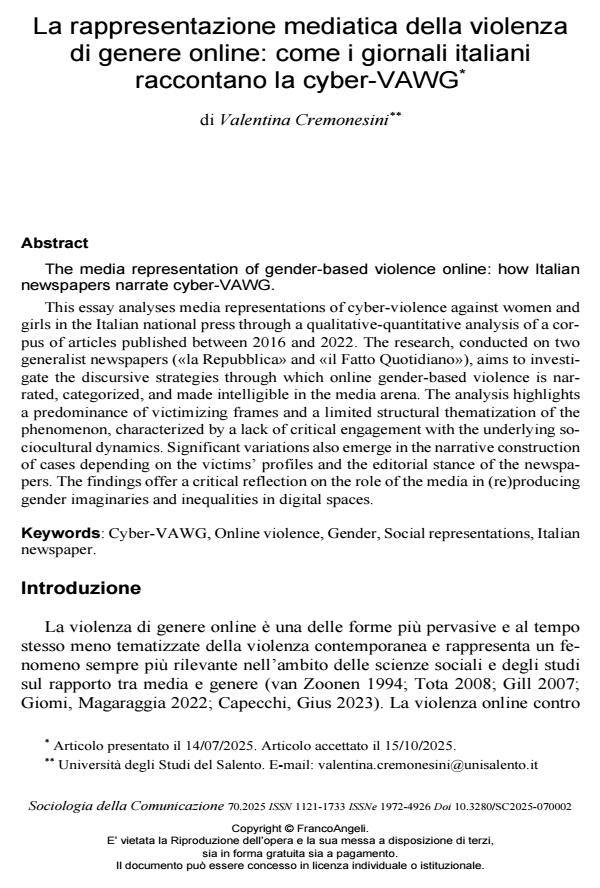
Below, you can see the article first page
If you want to buy this article in PDF format, you can do it, following the instructions to buy download credits
FrancoAngeli is member of Publishers International Linking Association, Inc (PILA), a not-for-profit association which run the CrossRef service enabling links to and from online scholarly content.
This essay analyses media representations of cyber-violence against women and girls in the Italian national press through a qualitative-quantitative analysis of a corpus of articles published between 2016 and 2022. The research, conducted on two generalist newspapers («la Repubblica» and «il Fatto Quotidiano»), aims to investigate the discursive strategies through which online gender-based violence is narrated, categorized, and made intelligible in the media arena. The analysis highlights a predominance of victimizing frames and a limited structural thematization of the phenomenon, characterized by a lack of critical engagement with the underlying sociocultural dynamics. Significant variations also emerge in the narrative construction of cases depending on the victims’ profiles and the editorial stance of the newspapers. The findings offer a critical reflection on the role of the media in (re)producing gender imaginaries and inequalities in digital spaces.
Keywords: Cyber-VAWG, Online violence, Gender, Social representations, Italian newspaper.
- Bourdieu P. (1998), La domination masculine, Editions du Seuils, Paris.
- Capecchi S., Gius C. (2023), Gender-based Violence Representation in the Italian Media: Reviewing Changes in Public Narrations from Femicide to “Revenge Pornography”, in «Italian Journal of Sociology of Education», 15(1), pp.81-100. DOI: 10.14658/PUPJ-IJSE-2023-1-4
- Citron D.K. (2014), Hate Crimes in Cyberspace, Harvard University Press, Cambridge.
- Connell R.W., Messerschmidt J.W. (2005), Hegemonic Masculinity: Rethinking the Concept, Gender and Society, in «Gender & Society», vol. 19/6, pp. 829-859. DOI: 10.1177/0891243205278639
- Cremonesini V. (2025), “In questa imprevedibile tragedia ci sono solo vittime”. La violenza di genere estrema nella rappresentazione giornalistica, in «Sociologia» Anno LIX n. 2, pp.4-9.
- Colonna I., Cremonesini V., Cristante S. (2020), “Anime fragile e storie criminali. Il racconto giornalistico pugliese sui femminicidi” in Lalli P. 2020, (a cura di), L’amore non uccide Femminicidio e discorso pubblico: cronaca, tribunali, politiche, il Mulino, Bologna, pp. 155-184.
- EIGE (2017), Cyber violence against women and girls, https://eige.europa.eu/publications/.
- EIGE (2019), Understanding intimate partner violence in the EU: the role of data, https://eige.europa.eu/publications/understanding-intimate-partner-violence-eu-role-data.
- European Parliament (2021), Combating gender-based violence: Cyber violence, https://www.europarl.europa.eu/RegData/etudes/STUD/2021/662621/EPRS_STU(2021)662621_EN.pdf.
- Europol (2023), Internet Organised Crime Threat Assessment (IOCTA); https://www.europol.europa.eu/publication-events/main-reports/internet-organised-crime-threat-assessment-iocta-2023.
- Fansher A.K., Randa R. (2019), Risky social media behaviors and the potential for victimization: A descriptive look at college students victimized by someone met online, in «Violence and Gender», n. 6(2), pp.115–123.
- Flynn A., Powell A., Hindes S. (2024), An intersectional analysis of technology-facilitated abuse: Prevalence, experiences and impacts of victimization, in «The British Journal of Criminology», 64(3), pp. 600-619.
- Gill R. (2007), Gender and the Media, Cambridge Polity Press, Cambridge.
- Giomi E., Magaraggia S. (2022), Male and Female Violence in Popular Media, Bloomsbury Publishing, London.
- Gius C., Lalli P. (2014), “I loved her so much, but I killed her”: Romantic love as a representational frame for intimate partner femicide in three Italian newspapers, in «ESSACHESS – Journal for Communication Studies», 7(2), pp. 53-75. PID: https://nbn-resolving.org/urn:nbn:de:0168-ssoar-413509
- Gius C. (2023), (Re)thinking gender in cyber-violence: Insights from awareness-raising campaigns on online violence against women and girls in Italy, in «Media Education», 14(2), pp. 95–106.
- Henry N., Powell A. (2018), Technology-Facilitated Sexual Violence: A Literature Review of Empirical Research, in «Trauma Violence Abuse», n. 19/2, pp. 195–208. DOI: 10.1177/1524838016650189
- Henry N., McGlynn C., Flynn A., Johnson K., Powell A, Scott A. J. (2020), Image-based sexual Abuse. A Study on the Causes and Consequences of Non-consensual Nude or Sexual Imagery, Routledge, London.
- ISTAT, La dimensione digitale della violenza di genere, Rapporto novembre 2023.
- Jane E.A. (2017), Misogyny online: A short (and brutish) history, Sage, London.
- - (2018), Systemic misogyny exposed: Translating Rapeglish from the Manosphere with a Random Rape Threat Generator, in «International Journal of Cultural Studies», vol. 21(6), pp. 661–680. DOI: 10.1177/1367877917734042
- - (2020), Online abuse and harassment, in «The International Encyclopedia of Gender, Media, and Communication», pp. 1-16.
- Lalli P. (2020), (a cura di), L’amore non uccide Femminicidio e discorso pubblico: cronaca, tribunali, politiche, il Mulino, Bologna.
- Lombardo E., Meier P. (2014), The Symbolic Representation of Gender, A Discursive Approach, Routledge, London.
- Medeiros de Araújo A.V., Vieira do Bonfim C., Bushatsky M., Alencar Furtado B.M. (2022). Technology-facilitated sexual violence: A review of virtual violence against women. Research, in « Research, Society and Development», 11(2), pp. 1-17.
- Pinelli E., Zanchi C. (2021), Gender-based violence in Italian local newspapers: how argument structure constructions can diminish Perpetrator’s responsibility, in Anesa P., Fragonara A. (eds.), Discourse Processes between Reason and Emotion, Palgrave Macmillan, Basingstoke, pp. 117-143. DOI: 10.1007/978-3-030-70091-1_6
- Powell A., Henry N. (2017), Sexual violence in a digital age, Palgrave Macmillan, London.
- Powell A., Stratton G., Cameron R. (2018), Digital criminology: Crime and justice in digital society, Routledge, New York.
- Rose G. (2016), Visual Methodologies: An Introduction to Researching with Visual materials, Sage, London.
- Save the Children (2022), La violenza di genere tra giornali e tribunali, https://ww
- w.savethechildren.it/blog-notizie/la-violenza-di-genere-tra-giornali-e-tribunali.
- Sorrentino C. (2025), Il giornalismo ha un futuro. Perché sta cambiando, come va ripensato, il Mulino, Bologna.
- Tota A. (2008), Gender e media. Verso un immaginario sostenibile, Meltemi, Milano.
- van Zoonen L. (1994), Feminist Media Studies, Sage, London.
Valentina Cremonesini, La rappresentazione mediatica della violenza di genere online: come i giornali italiani raccontano la cyber-VAWG in "SOCIOLOGIA DELLA COMUNICAZIONE " 70/2025, pp 19-38, DOI: 10.3280/SC2025-070002