A review of Performance Indicators adopted by the Italian Regulation Authority (ARERA) to target water losses in supply networks

Journal title ECONOMIA PUBBLICA
Author/s Sergio Garbarino
Publishing Year 2026 Issue 2025/3
Language Italian Pages 23 P. 427-449 File size 205 KB
DOI 10.3280/EP2025-003005
DOI is like a bar code for intellectual property: to have more infomation click here

Below, you can see the article first page

If you want to buy this article in PDF format, you can do it, following the instructions to buy download credits
Article preview

FrancoAngeli is member of Publishers International Linking Association, Inc (PILA), a not-for-profit association which run the CrossRef service enabling links to and from online scholarly content.

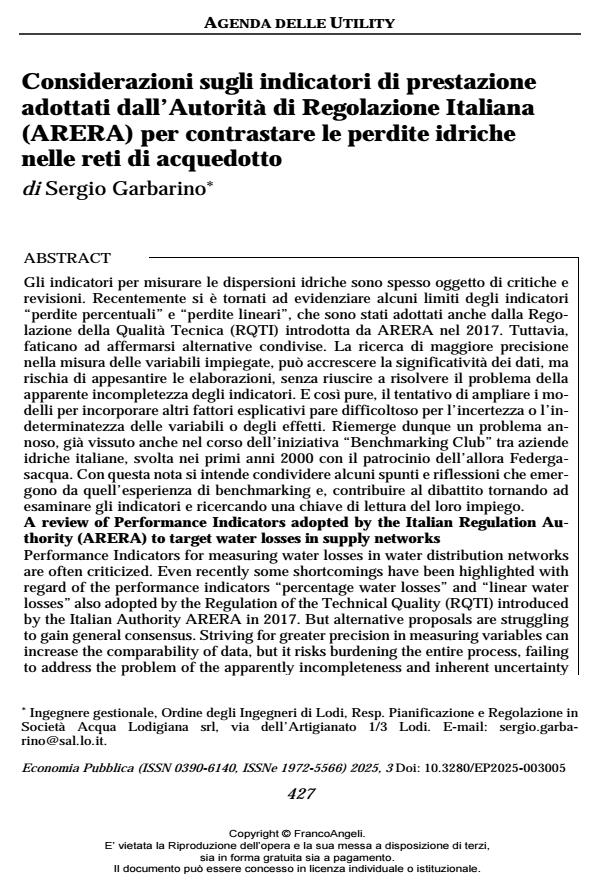
Performance Indicators for measuring water losses in water distribution networks are often criticized. Even recently some shortcomings have been highlighted with regard of the performance indicators “percentage water losses” and “linear water losses” also adopted by the Regulation of the Technical Quality (RQTI) introduced by the Italian Authority ARERA in 2017. But alternative proposals are struggling to gain general consensus. Striving for greater precision in measuring variables can increase the comparability of data, but it risks burdening the entire process, failing to address the problem of the apparently incompleteness and inherent uncertainty of the indicators. The same goes when seeking to improve the models, accounting for more explanatory factors, due to the uncertainty or indeterminacy. This is a longstanding problem, that we also encountered during the “Benchmarking Club” initiative among Italian water companies, conducted in the early 2000s under the patronage of the Federgasacqua. This paper aims to share some insights from that benchmarking experience, in an attempt to contribute to the ongoing debate through a deeper understanding about these indicators and their use.

Keywords: water losses, benchmarking, uncertainty, regulation

Jel codes: L95, L51, Q25

  1. ARERA (2017). Delibera 917/2017/R/idr Regolazione della qualità tecnica del servizio idrico integrato ovvero di ciascuno dei singoli servizi che lo compongono (RQTI) – Allegato A. https://www.arera.it/attieprovvedimenti/dettaglio/17/91717.
  2. ARERA (2025). Relazione annuale – Stato dei servizi 2024 https://www.arera.it/chisiamo/relazioneannuale/relazioneannuale2024.
  3. AWWA (2019). Water Loss Control Committee Report 2019. Key Performance Indicators for NonRevenue Water https://www.awwa.org/resource/waterlosscontrol/.
  4. BDEW (2025). Trinkwasser: Wasserverluste https://www.bdew.de/service/datenundgrafiken/trinkwasserwasserverluste/.
  5. Commissione Europea (2015). EU Reference document Good Practices on Leakage Management WFD CIS WG PoM Main Report.
  6. EurEau (2023). Proposal for a Harmonized Leakage Reporting Index https://www.eureau.org /news /838eureau newsletter october2023.
  7. Giustolisi O., Ciliberti F.G., Mazzolani G., Laforgia D. (2024). Effectiveness of water loss performance indicators for asset management. DOI: 10.1080/28375807.2024.2406746
  8. INE (2024). Estadística Sobre el Suministro y Saneamiento del Agua. Ano 2022. ISTAT (2024). Ancora elevate le perdite idriche della rete di distribuzione https://www.istat.it/it/files/2024/03/ReportGMAAnno2024.pdf.
  9. Lambert A.O. et al. (2001). International Report: Water losses management and techniques. Water Supply, 1 September 2002; 2 (4): 120.
  10. Lambert and McKenzie (2002). Paper presented at the International Water Association Conference “Leakage Management: A Practical Approach”. In Lemesos, Cyprus, disponible per cortesia dell’Ing. Marco Fantozzi http://www.studio marcofantozzi.it /iwacyprusnov2002lambert&mckenziepaper.pdf.
  11. OFB (2025). Panorama national des services publiques d’eau e d’assainissement https://www.services.eaufrance.fr/rapportnational.
  12. PE e CE (2020). Direttiva (UE) 2020/2184 del Parlamento Europeo e del Consiglio del 16 dicembre 2020 concernente la qualità delle acque destinate al consumo umano (refusione).
  13. Sanna F., Garbarino S. (2004). La gestione delle perdite idriche: la situazione in Italia. Atti del convegno “Verso una gestione più efficace delle perdite nei sistemi idrici secondo l’approccio dell’International Water Association (IWA)”.
  14. WAREG (2023). Key Performance Indicators Frameworks in Wareg Member Countries https://www.wareg.org/articles/insightsfromthewaregkpisreport2023/.

Sergio Garbarino, Considerazioni sugli indicatori di prestazione adottati dall’Autorità di Regolazione Italiana (ARERA) per contrastare le perdite idriche nelle reti di acquedotto in "ECONOMIA PUBBLICA " 3/2025, pp 427-449, DOI: 10.3280/EP2025-003005