Italian validation and psychometric properties of the Short Self-Regulation Questionnaire (SSRQ): self-regulation in adolescence
Journal title CADMO
Author/s Gabriella Ferrara, Francesca Pedone, Carlo Rossi
Publishing Year 2026 Issue 2025/2
Language Italian Pages 21 P. 93-113 File size 246 KB
DOI 10.3280/CAD2025-002006
DOI is like a bar code for intellectual property: to have more infomation
click here
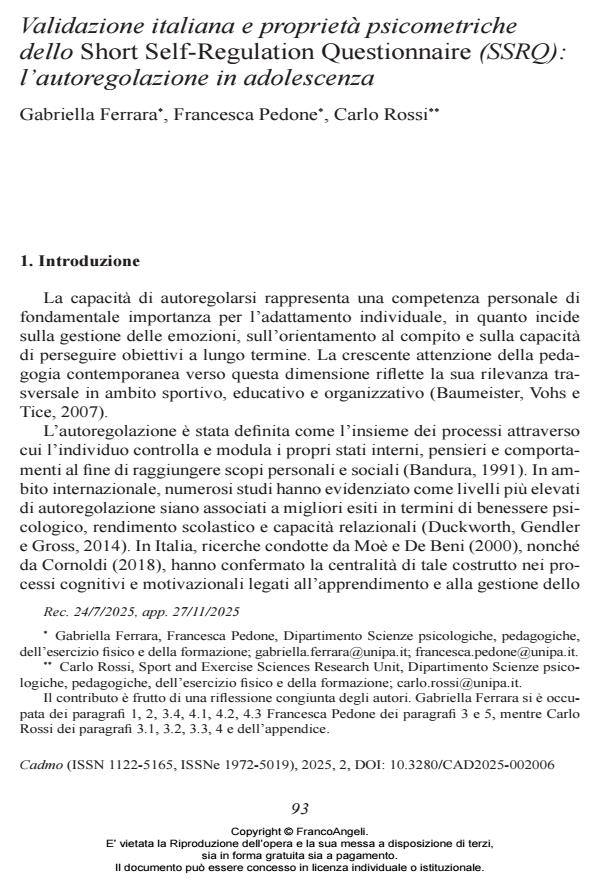
Below, you can see the article first page
If you want to buy this article in PDF format, you can do it, following the instructions to buy download credits
FrancoAngeli is member of Publishers International Linking Association, Inc (PILA), a not-for-profit association which run the CrossRef service enabling links to and from online scholarly content.
Self-regulation is a key transversal competence in educational, athletic, and social contexts. This study aims to validate the Italian version of the Short Self-Regulation Questionnaire (SSRQ), a widely used international tool for measuring self-regulation. The questionnaire was translated and cul-turally adapted using a back-translation procedure. It was administered onli-ne to a sample of 1,133 Italian young adults aged 17-22. Exploratory factor analysis confirmed a structure consistent with previous literature, although some cultural differences emerged in the factor organization. The SSRQ de-monstrated good internal reliability and content validity. Findings support the use of the SSRQ in Italian educational and training settings, providing a reliable and efficient tool to assess self-regulation skills during late adole-scence and early adulthood.
Keywords: self-regulation; self-regulation questionnaire, validation, self-assessment. questionnaire.
- Bandura, A. (1991), “Social cognitive theory of self-regulation”, Organizational Be-havior and Human Decision Processes, 50 (2), pp. 248-287.
- Baumeister, R. F., Vohs, K. D., Tice, D. M. (2007), “The strength model of self-control”, Current Directions in Psychological Science, 16 (6), pp. 351-355.
- Brislin, R. W. (1970), “Back-translation for cross-cultural research”, Journal of Cross-cultural Psychology, 1 (3), pp. 185-216.
- Brown, J. M., Miller, W. R., Lawendowski, L. A. (1999), The self-regulation que-stionnaire. In VandeCreek, L., Jackson, T. L. (Eds), Innovations in clinical practi-ce: A source book. Sarasota: Professional Resource Press/Professional Resource Exchange, vol. 17, pp. 281-292.
- Caprara, G. V., Barbaranelli, C., Pastorelli, C., Bandura, A., Zimbardo, P. G. (2000), “Prosocial foundations of children’s academic achievement”, Psychological Science, 11 (4), pp. 302-306.
- Carey, K. B., Neal, D. J., Collins, S. E. (2004), “A psychometric analysis of the self-regulation questionnaire”, Addictive Behaviors, 29 (2), pp. 253-260.
- Carver, C. S. (2005), “Impulse and constraint: Perspectives from personality psy-chology, convergence with theory in other areas, and potential for integration”, Personality and Social Psychology Review, 9 (4), pp. 312-333.
- Cornoldi, C., Meneghetti, C., Moè, A., Zamperlin, C. (2018), Processi cognitivi, motivazione e apprendimento. Bologna: il Mulino.
- De Beni, R., Moè, A. (2000), Motivazione e apprendimento. Bologna: il Mulino.
- De Beni, R., Moè, A., Rizzato, R. (2003), “Lo studio all’università: caratteristiche e modalità di promozione”, Giornale Italiano di Psicologia, 30 (2), pp. 277-298. De Lillo, A. (2007), Analisi multivariata per le scienze sociali. San Bonico: Pearson Italia Spa.
- De Vincenzo, C. (2024), “Promuovere l’autoregolazione dell’apprendimento per ridurre le diseguaglianze educative”, Lifelong Lifewide Learning, 21 (44), pp. 339-348.
- Duckworth, A. L., Gendler, T. S., Gross, J. J. (2014), “Self-control in school-age children”, Educational Psychologist, 49 (3), pp. 199-217.
- Gross, J. J., John, O. P. (2003), “Individual differences in two emotion regulation processes: implications for affect, relationships, and well-being”, Journal of Per-sonality and Social Psychology, 85 (2), pp. 348-362.
- Housman, D. K. (2017), “The importance of emotional competence and self-regu-lation from birth: A case for the evidence-based emotional cognitive social early learning approach”, International Journal of Child Care and Education Policy, 11 (1), pp. 13-31.
- Jonker, L., Elferink-Gemser, M. T., Visscher, C. (2010), “Differences in self-regu-latory skills among talented athletes: The significance of competitive level and type of sport”, Journal of Sports Sciences, 28 (8), pp. 901-908.
- Mega, C., Meneghetti, C., De Beni, R. (2008), “Strategie di autoregolazione ed emo-zioni legate allo studio: un intervento per la promozione delle abilità di studio con gruppi di studenti universitari”, Psicologia Clinica dello Sviluppo, 12 (1), pp. 167-160.
- Moilanen, K. L., Rasmussen, K. E., Padilla-Walker, L. M. (2015), “Bidirectional associations between self-regulation and parenting styles in early adolescence”, Journal of Research on Adolescence, 25 (2), pp. 246-262.
- Moilanen, K. L., Shaw, D. S., Fitzpatrick, A. (2010), “Self-regulation in early ado-lescence: Relations with mother-son relationship quality and maternal regulatory support and antagonism”, Journal of Youth and Adolescence, 39 (11), pp. 1357-1367.
- Tangney, J. P., Boone, A. L., Baumeister, R. F. (2018), High self-control predicts good adjustment, less pathology, better grades, and interpersonal success. In Self-regulation and self-control. London: Routledge, pp. 173-212.
- Thompson, R. A. (1994), “Emotion regulation: A theme in search of definition”, Mo-nographs of the Society for Research in Child Development, 59, 2/3, pp. 25-52.
- Vohs, K. D., Baumeister, R. F. (2004), “Understanding self-regulation”, Handbook of Self-regulation, 19, pp. 1-9.
- Zimmerman, B. J. (2000), Attaining self-regulation: A social cognitive perspecti-ve. In Handbook of self-regulation. San Diego: Elsevier, pp. 13-39, https://doi. org/10.1016/B978-0-12-109890-2.X5027-6
Gabriella Ferrara, Francesca Pedone, Carlo Rossi, Validazione italiana e proprietà psicometriche dello Short Self-Regulation Questionnaire (SSRQ): l’autoregolazione in adolescenza in "CADMO" 2/2025, pp 93-113, DOI: 10.3280/CAD2025-002006