Science Diplomacy and Cultural Heritage in Conflict Areas: The Case of Sudan
Journal title WELFARE E ERGONOMIA
Author/s Sabrina Greco, Maurizio Lazzari
Publishing Year 2026 Issue 2026/1 Suppl.
Language Italian Pages 16 P. 61-76 File size 127 KB
DOI 10.3280/WE2026-001-S1004
DOI is like a bar code for intellectual property: to have more infomation
click here
Below, you can see the article first page
If you want to buy this article in PDF format, you can do it, following the instructions to buy download credits
FrancoAngeli is member of Publishers International Linking Association, Inc (PILA), a not-for-profit association which run the CrossRef service enabling links to and from online scholarly content.
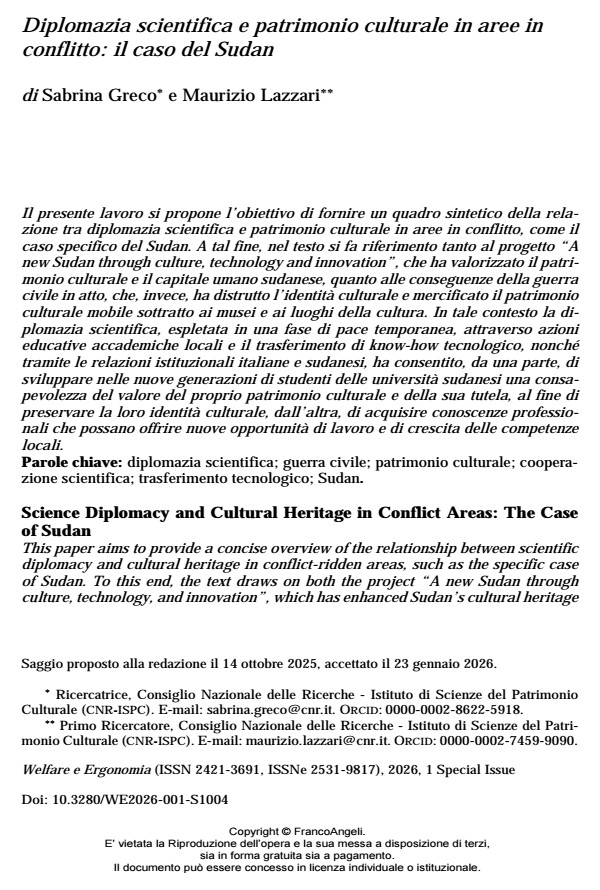
This paper aims to provide a concise overview of the relationship between scientific diplomacy and cultural heritage in conflict-ridden areas, such as the specific case of Sudan. To this end, the text draws on both the project “A new Sudan through culture, technology, and innovation”, which has enhanced Sudan’s cultural heritage and human capital, and the consequences of the ongoing civil war, which has destroyed cultural identity and commodified the movable cultural heritage removed from museums and cultural sites. In this context, scientific diplomacy, carried out during a period of temporary peace, through local academic educational initiatives and the transfer of technological know-how, as well as through Italian and Sudanese institutional relations, has enabled, on the one hand, the development of awareness among new generations of Sudanese university students of the value of their cultural heritage and its protection, in order to preserve their cultural identity, and on the other, the acquisition of professional knowledge that could offer new job opportunities and the growth of local skills.
Keywords: science diplomacy: civil war; cultural heritage; scientific cooperation; technology transfer; Sudan.
Sabrina Greco, Maurizio Lazzari, Diplomazia scientifica e patrimonio culturale in aree in conflitto: il caso del Sudan in "WELFARE E ERGONOMIA" 1 Suppl./2026, pp 61-76, DOI: 10.3280/WE2026-001-S1004