La salute mentale delle persone di seconda generazione nei podcast degli Italiani razzializzati
Titolo Rivista MONDI MIGRANTI
Autori/Curatori Clelia D’Apice, Annavittoria Sarli
Anno di pubblicazione 2025 Fascicolo 2025/3
Lingua Italiano Numero pagine 23 P. 143-165 Dimensione file 201 KB
DOI 10.3280/MM2025-003007
Il DOI è il codice a barre della proprietà intellettuale: per saperne di più
clicca qui
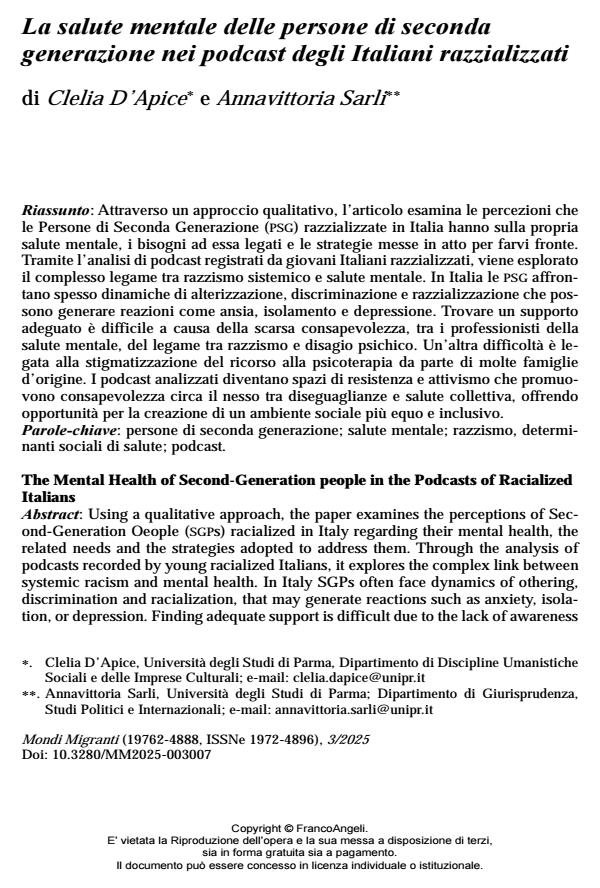
Qui sotto puoi vedere in anteprima la prima pagina di questo articolo.
Se questo articolo ti interessa, lo puoi acquistare (e scaricare in formato pdf) seguendo le facili indicazioni per acquistare il download credit. Acquista Download Credits per scaricare questo Articolo in formato PDF
FrancoAngeli è membro della Publishers International Linking Association, Inc (PILA), associazione indipendente e non profit per facilitare (attraverso i servizi tecnologici implementati da CrossRef.org) l’accesso degli studiosi ai contenuti digitali nelle pubblicazioni professionali e scientifiche.
Using a qualitative approach, the paper examines the perceptions of Second-Generation Oeople (SGPs) racialized in Italy regarding their mental health, the related needs and the strategies adopted to address them. Through the analysis of podcasts recorded by young racialized Italians, it explores the complex link between systemic racism and mental health. In Italy SGPs often face dynamics of othering, discrimination and racialization, that may generate reactions such as anxiety, isolation, or depression. Finding adequate support is difficult due to the lack of awareness among mental health professionals of the connection between racism and psychological distress. A further problem is the stigmatization of psychotherapy by many families of origin. The analyzed podcasts become spaces for resistance and activism, that promote awareness of the impact of inequalities on collective health, offering opportunities to create a more inclusive and equitable social environment.
Parole chiave:persone di seconda generazione; salute mentale; razzismo, determinanti sociali di salute; podcast.
- Fonagy P. e Campbell C. (2021). Future directions in personality pathology. Current opinion in psychology, 37: 145-151;
- Finozzi A. (2023). Podcasting the Italian postcolonial: An analysis of black coffee and S/confini. The Italianist, 43, 1: 156-173; DOI: 10.1080/02614340.2022.2167326/
- Abubakar I., Gram L., Lasoye S., Achiume E.T., Becares L., Bola G.K., Dhairyawan R., Lasco G., McKee M., Paradies Y., Sabharwal N.S., Selvarajah S., Shannon G. e Devakumar D. (2022). Confronting the consequences of racism, xenophobia, and discrimination on health and health-care systems. Lancet (London, England), 400, 10368: 2137-2146; DOI: 10.1016/S0140-6736(22)01989-4/
- Ambrosini M. (2005). Sociologia delle migrazioni. il Mulino: Bologna.
- Bemme D. e Kirmayer L.J. (2020). Global Mental Health: Interdisciplinary challenges for a field in motion. Transcultural psychiatry, 57, 1: 3-18; DOI: 10.1177/1363461519898035/
- Beneduce R. (2004). Le frontiere dell’identità e della memoria. Etnopsichiatria e migrazioni in un mondo creolo. Milano: FrancoAngeli (collana Scienza e Salute); http://www.francoangeli.it/Ricerca/Scheda_Libro.asp?CodiceLibro=1370.5 ./
- Berry J.W. e Sabatier C. (2010). Acculturation, discrimination, and adaptation among second generation immigrant youth in Montreal and Paris. International Journal of Intercultural Relations: IJIR, 34, 3: 191-207;
- Bova R. e Lusardi R. (2022). The mental health of migrant people: Western medical systems facing a globalized society. Sociology Compass, 16, 10;
- Brance K., Chatzimpyros V. e Bentall R.P. (2024). Social identity, mental health and the experience of migration. The British journal of Social Psychology, 10.1111/bjso.12745;
- Braun V. e Clarke V. (2006). Using thematic analysis in psychology. Qualitative Research in Psychology, 3, 2: 77-101;
- Campion J., Bhugra D., Bailey S. e Marmot M. (2013). Inequality and mental disorders: opportunities for action. Lancet (London, England), 382, 9888: 183-184; DOI: 10.1016/S0140-6736(13)61411-7/
- Chimienti M., Bloch A., Ossipow L. e de Wenden C.W. (2019). Second generation from refugee backgrounds in Europe. Comparative Migration Studies, 7, 1;
- Clò C. (2012). Hip pop Italian style: The postcolonial imagination of second-generation authors in Italy. In: Lombardi-Diop C. e Romeo C., a cura di, Postcolonial Italy: Challenging National Homogeneity (pp. 275-291). New York: Palgrave Macmillan.
- Daskalakis N.P., Xu C., Bader H.N., Chatzinakos C., Weber P., Makotkine I., Lehrner A., Bierer L.M., Binder E.B. e Yehuda R. (2021). Intergenerational trauma is associated with expression alterations in glucocorticoid- and immune-related genes. Neuropsychopharmacology: Official Publication of the American College of Neuropsychopharmacology, 46, 4: 763-773;
- De Piccoli N. (2014). Salute e qualità della vita nella società del benessere. Roma: Carrocci Editore.
- Devakumar D., Selvarajah S., Abubakar I., Kim S.S., McKee M., Sabharwal N.S., Saini A., Shannon G., White A.I.R. e Achiume E.T. (2022). Racism, xenophobia, discrimination, and the determination of health. Lancet (London, England), 400, 10368: 2097-2108; DOI: 10.1016/S0140-6736(22)01972-9/
- de Vroome T., Martinovic B. e Verkuyten M. (2014). The integration paradox: level of education and immigrants’ attitudes towards natives and the host society. Cultural diversity & ethnic minority psychology, 20, 2: 166-175;
- Ergin D.A. (2021). The effects of perceived discrimination, social support and ethnic identity on mental health of immigrant adolescents. Scandinavian journal of child and adolescent psychiatry and psychology, 9, 1: 127-136;
- Espinosa A. (2021). Discrimination, self-esteem, and mental health across ethnic groups of second-generation immigrant adolescents. Journal of Racial and Ethnic Health Disparities, 8, 6: 1539-1550;
- Frisina A. e Kyeremeh S.A. (2022). Music and words against racism: a qualitative study with racialized artists in Italy. Ethnic and Racial Studies, 45, 15: 2913-2933; DOI: 10.1080/01419870.2022.2046841/
- Galderisi S., Heinz A., Kastrup M., Beezhold J. e Sartorius N. (2017). A proposed new definition of mental health. Psychiatria polska, 51, 3: 407-411; DOI: 10.12740/PP/74145/
- Giuliani G. (2018). Race, Nation and Gender in Modern Italy. New York: Palgrave Macmillan.
- Heath A.F., Rothon C. e Kilpi E. (2008). The second generation in Western Europe: Education, unemployment, and occupational attainment. Annual Review of Sociology, 34: 211-235;
- Hurtado A., Gurin P. e Peng T. (1994). Social identities -- A framework for studying the adaptations of immigrants and ethnics: The adaptations of Mexicans in the United States. Social Problems, 41, 1: 129-151;
- Ince-Beqo G. e Ambrosini M. (2022). Reimagining the homeland: diasporic belonging among Turkish and Kurdish second generations in Italy. International Review of Sociology, 32, 3: 483-500; DOI: 10.1080/03906701.2022.2121118/
- Johnson J.G., Smailes E.M., Cohen P., Brown J. e Bernstein D.P. (2000). Associations between four types of childhood neglect and personality disorder symptoms during adolescence and early adulthood: findings of a community-based longitudinal study. Journal of Personality Disorders, 14, 2: 171-187;
- Kerr I.B., Dent-Brown K. e Parry G.D. (2007). Psychotherapy and mental health teams. International Review of Psychiatry (Abingdon, England), 19, 1: 63-80; DOI: 10.1080/09540260601109380/
- Loi E., Andriuolo G., LA Boria P., Battaglia S., Vezzoli M. e Fazzi E. (2022). Psychiatric emergencies in migrant adolescents. Minerva Pediatrics; DOI: 10.23736/S2724-5276.22.06635-6/
- Manwell L.A., Barbic S.P., Roberts K., Durisko Z., Lee C., Ware E. e McKenzie K. (2015). What is mental health? Evidence towards a new definition from a mixed methods multidisciplinary international survey. BMJ Open, 5, 6: e007079;
- Margari L., Pinto F., Lafortezza M. E., Lecce P.A., Craig F., Grattagliano I., Zagaria G. e Margari F. (2013). Mental health in migrant schoolchildren in Italy: teacher-reported behavior and emotional problems. Neuropsychiatric disease and treatment, 9: 231-241;
- Marmot M. (2016). La salute disuguale. La sfida di un mondo ingiusto. Roma: Il pensiero scientifico Editore.
- Miles R. (1989). Racism. London: Routledge.
- Murji K. e Solomos J., a cura di (2006). Racialization: Studies in Theory and Practice. Oxford & New York: Oxford University Press.
- Padilla A.M. (2006). Bicultural Social Development. Hispanic Journal of Behavioral Sciences, 28, 4: 467-497; DOI: 10.1177/0739986306294255.
- Patel V., Belkin G.S., Chockalingam A., Cooper J., Saxena S. e Unützer J. (2013). Grand challenges: integrating mental health services into priority health care platforms. PLoS Medicine, 10, 5, e1001448;
- Phelan J.C. e Link B.G. (2015). Is racism a fundamental cause of inequalities in health? Annual Review of Sociology, 41, 1: 311-330;
- Pesarini A. e Tintori G. (2020). Mixed Identities in Italy: A Country in Denial. In: Rocha Z.L. e Aspinall P.J., The Palgrave International Handbook of Mixed Racial and Ethnic Classification (pp. 349-365). Cham: Palgrave Macmillan; DOI: 10.1007/978-3-030-22874-3_19/
- Pickett K.E. e Wilkinson R.G. (2010). Inequality: an underacknowledged source of mental illness and distress. The British journal of Psychiatry: the Journal of Mental Science, 197, 6: 426-428;
- Pignon B., Amad A., Pelissolo A., Fovet T., Thomas P., Vaiva G., Roelandt J.L., Benradia I., Rolland B. e Geoffroy P.A. (2018). Increased prevalence of anxiety disorders in third-generation migrants in comparison to natives and to first-generation migrants. Journal of Psychiatric Research, 102: 38-43;
- Portes A., Fernández-Kelly P. e Haller W. (2005). Segmented assimilation on the ground: The new second generation in early adulthood. Ethnic and Racial Studies, 28, 6: 1000-1040; DOI: 10.1080/01419870500224117/
- Pruccoli J., La Tempa A., Francia V., Gualandi P., Malaspina E., Moscano F., Rossi F., Sacrato L., Rucci P. e Parmeggiani A. (2022). Anorexia nervosa among first- and second-generation immigrant children and adolescents in Italy: treatment and clinical outcomes. Rivista di Psichiatria, 57, 2: 80-87; DOI: 10.1708/3790.37739/
- Richardson E.T. (2020). Epidemic illusions. Cambridge MA: The MIT Press.
- Sarli A. e Phillimore J. (2022). The intercultural competence of second-generation individuals: knowledge gaps and steps forward, International Journal of Intercultural Relations, Volume 88, 2022, Pages 11-21, ISSN 0147-1767,
- Sarli A. (2023). From being othered to promoting the value of otherness: pride and price of intercultural dialogue among migrant immediate descendants in Italy. Identities, 31, 4: 466-486; DOI: 10.1080/1070289X.2023.2223056/
- Scarabello S., de Witte M. (2019). Afroeuropean modes of self-making: Afro-Dutch and Afro-Italian projects compared. Open Cultural Studies, 3, 1: 317-331;
- Schaeffer M. e Kas J. (2023). The Integration Paradox: A Review and Meta-Analysis of the Complex Relationship Between Integration and Reports of Discrimination. International Migration Review, 0, 0; DOI: 10.1177/01979183231170809/
- Schiavone G.F. (2022). La strumentale difesa delle identità nazionali è l’anticammera del razzismo. Altreconomia, nov 22, 253. ISBN: 9788865164747.
- Sue D.W., Neville H.A. e Smith L. (2024). Racism in counseling and psychotherapy: Illuminate and disarm. American Psychologist, 79, 4: 593-605;
- Swiatek L. (2018). The Podcast as an Intimate Bridging Medium. In: Llinares D., Fox N., Berry R., eds., Podcasting. London: Palgrave Macmillan, Cham; DOI: 10.1007/978-3-319-90056-8_9/
- Szaflarski M. e Bauldry S. (2019). The Effects of Perceived Discrimination on Immigrant and Refugee Physical and Mental Health. Advances in Medical Sociology, 19: 173-204; DOI: 10.1108/S1057-629020190000019009/
- Triulzi A. (2006). Displacing the Colonial Event: Hybrid Memories of Postcolonial Italy. Colonial and Postcolonial Italy. Ed. Fabrizio De Donno and Neelam Srivastava. Spec. issue of Interventions, 8, 3/2006: 430-443.
- Verkuyten M. (2016). The integration paradox: Empiric evidence from the Netherlands. The American Behavioral Scientist, 60, 5-6: 583-596; DOI: 10.1177/0002764216632838/
- Voglino G., Gualano M.R., Lo Moro G., Forghieri P., Caprioli M., Elhadidy H.S. M.A., Bert F. e Siliquini R. (2022). Mental health and discrimination among migrants from Africa: An Italian cross-sectional study. Journal of Community Psychology, 50, 1: 601-619;
- WHO. (2014). Social Determinants of mental Health; https://www.who.int/ publications/i/item/9789241506809 (ultimo accesso 23/09/24).
- WHO. (1948). Constitution of the World Health Organization; http://www.who.int/governance/eb/who_constitution_en.pdf (ultimo accesso 23/09/24).
- Wilkinson R.D. e Pickett K. (2009). The spirit level: Why more equal societies almost always do better. Bloomsbury: Allen Lane/Penguin Group UK.
Clelia D’Apice, Annavittoria Sarli, La salute mentale delle persone di seconda generazione nei podcast degli Italiani razzializzati in "MONDI MIGRANTI" 3/2025, pp 143-165, DOI: 10.3280/MM2025-003007