L’idea estetica di "chiarezza estensiva" e la sua genesi nella filosofia Wolffiana
Titolo Rivista RIVISTA DI STORIA DELLA FILOSOFIA
Autori/Curatori Alessandro Nannini
Anno di pubblicazione 2014 Fascicolo 2014/3
Lingua Italiano Numero pagine 22 P. 421-442 Dimensione file 82 KB
DOI 10.3280/SF2014-003002
Il DOI è il codice a barre della proprietà intellettuale: per saperne di più
clicca qui
Qui sotto puoi vedere in anteprima la prima pagina di questo articolo.
Se questo articolo ti interessa, lo puoi acquistare (e scaricare in formato pdf) seguendo le facili indicazioni per acquistare il download credit. Acquista Download Credits per scaricare questo Articolo in formato PDF
FrancoAngeli è membro della Publishers International Linking Association, Inc (PILA), associazione indipendente e non profit per facilitare (attraverso i servizi tecnologici implementati da CrossRef.org) l’accesso degli studiosi ai contenuti digitali nelle pubblicazioni professionali e scientifiche.
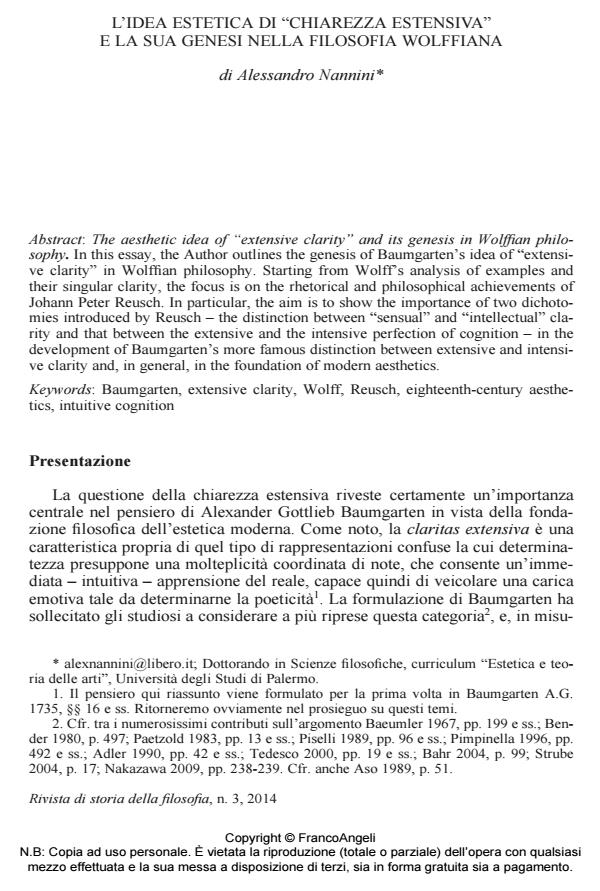
In this essay, the Author outlines the genesis of Baumgarten’s idea of "extensive clarity" in Wolffian philosophy. Starting from Wolff’s analysis of examples and their singular clarity, the focus is on the rhetorical and philosophical achievements of Johann Peter Reusch. In particular, the aim is to show the importance of two dichotomies introduced by Reusch - the distinction between "sensual" and "intellectual" clarity and that between the extensive and the intensive perfection of cognition - in the development of Baumgarten’s more famous distinction between extensive and intensive clarity and, in general, in the foundation of modern aesthetics.
Parole chiave:Baumgarten, extensive clarity, Wolff, Reusch, eighteenth-century aesthetics, intuitive cognition
- - Adler 1990: Hans Adler, Die Prägnanz des Dunklen. Gnoseologie, Ästhetik, Geschichtsphilosophie bei Johann Gottfried Herder, Meiner, Hamburg 1990.
- - Adler 1998a: Hans Adler, Prägnanz – Eine Denkfigur des 18. Jahrhunderts, in Karl Menges (Hrsg.), Literatur und Geschichte. Festschrift für Wulf Koepke zum 70. Geburtstag, Editions Rodopi, Amsterdam-Atlanta 1998, pp. 15-34.
- - Adler 1998b: Hans Adler, Fundus Animae – der Grund der Seele: Zur Gnoseologie des Dunkeln in der Aufklärung, «Deutsche Vierteljahrsschrift für Literaturwissenschaft und Geistesgeschichte», LXII (1998), pp. 197–220.
- - Aichele 2008: Alexander Aichele, Wahrheit – Gewißheit – Wirklichkeit. Die systematische Ausrichtung von A.G. Baumgartens Philosophie, «Aufklärung», XX (2008), pp. 13-36.
- - Amoroso 2000: Leonardo Amoroso, Ratio & aesthetica. La nascita dell’estetica e la filosofia moderna, ETS, Pisa 2000.
- - [Arnauld, Nicole] 1662: [Antoine Arnauld, Pierre Nicole], La logique ou l’art de penser, Charles Savreux, Paris 1662.
- - Aso 1989: Ken Aso et al. (Hrsg.), Onomasticon philosophicum latinoteutonicum et teutonicolatinum, Typographeo Philosophico, Tokiensi 1989.
- - Baeumler 1967: Alfred Baeumler, Das Irrationalitätsproblem in der Ästhetik und Logik des 18. Jahrhunderts bis zur Kritik der Urteilskraft (1923), Wissenschaftliche Buchgesellschaft, Darmstadt 1967.
- - Bahr 2004: Petra Bahr, Darstellung des Undarstellbaren: Religionstheoretische Studien zum Darstellungsbegriff bei A.G. Baumgarten und I. Kant, Siebeck, Tübingen 2004.
- - Baumgarten A.G. 1735: Alexander Gottlieb Baumgarten (auctor); Nathanael Baumgarten (respondens), Meditationes philosophicae de nonnullis ad poema pertinentibus, Grunert, Halae Magdeburgicae 1735 (nuova ed. it. a cura di Pietro Pimpinella e Salvatore Tedesco, Riflessioni sulla poesia, Aesthetica, Palermo 1999).
- - Baumgarten A.G. 1739: Alexander Gottlieb Baumgarten, Metaphysica, Hemmerde, Halae Magdeburgicae 1739.
- - Baumgarten A.G. 1740: Alexander Gottlieb Baumgarten, Ethica philosophica, Hemmerde, Halae Magdeburgicae 1740.
- - [Baumgarten A.G.] 1741: [Alexander Gottlieb Baumgarten], Philosophische Brieffe von Aletheophilus, [s. n.], Frankfurth und Leipzig 1741.
- - Baumgarten A.G. 1743: Alexander Gottlieb Baumgarten, Metaphysica, Hemmerde, Halae Magdeburgicae 17432.
- - Baumgarten A.G. 1750-1758: Alexander Gottlieb Baumgarten, Aesthetica, Kleyb, Traiecti cis Viadrum 1750-1758 (ed. it. a cura di S. Tedesco, L’Estetica, Aesthetica, Palermo 2000).
- - Baumgarten A.G. 1761: Alexander Gottlieb Baumgarten, Acroasis logica in Christianum L.B. de Wolff, Hemmerde, Halae Magdeburgicae 1761.
- - Baumgarten S.J. 1738: Siegmund Jacob Baumgarten, Unterricht vom rechtmäßigen Verhalten eines Christen, oder Theologische Moral, Johann Andreas Bauer, Halle im Magdeburgischen 1738.
- - Beiser 2010: Frederick C. Beiser, German Aesthetic Rationalism from Leibniz to Lessing, Oxford University Press, Oxford 2010.
- - Bender 1980: Wolfgang Bender, Rhetorische Tradition und Ästhetik im 18. Jahrhundert, «Zeitschrift für deutsche Philologie», IC (1980), pp. 481-506. - Bilfinger 1725: Georg Bernhard Bilfinger, Dilucidationes philosophicæ de Deo, anima humana, mundo et generalibus rerum affectionibus, Cotta, Tubingæ 1725.
- - Buchenau 2004: Stefanie Buchenau, The Art of Invention and the Invention of Art. Logic, Rhetoric and Aesthetics in the Early German Enlightenment, PhD thesis, Yale-Lyon 2004.
- - Buchenau 2008: Stefanie Buchenau, Die Sprache der Sinnlichkeit. Baumgartens poetische Begründung der Ästhetik in den Meditationes philosophicae, «Aufklärung», XX (2008), pp. 151-173.
- - Buchenau 2009: Stefanie Buchenau, Die Einbindung von Poetik und Ästhetik in die Logik der Aufklärung, in Astrid Bauereisen (Hrsg.), Kunst und Wissen: Beziehungen zwischen Ästhetik und Erkenntnistheorie im 18. und 19. Jahrhundert, Königshausen & Neumann, Würzburg 2009, pp. 71-84.
- - Buchenau 2013: Stefanie Buchenau, The Founding of Aesthetics in the German Enlightenment: The Art of Invention and the Invention of Art, Cambridge University Press, Cambridge 2013.
- - Buddeus 1715: Johann Franz Buddeus, Commentatio theologica de eo, quod in theologia pulchrum est, Müller, Ienae 1715.
- - Campe 2005: Rüdiger Campe, Der Effekt der Form. Baumgartens Ästhetik am Rande der Metaphysik, in Eva Horn et al. (Hrsg.), Literatur als Philosophie – Philosophie als Literatur, Fink, München 2005, pp. 17-34.
- - Crousaz 1715: Jean-Pierre de Crousaz, Traité du beau, L’Honoré, Amsterdam 1715.
- - Wolff 1734: Christian Wolff, Psychologia rationalis, Renger, Francofurti et Lipsiæ 1734.
- - Wolff 1736: Christian Wolff, Theologia naturalis. Pars prior, Renger, Francofurti et Lipsiæ 1736.
- - Décultot 2010: Élisabeth Décultot, Die Schattenseiten der Seele: Zu Johann Georg Sulzers Theorie der dunklen Vorstellungen, in Hans Adler, Rainer Godel (Hrsg.), Formen des Nichtwissens der Aufklärung, Fink, Paderborn 2010, pp. 263-278.
- - Descartes 1904: René Descartes, Principes. Traduction française, in OEuvres de Descartes, publiées par Charles Adam et Paul Tannery, Cerf, Paris 1904, vol. IX-2.
- - École 1986: Jean École, Du rôle de l’entendement intuitif dans la conception wolffienne de la connaissance, «Archiv für Geschichte der Philosophie», LXVIII (1986), 3, pp. 280-291.
- - Favaretti Camposampiero 2009: Matteo Favaretti Camposampiero, Conoscenza simbolica. Pensiero e linguaggio in Wolff e nella prima età moderna, Olms, Hildesheim-Zürich-New York 2009.
- - Ferraris 1994: Maurizio Ferraris, Analogon rationis, in Maurizio Ferraris, Pietro Kobau, Analogon rationis. La fondazione dell’estetica filosofica, Librerie CUEM, Milano 1994.
- - Frackowiak 1994: Ute Frackowiak, Der Gute Geschmack. Studien zur Entwicklung des Geschmacksbegriffs, Fink, München 1994.
- - Gabriel 2008: Gottfried Gabriel, Baumgartens Begriff der perceptio praegnans und seine systematische Bedeutung, «Aufklärung», XX (2008), pp. 61-71.
- - Galilei 1842: Galileo Galilei, Opere complete. Tomo primo, Società Editrice Fiorentina, Firenze 1842.
- - Harth 1978: Dietrich Harth, Christian Wolffs Begründung des Exempel- und Fabelgebrauches im Rahmen der Praktischen Philosophie, «Deutsche Vierteljahrsschrift für Literaturwissenschaft und Geistesgeschichte», LII (1978), pp. 43-62.
- - Krueger 1980: Joachim Krueger, Christian Wolff und die Ästhetik, Humboldt-Universität zu Berlin, Berlin 1980.
- - Leibniz 1999a: Gottfried Wilhelm von Leibniz, Meditationes de cognitione, veritate, et ideis, in Gottfried Wilhelm von Leibniz, Sämtliche Schriften und Briefe. Sechste Reihe: Philosophische Schriften, Bd. 4: 1677-Juni 1690, Teil A. Bearbeiter: Heinrich Schepers, Martin Schneider, Gerhard Biller, Ursula Franke, Herma Kliege-Biller, Akad.-Verl., Berlin 1999. - Leibniz 1999b: Gottfried Wilhelm von Leibniz, Discours de métaphysique, in Gottfried Wilhelm von Leibniz, Sämtliche Schriften und Briefe. Sechste Reihe: Philosophische Schriften, Bd. 4: 1677-Juni 1690, Teil B. Bearbeiter: Heinrich Schepers, Martin Schneider, Gerhard Biller, Ursula Franke, Herma Kliege-Biller, Akad.-Verl., Berlin 1999.
- - Malinowski-Charles 2005: Syliane Malinowski-Charles, Baumgarten, l’intuition sensible et la connaissance vive, in M. Modica et al. (a cura di), Visione, percezione e cognizione nell’età dell’Illuminismo. Filosofia, estetica, materialismo, Bibliopolis, Napoli 2005, pp. 37-79.
- - Mei 2007: Manuela Mei, Sensazioni e Ideæ sensuales nella filosofia di Christian Wolff, in Ferdinando L. Marcolungo (a cura di), Christian Wolff tra psicologia empirica e psicologia razionale: atti del seminario internazionale di studi, Verona, 13-14 maggio 2005, Olms, Hildesheim 2007, pp. 95-112.
- - Mei 2011: Manuela Mei, L’intuizione dei pensieri. La pars inferior animae nella psicologia cognitiva di Christian Wolff, Aracne, Roma 2011.
- - Meier 1763: Georg Friedrich Meier, Alexander Gottlieb Baumgartens Leben, Hemmerde, Halle im Magdeburgischen 1763.
- - Meuthen 1994: Erich Meuthen, Selbstüberredung: Rhetorik und Roman im 18. Jahrhundert, Rombach, Freiburg 1994.
- - Moretto 1995: Antonio Moretto, La rilevanza matematica della discussione sui concetti di continuo e di funzione nella filosofia tedesca dell’età dell’Illuminismo. Grandezza estensiva, continua e intensiva in Leibniz, Wolff, Baumgarten e Kant, «Fenomenologia e società», XVIII (1995), pp. 109-153.
- - Nakazawa 2009: Takeshi Nakazawa, Kants Begriff der Sinnlichkeit. Seine Unterscheidung zwischen apriorischen und aposteriorischen Elementen der sinnlichen Erkenntnis und deren lateinischen Vorlagen, frommann-holzboog Verlag, Stuttgart-Bad Cannstatt 2009.
- - Nannini 2013: Alessandro Nannini, Da Baumgarten a Baumgarten. Siegmund Jacob Baumgarten e la fondazione dell’estetica moderna, in Luigi Russo (a cura di), Premio Nuova Estetica della Società Italiana d’Estetica, Aesthetica, Palermo 2013, pp. 67-90.
- - Oberhausen 2002: Michael Oberhausen, Dunkle Vorstellungen als Thema von Kants Anthropologie und A.G. Baumgartens Psychologie, «Aufklärung», XIV (2002), pp. 123-146.
- - Otabe 2012: Tanehisa Otabe, Der “Grund der Seele”. Über Entstehung und Verlauf eines ästhetischen Diskurses im 18. Jahrhundert, in Julian Nida-Rümelin et al. (Hrsg.),
- Welt der Gründe. XXII. Deutscher Kongress für Philosophie, Felix Meiner, Hamburg 2012, pp. 763-774.
- - Paetzold 1983: Heinz Paetzold, Ästhetik des deutschen Idealismus, Steiner, Wiesbaden 1983.
- - Paetzold 1995: Heinz Paetzold, Rhetorik-Kritik und Theorie der Künste in der philosophischen Ästhetik von Baumgarten bis Kant, in Gérard Raulet (Hrsg.), Von der Rhetorik zur Ästhetik. Studien zur Entstehung der modernen Ästhetik im 18. Jahrhundert, Centre de recherche PHILIA, Rennes 1992, pp. 9-40.
- - Pimpinella 1996: Pietro Pimpinella, “Sensus” e “sensatio” in Wolff e Baumgarten, in Massimo L. Bianchi (a cura di), Sensus – Sensatio. VIII Colloquio Internazionale. Roma, 6-8 gennaio 1995, Olschki, Firenze 1996.
- - Pimpinella 2001: Pietro Pimpinella, Cognitio intuitiva bei Wolff und Baumgarten, in Michael Oberhausen et al. (Hrsg.), Vernunftkritik und Aufklärung. Studien zur Philosophie Kants und seines Jahrhunderts, frommann-holzboog Verlag, Stuttgart-Bad Cannstatt 2001, pp. 265-294. - Pimpinella 2007: Pietro Pimpinella, Symbolische Erkenntnis bei Wolff, in Jürgen Stolzenberg et al. (Hrsg.), Christian Wolff und die europäische Aufklärung/2, Olms, Hildesheim 2007, pp. 33-54.
- - Pimpinella 2008: Pietro Pimpinella, Veritas aesthetica. Erkenntnis des Individuellen und mögliche Welten, «Aufklärung», XX (2008), pp. 37-60.
- - Piselli 1989: Francesco Piselli, Perfectio phaenomenon. Baumgarten e l’estetica, [Solari], Milano 1989.
- - Reusch 1724: Johann Peter Reusch (praeses); Wilhelm Levin Sever (respondens), Disputationem philosophicam de eo, quod pulchrum est in eloquentia eiusque potissimum rationibus traditurus specimen rhetoricae rationalis, Litteris Mullerianis, Ienae 1724.
- - Reusch 1728: Johann Peter Reusch, Via ad perfectiones intellectus compendiaria, Ioan. Adolph. Boetium, Isenaci 1728.
- - Reusch 1734: Johann Peter Reusch, Systema logicum antiquiorum atque recentiorum item propria dogmata et hypotheses exhibens, Cröker, Ienae 1734.
- Reusch 1735: Johann Peter Reusch, Systema metaphysicum antiquiorum atque recentiorum item propria dogmata et hypotheses exhibens, Cröker, Ienae 1735.
- - Saccon 1996: Alessandra Saccon, Fondo dell’anima, fondo del cuore, «Rivista di estetica», I, n. s., 1996, n. 3, pp. 195-202.
- - Schrader 1991: Monika Schrader, Sprache und Lebenswelt. Fabeltheorien des 18. Jahrhunderts, Olms, Hildesheim-Zürich-New York 1991.
- - Schwaiger 1995: Clemens Schwaiger, Das Problem des Glücks im Denken Christian Wolffs, frommann-holzboog Verlag, Stuttgart-Bad Cannstatt 1995.
- - Wolff 1739: Christian Wolff, Philosophia practica universalis. Pars posterior, Renger, Francofurti et Lipsiæ, 1739.
- - Schwaiger 2000: Clemens Schwaiger, Ein “missing link” auf dem Weg der Ethik von Wolff zu Kant: Zur Quellen- und Wirkungsgeschichte der praktischen Philosophie von Alexander Gottlieb Baumgarten, «Jahrbuch für Recht und Ethik», VIII (2000), pp. 247-261.
- - Schwaiger 2001a: Clemens Schwaiger, Vollkommenheit als Moralprinzip bei Wolff, Baumgarten und Kant, in Michael Oberhausen et al. (Hrsg.), Vernunftkritik und Aufklärung. Studien zur Philosophie Kants und seines Jahrhunderts, frommann-holzboog Verlag, Stuttgart-Bad Cannstatt 2001, pp. 317-328.
- - Schwaiger 2001b: Clemens Schwaiger, Symbolische und intuitive Erkenntnis bei Leibniz, Wolff und Baumgarten, in Hans Poser et al. (Hrsg.), VII. Internationaler Leibniz-Kongreß Berlin, 10.-14. September 2001. Nihil sine ratione. Mensch, Natur und Technik im Wirken von G. W. Leibniz. Vorträge 3. Teil, Gottfried-Wilhelm-Leibniz Ges., Hannover 2001, pp. 1178-1184.
- - Schwaiger 2011: Clemens Schwaiger, Alexander Gottlieb Baumgarten – Ein intellektuelles Porträt. Studien zur Metaphysik und Ethik von Kants Leitautor, frommannholzboog Verlag, Stuttgart-Bad Cannstatt 2011.
- - Strube 2004: Werner Strube, Die Entstehung der Ästhetik als einer wissenschaftlichen Disziplin, «Scientia poetica», VIII (2004), pp. 1-30.
- - Tedesco 1997: Salvatore Tedesco, Breitinger e l’estetica dell’Illuminismo tedesco, Aesthetica, Palermo 1997.
- - Tedesco 2000: Salvatore Tedesco, L’estetica di Baumgarten, Aesthetica, Palermo 2000.
- - Tedesco 2008: Salvatore Tedesco, L’oscuro in Wolff, Baumgarten e Herder, in Piero Giordanetti, Giambattista Gori, Maddalena Mazzocut-Mis (a cura di), Il secolo dei lumi e l’oscuro, Mimesis, Milano 2008, pp. 225-239.
- - Torra-Mattenklott 2002: Caroline Torra-Mattenklott, Metaphorologie der Rührung. Ästhetische Theorie und Mechanik im 18. Jahrhundert, Fink, München 2002. - Torra-Mattenklott 2005: Caroline Torra-Mattenklott, The Fable as Figure: Christian Wolff’s Geometric Fable Theory and Its Creative Reception by Lessing and Herder, «Science in Context», XVIII (2005), 4, pp. 525-552.
- - Ungeheuer 1983: Gerold Ungeheuer, Sprache und symbolische Erkenntnis bei Wolff, in Werner Schneiders (Hrsg.), Christian Wolff. 1679-1754 (1983), Meiner, Hamburg 19862, pp. 89-112.
- - Van Peursen 1989: Cornelis-Anthonie van Peursen, Cognitio symbolica in the philosophy of Christian Wolff, «Il cannocchiale», (1989), 2-3, pp. 61-76.
- - Weber 1998: Claude Weber, «Naturae mentis nostrae nobis conscii ad exempla attendentes ». Zur Funktion des Exempels in Christian Wolffs Schriften zur Metaphysik, in Frank Grunert, Friedrich Vollhardt (Hrsg.), Aufklärung als praktische Philosophie.
- Werner Schneiders zum 65. Geburtstag, Niemeyer, Tübingen 1998, pp. 99-126.
- - Wolff 1710: Christian Wolff, Anfangs-Gründe der Bau-Kunst, in Christian Wolff, Anfangs-Gründe aller mathematischen Wissenschaften, vol. IV, Renger, Halle im Magdeburgischen 1710.
- - Wolff 1713: Christian Wolff, Vernünfftige Gedancken von der Kräfften des menschlichen Verstandes, Renger, Halle im Magdeburgischen 1713.
- - Wolff 1720a: Christian Wolff, Vernünfftige Gedancken von Gott, der Welt und der Seele des Menschen, Auch allen Dingen überhaupt, Renger, Halle 1720.
- - Wolff 1720b: Christian Wolff, Vernünfftige Gedancken von der Menschen Thun und Lassen, Renger, Halle im Magdeburgischen 1720.
- - Wolff 1730: Christian Wolff, Philosophia prima sive Ontologia, Renger, Francofurti 1730.
- - Wolff 1732: Christian Wolff, Psychologia empirica, Renger, Francofurti et Lipsiæ 1732.
- - Wolff 1750: Christian Wolff, Philosophia moralis seu Ethica, vol. I, Renger, Halæ Magdeburgicæ 1750.
- The Six Faces of Beauty. Baumgarten on the Perfections of Knowledge in the Context of the German Enlightenment Alessandro Nannini, in Archiv für Geschichte der Philosophie /2020 pp.477
DOI: 10.1515/agph-2017-0034
Alessandro Nannini, L’idea estetica di "chiarezza estensiva" e la sua genesi nella filosofia Wolffiana in "RIVISTA DI STORIA DELLA FILOSOFIA" 3/2014, pp 421-442, DOI: 10.3280/SF2014-003002