Custodia dei figli e vittimizzazione secondaria nel caso di IPV
Titolo Rivista MALTRATTAMENTO E ABUSO ALL’INFANZIA
Autori/Curatori Paola Ferro, Immacolata Di Napoli, Caterina Arcidiacono
Anno di pubblicazione 2026 Fascicolo 2025/3
Lingua Italiano Numero pagine 17 P. 59-75 Dimensione file 129 KB
DOI 10.3280/MAL2025-003004
Il DOI è il codice a barre della proprietà intellettuale: per saperne di più
clicca qui
Qui sotto puoi vedere in anteprima la prima pagina di questo articolo.
Se questo articolo ti interessa, lo puoi acquistare (e scaricare in formato pdf) seguendo le facili indicazioni per acquistare il download credit. Acquista Download Credits per scaricare questo Articolo in formato PDF
FrancoAngeli è membro della Publishers International Linking Association, Inc (PILA), associazione indipendente e non profit per facilitare (attraverso i servizi tecnologici implementati da CrossRef.org) l’accesso degli studiosi ai contenuti digitali nelle pubblicazioni professionali e scientifiche.
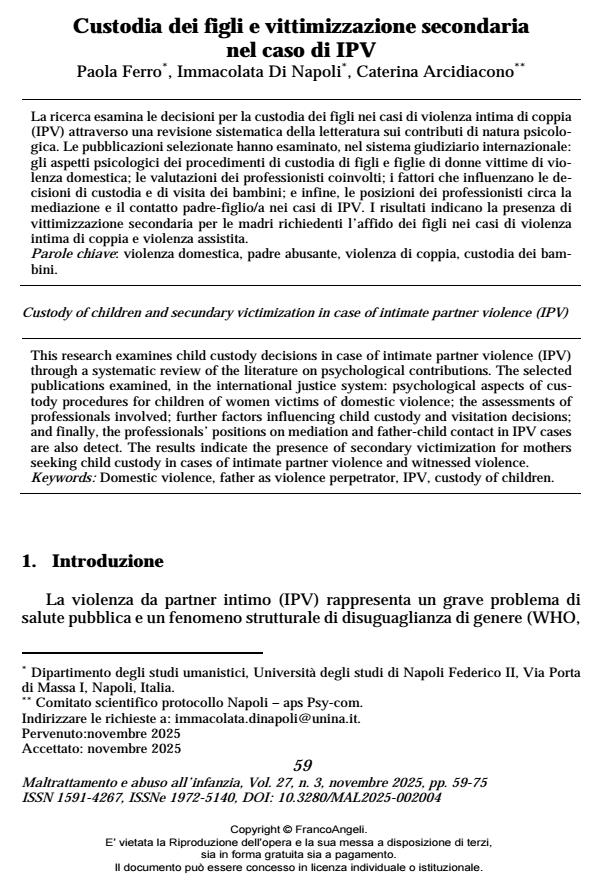
La ricerca esamina le decisioni per la custodia dei figli nei casi di violenza intima di coppia (IPV) attraverso una revisione sistematica della letteratura sui contributi di natura psicologica. Le pubblicazioni selezionate hanno esaminato, nel sistema giudiziario internazionale: gli aspetti psicologici dei procedimenti di custodia di figli e figlie di donne vittime di violenza domestica; le valutazioni dei professionisti coinvolti; i fattori che influenzano le decisioni di custodia e di visita dei bambini; e infine, le posizioni dei professionisti circa la mediazione e il contatto padre-figlio/a nei casi di IPV. I risultati indicano la presenza di vittimizzazione secondaria per le madri richiedenti l’affido dei figli nei casi di violenza intima di coppia e violenza assistita.
Parole chiave:violenza domestica, padre abusante, violenza di coppia, custodia dei bambini.
- Mathis, R. D., & Tanner, Z. (1998). Effects of unscreened spouse violence on mediated agreements. American Journal of Family Therapy, 26(3), 251-260. DOI: 10.1080/01926189808251104
- WHO (World Health Organization) (2018). Violence against women: Prevalence estimates 2018. Geneva: WHO.
- Al Saleem, R. (2023). Custody, violence against women and violence against children. United Nations, Human Rights Council (disponibile online: https://www.ohchr.org/en/documents/thematic-reports/ahrc5336-custody-violence-against-women-and-violence-against-children).
- Beck, C. J. A., & Raghavan, C. (2010). Intimate partner abuse screening in custody mediation: The importance of assessing coercive control. Family Court Review, 48(3), 555-565.
- Bemiller, M. (2008). When battered mothers lose custody: A qualitative study of abuse at home and in the courts. Journal of Child Custody: Research, Issues, and Practices,5, 3-4. DOI: 10.1080/15379410802583742
- Bow, J. N., & Boxer, P. (2003). Assessing Allegations of Domestic Violence in Child Custody Evaluations. Journal of Interpersonal Violence, 18(12), 1394-1410. DOI: 10.1177/088626050325803
- Brownridge, D. A. (2006). Violence against women post-separation Aggression and Violent Behavior, 1; 514-530.
- WHO (World Health Organization) (2020). Global status report on preventing violence against children. Geneva: WHO.
- Consiglio d’Europa. (2011). Convenzione sulla prevenzione e la lotta contro la violenza nei confronti delle donne e la violenza domestica (STE No. 210) (disponibile online: https://rm.coe.int/council-of-europe-convention-on-preventing-and-combating-violence-agai/1680462537).
- Davies, B., & Ralph, S. (1998). Client and counsellor perceptions of the process and outcomes of family court counselling in cases involving domestic violence. Family & Conciliation Courts Review, 36(2), 227-245.
- Dim, E.E., & Lysova, A. (2021). Male Victims’ Experiences With and Perceptions of the Criminal Justice Response to Intimate Partner Abuse. Journal of Interpersonal Violence, 37(15-16), NP13067-NP13091. DOI: 10.1177/08862605211001476
- Dragiewicz, M., (2010). Gender Bias in the Courts: Implications for Battered Mother and their Children. In M. Hannah & B.Goldstein (Eds.). Domestic Violence, Abuse, and Child Custody. DOI: 10.1177/1077801209331409
- Edleson, J. L. (1999). Mothers and children: Understanding the links between woman battering and child abuse. Sage Publications.
- Fehlberg, B., Kaspiew, R., Millbank, J., Kelly, F., & Behrens, J. (2015). Australian family law: The contemporary context (2nd ed.). South Melbourne, Australia: Oxford University Press.
- Feresin, M., Folla, N., Lapierre, S., & Romito, P. (2018). Family mediation in child custody cases and the concealment of domestic violence. Affilia: Journal of Women & Social Work, 33(4), 509-525. DOI: 10.1177/088610991876665962
- Feresin, M. (2020). Parental alienation (syndrome) in child custody cases: Survivors’ experiences and the logic of psychosocial and legal services in Italy. Journal of Social Welfare and Family Law, 42(1), 56-67. DOI: 10.1080/09649069.2019.1701924
- Forssell, A. M., & Cater, Å. (2015). Patterns in child-father contact after parental separation in a sample of child witnesses to intimate partner violence. Journal of Family Violence, 30(3), 339-349.
- Galántai, J., Ligeti, A. S., & Wirth, J. (2019). Children exposed to violence: Child custody and its effects on children in intimate partner violence related cases in Hungary. Journal of Family Violence, 34(5), 399-409.
- Gardner, R. A. (1985). The Boys and Girls Book about Divorce: For Children and Their Divorced Parents - The Essential Book. Bantam Books.
- Georgsson, A., Almqvist, K., & Broberg, A. G. (2011). Dissimilarity in vulnerability: Self-reported symptoms among children with experiences of intimate partner violence. Child Psychiatry and Human Development, 42(5), 539-556.
- Gutowski, E., & Goodman, L. A. (2020). Like I’m invisible’: IPV survivor-mothers’ perceptions of seeking child custody through the family court system. Journal of Family Violence, 35(5), 441-457.
- Hamel, J., Nicholls, T. L., Desmarais, S. L., Malley-Morrison, K., & Aaronson, J. (2009). Domestic violence and child custody: Are family court professionals’ decisions based on erroneous beliefs?. Journal of Aggression, Conflict and Peace Research, 1(2), 37-52. DOI: 10.1108/17596599200900011
- Hans, J. D., Hardesty, J. L., Haselschwerdt, M. L., & Frey, L. M. (2014). The effects of domestic violence allegations on custody evaluators’ recommendations. Journal of Family Psychology, 28(6), 957-966.
- Hardesty, J. L., Ganong, L. H., & Lloyd, S. (2006). How women make custody decisions and manage co-parenting with abusive former husbands. Journal 63 of Social and Personal Relationships, 23(4), 543-563. DOI: 10.1177/0265407506065983
- Hardesty, J. L., Hans, J. D., Haselschwerdt, M. L., Khaw, L., & Crossman, K. A. (2015). The influence of divorcing mothers’ demeanor on custody evaluators’ assessment of their domestic violence allegations. Journal of Child Custody: Research, Issues, and Practices, 12(1), 47-70. DOI: 10.1080/15379418.2014.943451
- Harman, J. J., & Lorandos, D. (2021). Allegations of family violence in court: How parental alienation affects judicial outcomes. Psychology, Public Policy, and Law, 27(2), 184-208.
- Haselschwerdt, M. L., Hardesty, J. L., & Hans, J. D. (2011). Custody evaluators’ beliefs about domestic violence allegations during divorce: Feminist and family violence perspectives. Journal of Interpersonal Violence, 26(8), 1694-1719. DOI: 10.1177/0886260510370599
- Holtzworth-Munroe, A., Beck, C. J., Applegate, A. G., Adams, J. M., Rossi, F. S., Jiang, L. J., Tomlinson, C. S., & Hale, D. F. (2021). Intimate partner violence (IPV) and family dispute resolution: A randomized controlled trial comparing shuttle mediation, videoconferencing mediation, and litigation. Psychology, Public Policy, and Law, 27(1), 45-64.
- Hughes, J., & Chau, S. (2012). Children’s best interests and intimate partner violence in the Canadian family law and child protection systems. Critical Social Policy, 32(4), 677-695. DOI: 10.1177/0261018311435025
- ISTAT (2019). La violenza sulle donne dentro e fuori la famiglia. Roma: Istituto Nazionale di Statistica (disponibile online: https://www.istat.it/it/files/2019/11/Istat-audizione-violenza-genere-19-novembre-2019.pdf).
- Johnson, N. E., Saccuzzo, D. P., & Koen, W. J. (2005). Child Custody Mediation in Cases of Domestic Violence: Empirical Evidence of a Failure to Protect. Violence Against Women, 11(8), 1022-1053. DOI: 10.1177/1077801205278043
- Kernic, M. A., Monary-Ernsdorff, D. J., Koepsell, J. K., & Holt, V. L. (2005). Children in the Crossfire: Child Custody Determinations Among Couples with a History of Intimate Partner Violence. Violence Against Women, 11(8), 991-1021. DOI: 10.1177/1077801205278042
- Khaw, L., Bermea, A.M., Hardesty, J.L., Saunders, D., & Whittaker, A.M. (2021). “The System Had Choked Me Too”: Abused Mothers’ Perceptions of the Custody Determination Process That Resulted in Negative Custody Outcomes. J Interpers Violence, 36(9-10), 4310-4334. DOI: 10.1177/0886260518791226
- Kirkwood, D., (2012). ‘Just say goodbye’: Parents who kill their children in the context of parental separation. Melbourne: Domestic Violence Resource Centre Victoria.
- Laing, L. (2017). Secondary victimization: Domestic violence survivors navigating the family law system. Violence Against Women, 23(11), 1314-1335. DOI: 10.1177/1077801216659942
- Lessard, G., Flynn, C., Turcotte, P., Damant, D., Vézina, J.-F., Godin, M.-F., Paradis, F., Delisle, R., Alcedo, Y., Juneau, L., Rock, L., & Rondeau-Cantin, S. (2010). Child custody issues and co-occurrence of intimate partner violence and child maltreatment: Controversies and points of agreement amongst practitioners. Child & Family Social Work, 15(4), 492-500.
- Liberati, A., Altman, D. G., Tetzlaff, J., Mulrow, C., Gøtzsche, P. C., Ioannidis, J. P., Clarke, M., Devereaux, P., Kleijnen, J., & Moher, D. (2009). The PRISMA statement for reporting systematic reviews and meta-analyses of studies that evaluate health care interventions: explanation and elaboration. DOI: 10.2427/5768
- Logan, T. K., Walker, R., Jordan, C. E., & Horvath, L. S. (2002). Child custody evaluations and domestic violence: Case comparisons. Violence and Victims, 17(6), 719-742.
- Miller, S.L., & Manzer, J.L. (2021). Safeguarding Children's Well-Being: Voices From Abused Mothers Navigating Their Relationships and the Civil Courts. Journal of Interpersonal Violence, 36(9-10), 4545-4569. DOI: 10.1177/0886260518791599
- Morrill, A. C., Dai, J., Dunn, S., Sung, I., & Smith, K. (2005). Child Custody and Visitation Decisions When the Father Has Perpetrated Violence Against the Mother. Violence Against Women, 11(8), 1076-1107. DOI: 10.1177/1077801205278046
- Naughton, C. M., O’Donnell, A. T., Greenwood, R. M., & Muldoon, O. T. (2015). ‘Ordinary decent domestic violence’: A discursive analysis of family law judges’ interviews. Discourse & Society, 26(3), 349-365. DOI: 10.1177/0957926514564738
- Nazioni Unite (1989). Convenzione internazionale sui diritti dell’infanzia e dell’adolescenza (disponibile online: https://www.unicef.it/convenzione-diritti-infanzia/).
- Pocar, V. e Ronfani, P.(1996). L’interesse del minore nella legge e nella pratica: esperienze nazionali a confronto. Milano: Guerini Scientifica.
- Rosen, L. N., & O’Sullivan, C. S. (2005). Outcomes of Custody and Visitation Petitions When Fathers Are Restrained by Protection Orders: The Case of the New York Family Courts. Violence Against Women, 11(8), 1054-1075. DOI: 10.1177/1077801205278045
- Rossi, F. S., Holtzworth, M. A., & Applegate, A. G. (2015). Does level of intimate partner violence and abuse predict the content of family mediation agreements?. Family Court Review, 53(1), 134-161.
- Sanders, L., Geffner, R., Bucky, S., Ribner, N., & Patino, A. J. (2015). A qualitative study of child custody evaluators’ beliefs and opinions. Journal of Child Custody: Research, Issues, and Practices, 12(3-4), 205-230. DOI: 10.1080/15379418.2015.1120476
- *Saunders, D. G., Tolman, R. M., & Faller, K. C. (2013). Factors associated with child custody evaluators’ recommendations in cases of intimate partner violence. Journal of Family Psychology, 27(3), 473-483.
- Saunders, D. G., Faller, K. C., & Tolman, R. M. (2016). Beliefs and recommendations regarding child custody and visitation in cases involving domestic violence: A comparison of professionals in different roles. Violence Against Women, 22(6), 722-744. DOI: 10.1177/1077801215608845
- Shepard, M. F., & Hagemeister, A. K. (2013). Perspectives of rural women: Custody and visitation with abusive ex-partners. "Affilia: Journal of Women & Social Work, 28(2), 165-176. DOI: 10.1177/0886109913490469
- Smith, C. P., & Freyd, J. J. (2014). Institutional betrayal. American Psychologist, 69(6), 575-587.
- Stover, C. S., Van Horn, P., Turner, R., Cooper, B., & Lieberman, A. F. (2003). The Effects of Father Visitation on Preschool-Aged Witnesses of Domestic Violence. Journal of Interpersonal Violence, 18(10), 1149-1166. DOI: 10.1177/0886260503255553
- Tishler, C. L., Bartholomae, S., Katz, B. L., & Landry-Meyer, L. (2004). Is Domestic Violence Relevant? An Exploratory Analysis of Couples Referred for Mediation in Family Court. Journal of Interpersonal Violence, 19(9), 1042-1062. DOI: 10.1177/0886260504268003
- Toews, M.L., & Bermea, A.M. (2017). “I Was Naive in Thinking, ‘I Divorced This Man, He Is Out of My Life’”: A Qualitative Exploration of Post-Separation Power and Control Tactics Experienced by Women. Journal of Interpersonal Violence, 32(14), 2166-2189. DOI: 10.1177/0886260515591278
- Vivienne, E. (2017). Custody Stalking: A Mechanism of Coercively Controlling Mothers Following Separation. Fem Leg Stud, 25, 185-201.
- WHO (World Health Organization) (2002). World report on violence and health. Geneva: WHO.
- Wuest, J., Ford-Gilboe, M., Merritt-Gray, M., & Lemire, S. (2006). Using Grounded Theory to Generate a Theoretical Understanding of the Effects of Child Custody Policy on Women’s Health Promotion in the Context of Intimate Partner Violence. Health Care for Women International, 27(6), 490-512. DOI: 10.1080/07399330600770221
- Watson, L. B., & Ancis, J. R. (2013). Power and control in the legal system: From marriage/relationship to divorce and custody. Violence Against Women, 19(2), 166-186. DOI: 10.1177/1077801213478027
- Yoshihama, M., & Mills, L. G. (2003). When is the personal professional in public child welfare practice? The influence of intimate partner and child abuse histories on workers in domestic violence cases. Child Abuse & Neglect, 27(3), 319-336. DOI: 10.1016/S0145-2134(03)00009-7
- Zeoli, A.M., Rivera, E.A., Sullivan, C.M., & Kubiak, S. (2013). Post-Separation Abuse of Women and their Children: Boundary-setting and Family Court Utilization among Victimized Mothers. J Fam Violence, 1, 28(6), 547-560.
Paola Ferro, Immacolata Di Napoli, Caterina Arcidiacono, Custodia dei figli e vittimizzazione secondaria nel caso di IPV in "MALTRATTAMENTO E ABUSO ALL’INFANZIA" 3/2025, pp 59-75, DOI: 10.3280/MAL2025-003004