Cohousing and the Thin Line between Public and Private Spaces: The Community Project

Journal title SOCIOLOGIA URBANA E RURALE
Author/s Maria Laura Ruiu
Publishing Year 2013 Issue 2013/100
Language Italian Pages 14 P. 105-118 File size 201 KB
DOI 10.3280/SUR2013-100008
DOI is like a bar code for intellectual property: to have more infomation click here

Below, you can see the article first page

If you want to buy this article in PDF format, you can do it, following the instructions to buy download credits
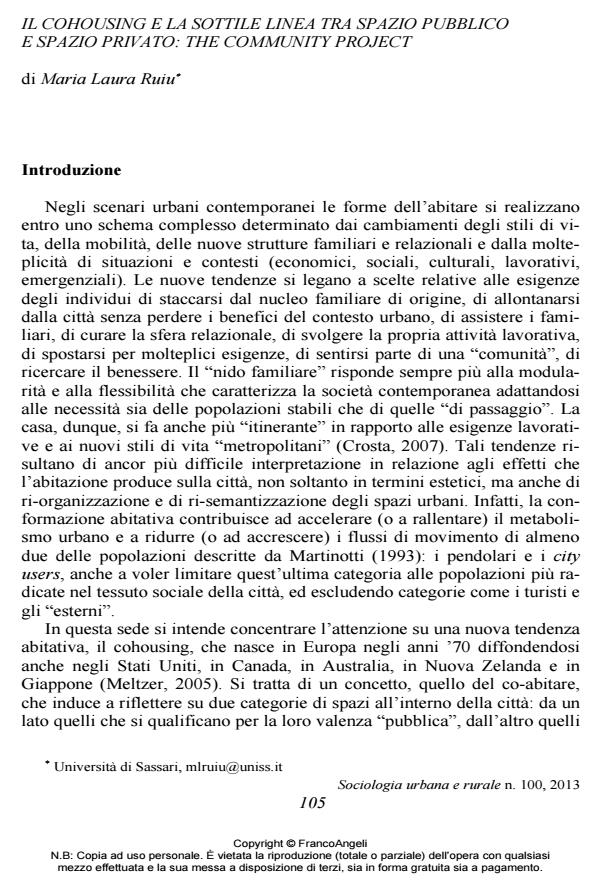
Article preview

FrancoAngeli is member of Publishers International Linking Association, Inc (PILA), a not-for-profit association which run the CrossRef service enabling links to and from online scholarly content.

The article focuses on cohousing phenomenon in order to identify what are public and private spaces within communities. It aims to trace both the influences that this new model of living may have in defining private and public space and the effects on the context where the communities rise. The phenomenon is analyzed in relation to two perspectives: the first one considers the relationships between members and the internal public/private dimension; the second considers the relationships between community spaces and the outside. Cohousing spaces could be defined as "semi-private" or "semi-public" in relation to the degree of opening or closure toward outside. The English case-study, The Community Project, shows the difficulty in classifying this new form of living in specific public or private categories.

Keywords: Cohousing, Way of Living, Communities, Neighborhood, Public Space, The Community Project

  1. Lietaert M. (2010). Le forme dell’abitare condiviso: il Cohousing. In Di Sapio A. (a cura di). Famiglie, Reti Familiari e Cohousing. Verso nuovi stili del vivere, del convivere e dell’abitare. Milano: FrancoAngeli
  2. Martinotti G. (1993). Metropoli. La nuova morfologia sociale della città. Bologna: Il Mulino
  3. Mazzette A. (2010). Lo spazio pubblico come pratica di cittadinanza. In Bottini F. (a cura di). Spazio Pubblico. Declino, Difesa, Riconquista. Roma: Ediesse
  4. Mazzette A., Sgroi E. (2007). La metropoli consumata. Antropologie, architetture, politiche, cittadinanze. Milano: FrancoAngeli
  5. McCamant K., Durret C. (1994). Cohousing. A contemporary approach to Housing Ourselves. Korea: Ten Speed Press.
  6. Meltzer G. (2005). Sustainable Community. Learning from the Cohousing Model. Canada: Trafford
  7. Mitscherlich A. (1968). Il feticcio urbano. Torino: Einaudi
  8. Parker S. (2006). Teoria ed esperienza urbana. Bologna: il Mulino
  9. Ratti M. (2011). Rivoluzione in casa. In L’Espresso, 19 novembre
  10. Ricciardiello E. (2008). Il socio amministratore di S.R.L. Milano: Giuffrè
  11. Sassen S. (1997). Città globali. New York, Londra, Tokyo. Torino: Utet
  12. Scott Hunt S. (2007). Intentional Communities and Care-giving: Cohousing Possibilities. In Bottomley A., Wong S. (a cura di). Changing Contours of Domestic Life, Family and Scotthanson C., Scotthanson K. The Cohousing Handbook. Bulding a place for Community. Canada: New Society Publishers
  13. Sennet R. (2006). Il declino dell’uomo pubblico. Milano: Bruno Mondadori
  14. Simmel G. (1995). La metropoli e la vita dello spirito. Roma: Armando.
  15. The Community Project (2008). The Community Project - a short introduction, in http://www.cohousing.org.uk/casestudies#attachments (29/09/2011).
  16. Tidore C. (2008). Processi partecipativi nel governo del territorio. Milano: FrancoAngeli
  17. Bauman Z. (2000). Modernità liquida. Roma-Bari: Laterza
  18. Bauman Z. (2008). Vita liquida. Rom-Bari: Laterza
  19. Beck U. (2004). La società del rischio. Verso una seconda modernità. Roma: Carocci
  20. Bergamasco F., Canossa G. (2007). Jan Gødmand Høyer, l’ideatore del Cohousing, in Lietaert M., Cohousing e condomini solidali. Firenze: Aam Terranuova.
  21. Biraghi G. (2011). Niente panico! Siamo in città... Come il cohousing può cambiare le metropoli contemporanee. In www.cohousing.it/images/stories/approfondimenti/il_cohousing_e_la_citta.pdf (10/09/2009).
  22. Boni F., Poggi F. (2011). Sociologia dell’architettura. Roma: Carocci
  23. Brenton M. (2010). Low carbon living and community development, paper convegno Delivering sustainable housing for eco-towns. London: TCPA, 11/02/2010
  24. Castel R. (2008). La discriminazione negativa. Cittadini o indigeni. Macerata: Quodiblet.
  25. Crosta P.L. (2000). Società e territorio, al plurale. Foedus, n. 1.
  26. Crosta P.L. (2007). L’abitare itinerante come “pratica dell’abitare” che costruisce territori e costituisce popolazioni. Politicità delle pratiche. In Balducci A., Fedeli V. (a cura di). I territori della città in trasformazione. Milano: FrancoAngeli.
  27. Davis M. (1999). Geografie della paura: Los Angeles: l’immaginario collettivo del disastro. Milano: Feltrinelli
  28. De Carlo G. (2002). Sulla progettazione partecipata. In Sclavi M., Romano I., Guercio S., Pillon A, Robiglio M., Toussaint I. Avventure urbane. Milano: Elèuthera
  29. Dioguardi G. (2001). Ripensare la città. Roma: Donzelli.
  30. Durret C. (2005). Senior Cohousing. A Community Approach to Indipendent Living. Canada: Ten Speed Press
  31. Ferraro G. (1990). La città nell’incertezza e la retorica del piano. Milano: FrancoAngeli
  32. Friedman Y. (2009). L’architettura della sopravvivenza. Torino: Bollati Boringhieri
  33. Friedmann J. (1986). The World City Hypothesis. Development and Change, n. 17.
  34. Friedmann J. (1995). Were we stand: a decade of World City Research. In Knox P.L., Taylor P.J. (eds.). World Cities in a World System. Cambridge: Cambridge University Press.
  35. Gans H. J. (1962). The Urban Villagers: Group and class in the life of Italian-Americans. New York: Free Press of Glencoe
  36. Giddens A. (2003). Le conseguenze della modernità. Bologna: il Mulino
  37. Illich I. (1993). La convivialità. Como: Red Edizioni.
  38. Innerarity D. (2008). Il nuovo spazio pubblico. Roma: Meltemi Editore
  39. Iveson K. (2007). Publics and the city. Singapore: Blackwell Pubblishing
  40. Landuzzi C. (2009). Incertezze di vita e labilità dei confini. Essere anziane a Bologna. In Mazzette A. (a cura di). Estranee in città. A casa, nelle strade, nei luoghi di studio e di lavoro. Milano: FrancoAngeli
  41. Lietaert M. (a cura di). (2007). Cohousing e condomini solidali. Firenze: Aam Terranuova

  • Leco-housingen Italie entre rêve et réalité. Une recherche sur les aspirations à laco-résidence Francesca Bianchi, in International Review of Sociology /2015 pp.481
    DOI: 10.1080/03906701.2015.1050308
  • The Social Capital of Cohousing Communities Maria Laura Ruiu, in Sociology /2016 pp.400
    DOI: 10.1177/0038038515573473
  • Differences between Cohousing and Gated Communities. A Literature Review Maria L. Ruiu, in Sociological Inquiry /2014 pp.316
    DOI: 10.1111/soin.12031
  • Participatory processes in designing cohousing communities: the case of the community project Maria Laura Ruiu, in Housing and Society /2016 pp.168
    DOI: 10.1080/08882746.2017.1363934

Maria Laura Ruiu, Il cohousing e la sottile linea tra spazio pubblico e spazio privato: the community project in "SOCIOLOGIA URBANA E RURALE" 100/2013, pp 105-118, DOI: 10.3280/SUR2013-100008