Pazienti anziani, caregiver e medici nella relazione terapeutica. Equilibrismi tra negoziazioni e rischi di discriminazione

Journal title SALUTE E SOCIETÀ
Author/s Cristina Calvi, Eugenia Mercuri
Publishing Year 2026 Issue 2025/3 Suppl.
Language Italian Pages 21 P. 46-66 File size 372 KB
DOI 10.3280/SES2025-003-S001004
DOI is like a bar code for intellectual property: to have more infomation click here
Article preview

FrancoAngeli is member of Publishers International Linking Association, Inc (PILA), a not-for-profit association which run the CrossRef service enabling links to and from online scholarly content.

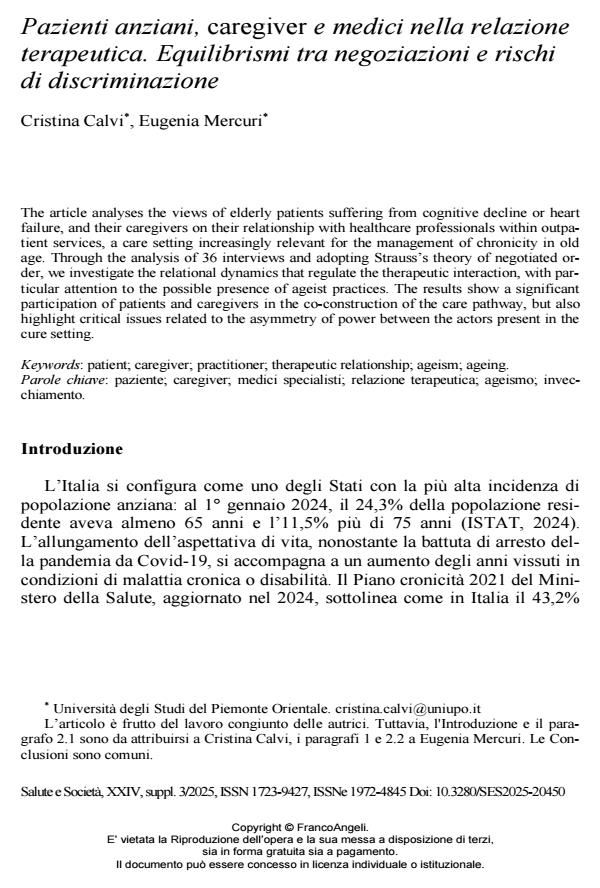
The article analyses the views of elderly patients suffering from cognitive decline or heart failure, and their caregivers on their relationship with healthcare professionals within outpatient services, a care setting increasingly relevant for the management of chronicity in old age. Through the analysis of 36 interviews and adopting Strauss’s theory of negotiated order, we investigate the relational dynamics that regulate the therapeutic interaction, with particular attention to the possible presence of ageist practices. The results show a significant participation of patients and caregivers in the coconstruction of the care pathway, but also highlight critical issues related to the asymmetry of power between the actors present in the cure setting.

Keywords: patient; caregiver; practitioner; therapeutic relationship; ageism; ageing.

  1. Ardissone A. (2022). A relational paradigm for the patientdoctor figuration, between engagement and shared doctoring. Salute e Società, 1: 6379. DOI: 10.3280/SES202200100
  2. Ayalon L., TeschRömer C., a cura di (2018). Contemporary Perspectives on Ageism. Cham: Springer.
  3. BenHarush A., ShiovitzEzra S., Doron I., Alon S., Leibovitz A., Golander H., Haron Y., Ayalon L. (2017). Ageism among physicians, nurses, and social workers: findings from a qualitative study. European Journal of Ageing, 14: 3948.
  4. Bosco N., Cappellato V. (2022). Putting patients first? Luci e ombre del coinvolgimento attivo dei pazienti nei processi di cura. Salute e Società, 1: 4862. DOI: 10.3280/SES202200100
  5. Bronzini M., Lusardi R., Atzori F. (2023). L’ordine negoziato e il lavoro di articolazione tra passato e futuro: una rassegna ragionata. Salute e Società, 22(3): 8199. DOI: 10.3280/SES202300300
  6. Conrad P. (1992). Medicalization and Social Control. Annual Review of Sociology, 18: 209232.
  7. Dunkelman D.M., Dressel R.C. (1994). The nursing home environment and dementia care. In: Aronson M.K., editor, Reshaping dementia carePractice andpolicy in longterm care (pp. 6068). Thousand Oaks, CA: Sage Publications.
  8. Favretto A.R. (2015). Costruire l’ordine negoziato nei contesti incerti: l’esperienza della malattia nei servizi sanitari. Sociologia del diritto, 2: 115146. DOI: 10.3280/SD201500200
  9. Favretto A.R., Zaltron F. (2015). «Qui sono come a casa mia». L’umanizzazione delle cure e l’esperienza di malattia nei contesti sanitari. Bologna: Il Mulino.
  10. Flick U. (2009). An Introduction to Qualitative Research. London: Sage.
  11. Glaser B., Strauss A. (1965). Awareness of Dying. Chicago: Aldine Publishing Company. DOI: 10.2307/58293
  12. Graffigna G., Barello S. (2018). Engagement: un nuovo modello di partecipazione in sanità. Roma: Il Pensiero Scientifico.
  13. Higgs P., Gilleard C. (2025). Rethinking The Sociology Of Ageing: Towards a Sociology of Later Life. Cheltenham: Edward Elgar Publishing.
  14. Ingrosso M. (2022). Verso nuove relazioni di cura: modelli e orientamenti. In: Alastra V., Bronzini M., Ingrosso. M., a cura di, Cambiare le relazioni di cura nelle organizzazioni sanitarie. Ricerche, progetti, esperienze (pp. 2244). Milano: Franco Angeli.
  15. ISTAT. (2024). Annuario Statistico Italiano 2024. Roma: Istituto Nazionale di Statistica.
  16. Iversen T.N., Larsen L., Solem P.E. (2009). A conceptual analysis of ageism. Nordic Psychology, 61(3): 4–22. DOI: 10.1027/19012276.61.3.
  17. Lupton D. (2012). Medicine as Culture. Illness, Disease and the Body. London: Sage.
  18. Lusardi R., Sergio Manghi S. (2013). I limiti del sapere tecnico: saperi sociali nella scena della cura. In: Vicarelli G., editor, Cura e salute. Prospettive sociologiche. Roma: Carocci Editore.
  19. MacIsaac M., Peter E. (2024). Emergency department crowding: An examination of older adults and vulnerability. Nursing Ethics, 32(1): 99110. DOI: 10.1177/0969733024123833
  20. MacRae H. (2022). ‘I’ve never given it a thought’: older men’s experiences with and perceptions of ageism during interactions with physicians. Ageing & Society, 42:13181339. DOI: 10.1017/S0144686X2000147
  21. Makris U.E., Higashi R.T., Marks E.G., Fraenkel L., Sale J.E., Gill T.M., Reid M.C. (2015). Ageism, negative attitudes, and competing comorbidities why older adults may not seek care for restricting back pain: A qualitative study. BMC Geriatrics, 15: 39.
  22. Mascagni G. (2016). Pazienti, medici e relazioni terapeutiche in trasformazione. Salute e Società, 3: 6174
  23. May C., Rapley T., Moreira T., Finch T., Heaven B. (2006). Technogoverance: evidence, subjectivity, and the clinical encounter in primary care medicine. Social Science & Medicine, 62: 1022–1030.
  24. McNamara T.K., Williamson J.B. (2019). Ageism. Past, present and future. London: Routledge.
  25. MorrowHowell N., Gonzales E. (2024). Explicating ageism in the productive aging framework. The Gerontologist, 64: 16.
  26. Nugus P. (2019). Restructuring the negotiated order of the hospital. Sociology of health and illness, 41(2): 378394. DOI: 10.1111/14679566.1283
  27. Peck B.M. (2011). AgeRelated Differences in DoctorPatient Interaction and Patient Satisfaction. Current Gerontology and Geriatrics Research, 110. DOI: 10.1155/2011/13749
  28. Schroyen S., Adam S., Marquet M., Jerusalem G., Thiel S., Giraudet AL., Missotten
  29. P. (2018). Communication of healthcare professionals: is there ageism?. European Journal of Cancer Care, 27: 110.
  30. Star S.L., Strauss A. (1999). Layers of silence, arenas of voice: the ecology of visible and invisible work. Computer supported cooperative work, 8(1): 930. DOI: 10.1023/A:100865110535
  31. Strauss A. (1985). Work and the Division of Labor. The Sociological Quarterly, 26(1): 119.
  32. Strauss A., Fagerhaugh S., Suczek B., Weiner C. (2017). Social organization of medical Work. London and New York: Routledge (ed. or.: Social organization of medical Work. London and New York: Routledge, 1997).
  33. Strauss A., Schatzman L.R., Bucher R., Ehrlich D., Sabshin M. (1963). The Hospital and Its Negotiated Order. In: Freidson G., editor, The Hospital in Modern Society. New York: Free Press.
  34. Vicarelli G., Giarelli G. a cura di (2021). Libro Bianco. Il Servizio Sanitario Nazionale e la pandemia da Covid19. Problemi e proposte. Milano: Franco Angeli.
  35. Vicarelli G., Neri S. (2021). Una catastrofe vitale? Le scelte di politica sanitaria per far fronte al Covid19. Politiche Sociali, 2: 233254. DOI: 10.7389/10167
  36. WHO (2015). World Report on Ageing and Health. Geneva: World Health Organization.

Cristina Calvi, Eugenia Mercuri, Pazienti anziani, caregiver e medici nella relazione terapeutica. Equilibrismi tra negoziazioni e rischi di discriminazione in "SALUTE E SOCIETÀ" 3 Suppl./2025, pp 46-66, DOI: 10.3280/SES2025-003-S001004