PAS and AP as tools for silencing and downplaying violence against women and minors, and their use in Italian courts in child custody proceedings
Journal title MALTRATTAMENTO E ABUSO ALL’INFANZIA
Author/s Caterina Arcidiacono, Antonietta Bozzaotra, Gabriella Ferrari Bravo
Publishing Year 2026 Issue 2025/3
Language Italian Pages 20 P. 15-34 File size 107 KB
DOI 10.3280/MAL2025-003002
DOI is like a bar code for intellectual property: to have more infomation
click here
Below, you can see the article first page
If you want to buy this article in PDF format, you can do it, following the instructions to buy download credits
FrancoAngeli is member of Publishers International Linking Association, Inc (PILA), a not-for-profit association which run the CrossRef service enabling links to and from online scholarly content.
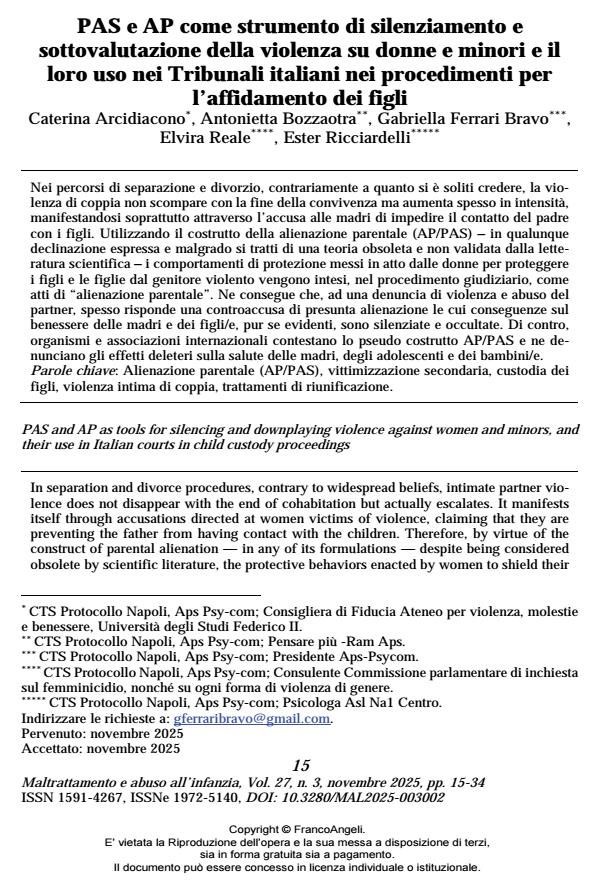
In separation and divorce procedures, contrary to widespread beliefs, intimate partner violence does not disappear with the end of cohabitation but actually escalates. It manifests itself through accusations directed at women victims of violence, claiming that they are preventing the father from having contact with the children. Therefore, by virtue of the construct of parental alienation — in any of its formulations — despite being considered obsolete by scientific literature, the protective behaviors enacted by women to shield their sons and daughters from the violent father are interpreted in judicial procedures as acts of parental alienation. As a result, a report of violence and abuse by the partner is often met with a counter-accusation of alleged parental alienation, the implications of which on the child’s well-being ‒ though evident ‒ are silenced. International organizations and associations have challenged this pseudo-construct and denounced its harmful effects on the health of adolescents and children.
Keywords: Parental alienation (PAS/AP), secondary victimization, children custody, Itimate partner violence, reunification treatment.
- Reale, E. (2023). Una sentenza di Cassazione illuminante. In. P.Cendon (Ed.). Persona e danno (pp. 1-5). (disponibile online: https://www.dirittiinmovimento.it/2023/03/).
- Alsalem, R. (2023). Special Rapporteur on violence against women and girls, its causes and consequences. Report (A/HRC/53/36) General Assembly, Human Rights Council, Fifty-third session 19 June-14 July 2023. In Custody, violence against women and violence against Children. (disponibile online: https://documents.un.org/doc/undoc/gen/g23/070/18/pdf/g2307018.pdf).
- Alsalem, R. (2024). Giudici obbligano i bambini a diritto di visita senza essere protetti. In DiRE, 24. (disponibile online: https://www.dire.it/24-11-2024/1101297-reel-alsalem-alienazione-parentale-bambini-donna-violenza/).
- American Psychiatric Association (2013). Dichiarazione cautelativa per l’uso del DSM-5 in ambito forense. In Manuale diagnostico e statistico dei disturbi mentali, Quinta edizione, DSM-5. American Psychiatric Association.
- Autiero, M., Procentese, F., Carnevale S., Arcidiacono C., & Di Napoli, I. (2020). Combatting Intimate Partner Violence: Representations of Social and Healthcare Personnel Working with Gender-Based Violence Interventions International journal of environmental research and public health, 17(15), 5543.
- Ayeb-Karlsson, S., Meier, J.S., Barnett, A., Mercer, J., Neilson, L.C., Pollack, D., Halperin-Kaddari, R., Corwin, D.L., Hester, M. Zaccour, S., Thiara, R., Weiner, M., Rathus, Z., Edleson, J.L., Page, N., Leonetti, C., Dalgarno, E., Spearman, K.J., Katz, E., Chester, S., Sheehy, E., Champion, K. et al. (2024). A collective international response to the claim that so-called ‘parental alienation’ is a well-studied ‘gender neutral’ empirical phenomenon which can easily be measured.
- Barnett, A. (2020a). Domestic abuse and private law children cases. Ministry of Justice (disponible online: https://bura.brunel.ac.uk/handle/2438/21153).
- Barnett, A. (2020b). A genealogy of hostility: parental alienation in England and Wales. Journal of Social Welfare and Family Law, 42(1), 18-29. DOI: 10.1080/09649069.2019.1701921
- Cannito, M., & De Felice, M. (2024). Bigenitorialità per chi? “Sindrome da alienazione parentale” e modelli di genere nelle sentenze. Studi sulla questione criminale, 23(1), 33-58.
- Carnevale, S., Di Napoli, I., Esposito, C., Arcidiacono, C. & Procentese, F. (2020). Children Witnessing Domestic Violence in the voice of health and social professionals dealing with contrasting gender violence, MDPI. International journal of environmental research and public health, 17(12), 4463.
- Choudhry, S. & Rodriguez Gutierrez, D. (2024). The family Justice Response to domestic abuse: A European Analysis. Oxford: Faculty of Law, Oxford University.
- Consiglio d’Europa (2011). La convenzione del Consiglio d’Europa sulla prevenzione e la lotta contro la violenza nei confronti delle donne e la violenza domestica. (disponibile online: https://rm.coe.int/istanbul-convention-questions-and-answers-italian/1680944876).
- Coffari, G.A. (2018) Rompere il silenzio. Le bugie sui bambini che gli adulti si raccontano. Milano: Laurana Editore.
- Commissione parlamentare d’inchiesta sul femminicidio, nonché su ogni forma di violenza di genere (2022). Relazione sulla vittimizzazione secondaria delle donne che subiscono violenza e dei loro figli nei procedimenti che disciplinano l’affidamento e la responsabilità genitoriale. (disponibile online: https://www.senato.it/service/PDF/PDFServer/BGT/1349605.pdf).
- Dalgarno, E., Katz, E., Ayeb-Karlsson, S., Barnett, A., Motosi, P., & Verma, A. (2023). “Swim, swim and die at the beach”: family court and perpetrator induced trauma (CPIT) experiences of mothers in Brazil. Journal of Social Welfare and Family Law, 46(1), 11-38.
- Dalgarno, E., Ayeb-Karlsson, S., Bramwell, D., Barnett, A., & Verma, A. (2024). Health-related experiences of family court and domestic abuse in England: A looming public health crisis. Journal of Family Trauma, Child Custody & Child Development, 21(3), 277-305.
- Di Napoli, I., Carnevale S., Esposito C., Block R., Arcidiacono C., Procentese F. (2020). “Kept in check”: Representations and feelings of social and health professionals facing Intimate Partner Violence (IPV). International Journal of Environmental Research and Public Health, 17(21), 7910.
- Di Nicola, P. (2018). La mia parola contro la sua. Milano: HarpersCollins.
- ECDV: Conférence Européenne sur la Violence Domestique. (2023). Domestic Violence and Parental Alienation: International Perspectives (disponibile online: https://ecdv.hi.is/wp-content/uploads/2023/09/abstractBook_final.pdf).
- Feresin, M., Bastiani, F., Beltramini, L. & Romito, P. (2019). The involvement of children in post-separation intimate partner violence in Italy: a strategy to maintain coercive control. Affilia, 34(4), 481-497. DOI: 10.1177/0886109919857672
- Feresin, M., & Santonocito, M. (2023). How expert are the experts? Child custody evaluations in situations of domestic violence in Italy. Violence and victims, 38(5), 664-679. DOI: 10.1891/VV-2021-0041
- Garbarino, J. (1998). Psychological maltreatment is not an ancillary issue. Brown University Child & Adolescent Behavior letter, 14(8), 2-4.
- Gardner, R.A. (1985). Recent trends in divorce and custody litigation. Academy Forum, 29(2), 3-7.
- Gardner, R. A. (1999). Family therapy of the moderate type of parental alienation syndrome. The American Journal of Family Therapy, 27(3), 195-212.
- Gardner, R. A. (2001). Should Courts Order Pas Children to Visit/Reside with The Alienated Parent? A Follow-Up Study. The American Journal of Forensic Psychology, 19(3), 61-106.
- Gardner, R. A. (2002). Parental Alienation Syndrome vs Parental Alienation: Which Diagnosis Should Evaluators Use in Child-Custody Disputes?. The American Journal of Family Therapy, 30(2), 93-115. DOI: 10.1080/019261802753573821
- Geffner, R. & Sandoval-Norton, A. (2020). Parental Alienation Syndrome/Parental Alienation Disorder (PAS/PAD): A Critique of a “Disorder” Frequently Used to Discount Allegations of Interpersonal Violence and Abuse. Child Custody Cases. In APSAC Advisor, 32(1), 28-37.
- Grevio (2021). Digital recommendation addresses the digital dimension of violence against women. (disponibile online: https://rm.coe.int/grevio-rec-no-on-digital-violence-against-women/1680a49147).
- Hunter, R., Burton, M. & Trinder, L. (2020) Assessing Risk of Harm to Children and Parents in Private Law Children Cases. Final Report. Ministry of Justice (disponibile online: https://assets.publishing.service.gov.uk/media/5ef3dcade 90e075c4e144bfd/assessing-risk-harm-children-parents-pl-childrens-cases-report_.pdf).
- Jacobs, N. (2023) The Family Court and domestic abuse: achieving cultural change. Domestic Abuse Commissioner. (disponibile online: https://domesticabuse commissioner.uk/wp-content/uploads/2023/10/DAC_Famliy-Court-Report_Oct-2023.pdf).
- Katz, A. (2003) Junk science v. novel scientific evidence: Parental alienation syndrome, getting it wrong in custody cases. Pace Law Review, 24(1), 239.
- Lapierre, S. & Côté, I. (2019). L’Aliénation Parentale, Stratégie D’occultation De La Violence Conjugale? Rapport de recherche. U. Ottawa, RéQEF, IREF et FemAnVie.
- Martinson, T H. D. (2023). Treating Children as Full Rights Bearers: Independent Legal Representation for Children in Family Violence and/or Resist-Refuse Contact Cases. Family Violence & Family Law Brief , 20. Vancouver, BC: The FREDA Centre for Research on Violence Against Women & Children.
- Meier, J. S. (2020). U.S. child custody outcomes in cases involving parental alienation and abuse allegations: what do the data show?. Journal of Social Welfare and Family Law 42(1), 92-105.
- Meier, J. S. (2022). Denial of Family Violence in Court: An Empirical Analysis and Path Forward for Family Law. The Georgetown Law Journal, 110(4), 835-898.
- Mencacci, C. (2012). La sindrome e le false tesi supposizioni. Corriere della sera, 15/10/12.
- Mercer, J. (2019a). Are intensive parental alienation treatments effective and safe for children and adolescents?. Journal of Child Custody, 16(1), 67-113.
- Mercer, J. (2019b). Examining Parental Alienation Treatments: Problems of Principles and Practices Child and adolescent social work journal, 36(4), 351-363.
- Mercer, J. (2022). Reunification therapies for parental alienation: Tenets, empirical evidence, commonalities, and differences. Journal of Family Trauma, Child Custody & Child Development, 19(3-4), 383-401.
- Milani, L. & Grumi, S. (2023). Psicologia della violenza di genere. Milano: Vita e Pensiero.
- Psychological American Association (1996). Violence and the Family: Report of the APA Presidential Task Force on Violence and the Family - Executive Summary. (disponibile online: http://www.nnflp.org/apa/APA_task_force.htm).
- Reale, E. (2016). Oltre la PAS. La vittimizzazione secondaria di donne e bambini. In G. Cassano (Ed.). Il minore nel conflitto genitoriale (pp 212-262). Milano: Giuffré Editore.
- Reale, E. (2018) I diritti dei minori a confronto con la violenza maschile sulle donne: la vittimizzazione secondaria di donne e bambini. In G. Cassano, I. Grimaldi, & P. Corder (Eds.). L’alienazione parentale nelle aule giudiziarie. Strumenti di contrasto e importanza dell'ascolto nei procedimenti di diritto di famiglia. (pp. 211-270). Santarcangelo di Romagna: Maggioli Editore.
- Reale E. (2024). La Cassazione penale bacchetta il tribunale civile sul diritto di visita. In: P. Cendon (Ed.) Diritti in movimento (pp.1-5). (disponibile online: https://www.dirittiinmovimento.it/la-cassazione-penale-bacchetta-il-tribunale-civile-sul-diritto-di-visita-elvira-reale/).
- Romito, P. (2005). Un silenzio assordante. La violenza occultata su donne e minori. Milano: FrancoAngeli.
- Romito, P. (2011). Les violences conjugales post-séparation et le devenir des femmes et des enfants. Revue internationale de l'éducation familiale, 29(1), 87-105.
- Roia, F. (2021). Il giudice Roia: Basta con i processi alle donne vittime di violenza. Il Sole 24ore, 9 giugno 2021. (disponibile online: https://alleyoop.ilsole24ore.com/2021/06/09/intervista-roia/?refresh_ce=1).
- Sabbadini L.L. (2025). Il Paese che conta. Padova: Marsilio Editori.
- Spearman, K.J., Vaughan-Eden, V., Hardesty, J.L., & Campbell, J.C. (2023). Post-separation abuse: A literature review connecting tactics to harm. Journal of family trauma, child custody & child development, 21(2), 145-164.
- Trocme, N. & Bala, N. (2005) False allegations of abuse and neglect when parents separate. Child Abuse & Neglect, 29, 1333-1345.
- Vaccaro, G. (2025). Visite genitori-figli vietate nei casi di violenza assistita. Le indicazioni dei giudici. Il sole 24ore, 16 Novembre.
- WHO (2019). ICD-11 Clinical Descriptions and Diagnostic Guidelines for Mental and Behavioural Disorders. Geneva: World Health Organisation. (disponibile online: gcp.network/en/private/icd-11-guidelines/disorders).
- WHO (2025). Parental alienation and parental estrangement. (disponibile online: https://www.who.int/standards/classifications/frequently-asked-questions/parental-alienation).
- Zaccour, S. (2024) Parental alienation: The one-size-fits-none theory. Law360 Canada, April 25, 2024. (disponible online: https://www.law360.ca/ca/family/articles/1829261/parental-alienation-the-one-size-fits-none-theory-suzanne-zaccour - https://www.solidarite-femmes.be/recherche/le-syndrome-dalienation-parentale/130).
Caterina Arcidiacono, Antonietta Bozzaotra, Gabriella Ferrari Bravo, PAS e AP come strumento di silenziamento e sottovalutazione della violenza su donne e minori e il loro uso nei Tribunali italiani nei procedimenti per l’affidamento dei figli in "MALTRATTAMENTO E ABUSO ALL’INFANZIA" 3/2025, pp 15-34, DOI: 10.3280/MAL2025-003002