Back in Town. Urban youth policies in Italy: findings from a European research project
Journal title TERRITORIO
Author/s Gabriele Pasqui, Francesco Pio Pugliese
Publishing Year 2026 Issue 2024/111
Language Italian Pages 7 P. 127-133 File size 287 KB
DOI 10.3280/TR2024-111011
DOI is like a bar code for intellectual property: to have more infomation
click here
Below, you can see the article first page
If you want to buy this article in PDF format, you can do it, following the instructions to buy download credits
FrancoAngeli is member of Publishers International Linking Association, Inc (PILA), a not-for-profit association which run the CrossRef service enabling links to and from online scholarly content.
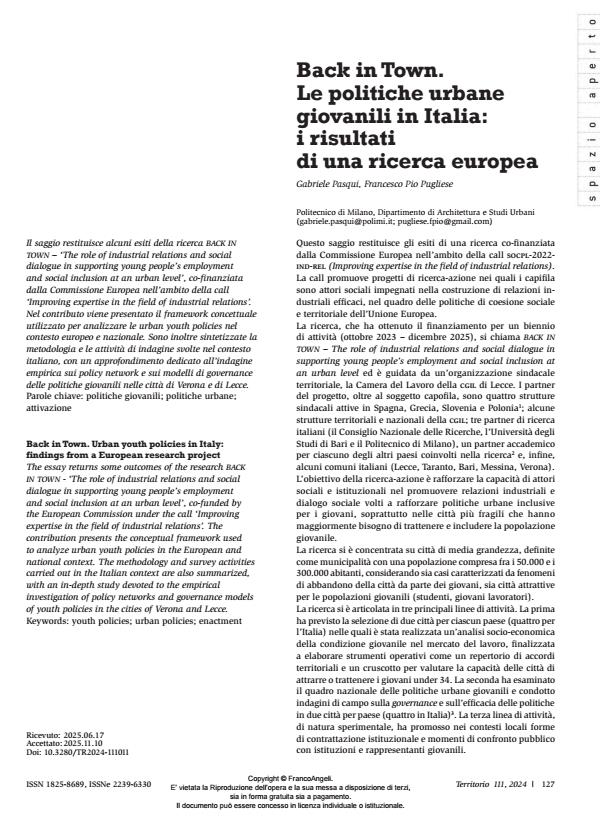
The essay returns some outcomes of the research BACK IN TOWN - ‘The role of industrial relations and social dialogue in supporting young people’s employment and social inclusion at an urban level’, co-funded by the European Commission under the call ‘Improving expertise in the field of industrial relations’. The contribution presents the conceptual framework used to analyze urban youth policies in the European and national context. The methodology and survey activities carried out in the Italian context are also summarized, with an in-depth study devoted to the empirical investigation of policy networks and governance models of youth policies in the cities of Verona and Lecce.
Keywords: youth policies; urban policies; enactment
- Ambrose D., 2003, «Barriers to Aspiration Development and Self-fulfil-ment: Interdisciplinary Insights for Talent Discovery». Gifted Child Quarterly, 47: 282. DOI: 10.1177/001698620304700405
- Basarab T., Williamson H., 2021, eds., About time! A reference manual for youth policy from a European perspective, Council of Europe and European Commission, Council of Europe Publishing, may.
- Chevalier T., Palier B., 2014, «The Dualisation of Social Policies Towards Young People in France: Between Familism and Activation». In: Antonucci L., Hamilton M., Roberts S (eds.), Young People and Social Policy in Europe, Basingstoke: Palgrave Macmillan, 189-209. DOI: 10.1057/978113737052510
- Cicognani E., Mazzoni D., Albanesi C., Zani B., 2015, «Sense of Com-munity and Empowerment Among Young People: Understanding Pathways from Civic Participation to Social Well-Being». Voluntas: International Journal of Voluntary and Nonpro?t Organizations, 26, 1: 24-44.
- Crath R., 2017, «Governing youth as an aesthetic and spatial practice». Urban Studies, 54, 5: 1263-1279. DOI: 10.1177/0042098015625034
- D’Elia A., Liberatore M., 2013, «L’innovazione dei Bollenti Spiriti», Che Fare, 7 ottobre 2013. https://che-fare.com/articoli/linnovazione-dei-bol-lenti-spiriti (accesso: 2025.11.10).
- du Bois-Reymond M., 1998, «‘I don’t want to commit myself yet’: Young People’s LifeConcepts». Journal of Youth Studies 1, 1: 63-79. DOI: 10.1080/13676261.1998.10592995
- EGRIS (European Group for Integrated Social Research), 2001, «Misleading Trajectories. Transition Dilemmas of Young Adults in Europe». Journal of Youth Studies, 4, 1: 101-19. DOI: 10.1080/13676260120028574
- Eurostat, 2024, Statistics on young people neither in employment nor in education or training. https://ec.europa.eu/eurostat/statistics-explai-ned/index.php?title=Statistics_on_young_people_neither_in_employ-ment_nor_in_education_or_training (accesso: 2025.03.29).
- Eurostat, 2025, When do young people in the EU leave home? https:// ec.europa.eu/eurostat/web/products-eurostat-news/w/ddn-20250923-1 (accesso: 2025.03.29).
- Gaeta G.L., Ghinoi S., Silvestri F., Trasciani G., 2021, «Exploring Networ-king of Third Sector Organizations: A Case Study Based on the Quartieri Spagnoli Neighborhood in Naples (Italy)». Voluntas: International Journal of Voluntary and Nonpro?t Organizations, 32, 4: 750-766.
- Gallie D., Paugam S., 2000, eds., Welfare Regimes and the Experience of Unemployment in Europe. Oxford: Oxford University Press.
- Giannoni P., 2024, «The governance of youth labour market policies in Italy and Austria: opportunities and challenges across national and local levels». In: Sojka B., Köppe S., Parma A., Cefalo R. (eds.), Social Policy Review 36: Analysis and Debate in Social Policy, Bristol: Bristol University Press. 109-128.
- Ginwright S., Cammarota J., Noguera P., 2005, «Youth, Social Justice, and Communities: Toward a Theory of Urban Youth Policy». Social Justice, 32, 3: 24-40. www.jstor.org/stable/29768319 (accesso: 2025.11.10).
- Il Sole 24 Ore, 2024, «Qualità della vita». Lab24 – Il Sole 24 Ore, https:// lab24.ilsole24ore.com/qualita-della-vita/ (accesso: 2025.03.29).
- Knecht A., 2024, Social Work in the Changing Welfare State: A Policy Analysis of Active Labour Market Policies for Disadvantaged Youth in Austria, Wiwn: Verlag Barbara Burdich, 11-20. rsf.2019.5.5.11.
- Mac Donald R., Marsh J., 2001, «Disconnected Youth? ». Journal of Youth Studies, 4, 4: 373-391. DOI: 10.1080/13676260120101860
- Manzo L.K,, Druta O., Ronald, R., 2019, «Supported Home Ownership and Adult Independence in Milan: The Gilded Cage of Family Housing Gifts and Transfers». Sociology, 53, 3: 519–537. 229.
- Pais J.M., 2003, «The Multiple Faces of the Future in the Labyrinth of Life». Journal of Youth Studies, 6, 2: 115-26.
- Pedri Stocco N.,2024, «Indagare gli spazi intermedi tra istituzioni e orga-nizzazioni dal basso stando nel mezzo: riflessioni dal campo». Tracce Urbane, 16: 129-149. DOI: 10.13133/2532-6562/18859
- Plug W., Zeijl E., du Bois-Reymond M., 2003, «Young People’s Perceptions on Youth and Adulthood: A Longitudinal Study from The Netherlands». Journal of Youth Studies, 6, 2: 127-44. e prospettive. Uno studio di caso». Education sciences and society, 11, 2:61-73
- Soler Masó P., Comas Arnau D., 2015, «Los estudios sobre políticas de juventud en España». Revista de Estudios de Juventud, 110: 173-189. https://dialnet.unirioja.es/servlet/articulo?codigo=5641908 (accesso: 2025.03.29).
- Siurala L., 2006, A European Framework for Youth Policy. Directorate of Youth and Sport, Council of Europe Publishing. www.youthpolicy.org/ uploads/documents/2006_European_Framework_Youth_Policy_Eng. pdf (accesso: 2025.03.29).
- Stauber B., Walther A., 2006, «De-standardized pathways to adulthood in Europe: informal learning in informal networks». Revista de Sociología, 31, 1: 241-262.
- Walther A., Stauber B., Biggart A., du Bois-Reymond M., Furlong A., López Blasco A., Mørch S., Pais J.M., 2002, eds., Misleading Trajectories – Inte-gration Policies for Young Adults in Europe?, Opladen: Leske+Budrich. DOI: 10.1007/978-3-663-10808-5
- Walther A., 2006, «Regimes of youth transitions: Choice, flexibility and security in young people’s experiences across different European con-texts». Young, 14, 2: 119-139.
- Westberg A., 2004, «Forever Young? Young People’s Conception of Adul-thood: The Swedish Case». Journal of Youth Studies,7, 1: 35-53. DOI: 10.1080/1367626042000209949
Gabriele Pasqui, Francesco Pio Pugliese, Back in Town. Le politiche urbane giovanili in Italia: i risultati di una ricerca europea in "TERRITORIO" 111/2024, pp 127-133, DOI: 10.3280/TR2024-111011